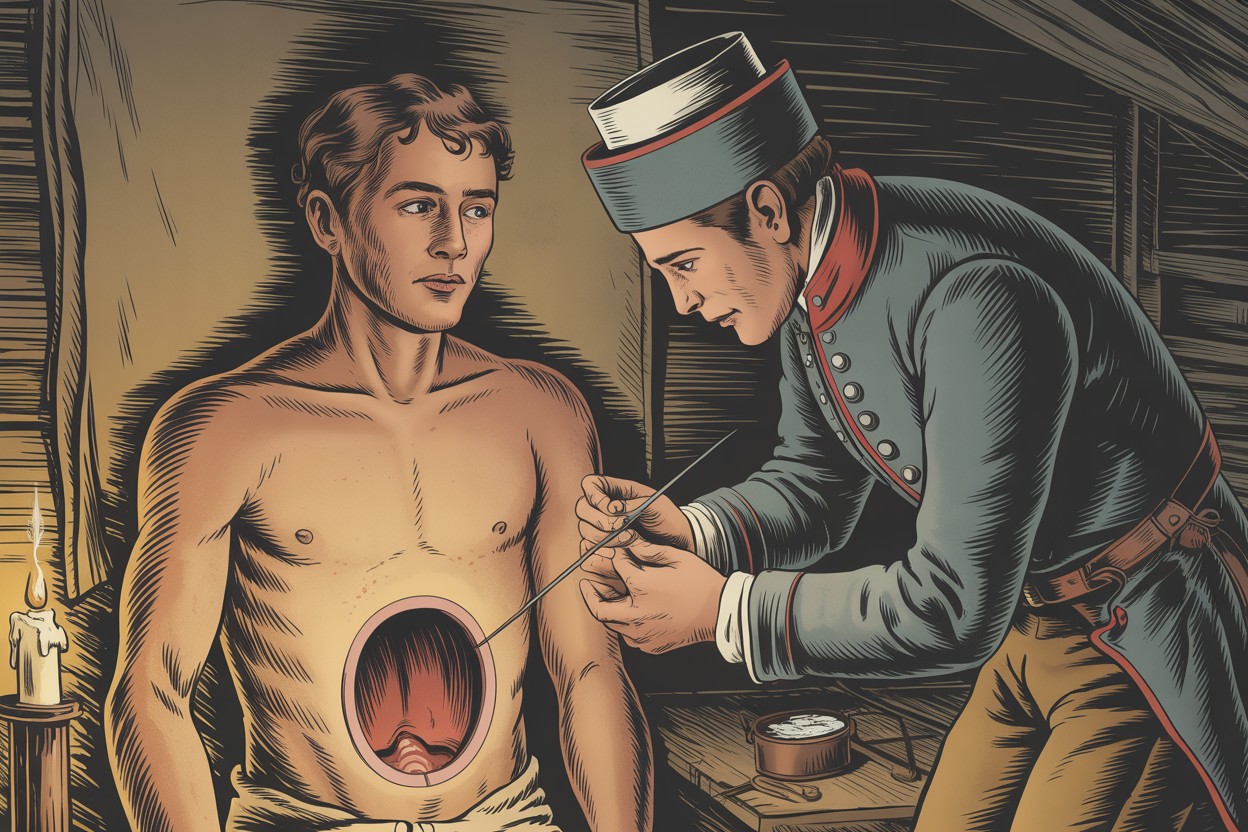
On June 6, 1822, a musket discharged at close range on Mackinac Island, Michigan, and the history of gastroenterology was born in the worst possible way. The shot hit a nineteen-year-old French-Canadian fur trade worker named Alexis St. Martin in the upper left abdomen and chest. It fractured ribs. It tore through the diaphragm. It perforated the lung. It blasted a hole in his stomach the size of a man's palm, and eyewitnesses reported that food and gastric contents were visibly leaking out of the wound before anyone had even decided what to do about it. [4] He was, in the most literal and horrible sense, digesting externally. In 1822. On a fur trading island. With no anesthesia worth mentioning, no sterile technique, no blood bank, no antibiotics, and no concept of bacteria that would've helped anyone.
He should have died. Every clinical instinct says he should have died. A close-range musket wound to the upper abdomen and chest in the nineteenth century was not a survivable injury by any reasonable metric — it was a formality before the funeral. [4] And yet. He didn't die. He survived, through a combination of extraordinary luck, a surprisingly competent Army surgeon, and a constitution that apparently refused to read the prognosis. That survival is the miracle part of this story. Everything that came after is the nightmare part.
Because when Alexis St. Martin didn't die, his wound didn't heal right. Instead of closing cleanly, the tissue fused in a configuration that left a permanent gastric fistula — an unnatural passage connecting the inside of his stomach directly to the outside world. [1] [5] Not metaphorically. Not poetically. A literal hole in the man's abdomen that opened into his stomach, sometimes with a small flap of prolapsed gastric mucosa poking outward like the world's most upsetting natural valve. You could, if you lifted the flap and looked inside, watch a human stomach doing its work in real time. You could see the folds of the gastric lining. You could watch peristalsis. You could smell the acid.
Army surgeon Dr. William Beaumont looked at this and heard a choir of angels.
Mackinac Island, 1822: Everything Smells Like Gunpowder and Bad Decisions
Let's actually place ourselves in this moment, because context matters and the context here is genuinely insane. Mackinac Island in 1822 is fur trade country — a military outpost, a commercial hub for the American Fur Company, and a place that operated on the frontier logic of "figure it out or die." [4] It smelled like wet leather, animal pelts, gun smoke, and the particular funk of men who hadn't bathed since the last time it was warm enough to care. The island sits at the junction of Lakes Huron and Michigan, which sounds scenic and is, in fact, scenic, but in 1822 it was primarily scenic in the way that somewhere very far from a hospital is scenic.
Alexis St. Martin was a voyageur — one of the French-Canadian laborers who moved goods and furs through the waterways of the Great Lakes region. [4] He was young, probably around nineteen or twenty, physically robust in the way that people who paddle canoes for a living tend to be, and by all historical accounts a perfectly ordinary young man with no particular ambition to become the most famous stomach in American medical history. The gunshot that changed his life was, as best as history can determine, accidental — a musket discharged at close range, no duel, no drama, just the kind of catastrophic oops that happened with alarming frequency when everyone around you was carrying loaded firearms and nobody had invented gun safety culture yet.
The wound was catastrophic. Witnesses described the scene as immediately gruesome — the ball and powder had entered at such close range that there were powder burns on the skin, a hole through the abdominal wall, fractured left ribs, damage to the lung, a perforated diaphragm, and a stomach that was no longer entirely contained within the body cavity it was designed for. [1] [4] Gastric contents — partially digested food, mucus, acid — leaked freely from the wound. One account notes that a portion of the lung itself was protruding. This was not a situation that called for calm assessment. This was a situation that called for someone to do something immediately or watch a young man bleed out on the floor of a trading post.
The musket ball struck St. Martin at extremely close range — close enough to leave powder burns on his skin. Damage included: fractured ribs, perforated diaphragm, injured left lung (with protrusion noted by witnesses), and a hole in the anterior stomach wall roughly the size of a man's fist. Gastric contents were visibly leaking from the wound on arrival. In modern trauma surgery, this presentation would trigger an immediate Level 1 activation. In 1822 Mackinac Island, it triggered William Beaumont. [4] [1]
William Beaumont arrived, assessed the situation, and did something genuinely impressive: he treated it. He cleaned the wound as thoroughly as 1822 medicine allowed, which is to say imperfectly but not incompetently. He removed fragments. He reduced the protruding tissue. He dressed the wound, managed the infection that inevitably followed, and kept Alexis St. Martin alive through weeks of recovery that should have killed him several times over. [7] We should be clear about this: Beaumont's initial clinical work was legitimately excellent. The man knew what he was doing with a wound. He was a skilled frontier surgeon operating at the edge of what medicine could accomplish, and he pulled off something that most of his contemporaries would not have managed.
Then the wound stopped closing. And Beaumont stopped wanting it to.
The Hole That Launched a Thousand Experiments (And One Very Bad Employment Situation)
Here is what medicine knew about digestion in 1822: not much, and most of it wrong. The theoretical landscape was a swamp of competing hypotheses, none of them particularly grounded in direct observation. Was digestion mechanical — a matter of the stomach physically grinding food into submission? Was it fermentation, like bread rising or beer brewing? Was it putrefaction, the stomach essentially rotting food in a controlled way? Or was it some mystical "vital force," the body's animating spirit doing work that chemistry couldn't explain? [3] Brilliant men had argued these positions for centuries with tremendous confidence and essentially zero hard data, because there was no good way to directly observe what happened inside a living human stomach. You could study digestion in dead animals. You could theorize. You could, if you were René-Antoine Ferchault de Réaumur in the 1750s, get a bird to swallow perforated metal tubes containing food and then retrieve them, which is exactly the kind of experiment that makes you wonder about people. But a real-time, repeatable, direct window into human gastric physiology? That didn't exist.
Until Alexis St. Martin's musket accident handed one to William Beaumont on a silver platter that Alexis had not agreed to carry.
The fistula, as it healed into its permanent configuration, was remarkable. The gastric mucosa — the inner lining of the stomach — had fused to the skin at the wound edges, creating a stable, durable opening. [1] [5] There was often a small prolapsed flap of stomach lining visible at the surface, which could be gently pushed aside to allow access to the stomach's interior. The opening was large enough to admit a finger, large enough to insert instruments, large enough to lower food samples on a string directly into the gastric cavity and retrieve them at intervals. It was, from a physiological research standpoint, an extraordinary accident of anatomy. It was, from Alexis St. Martin's standpoint, a permanent wound that required constant dressing, caused ongoing discomfort, and made eating an exercise in careful positioning so that his lunch didn't immediately leak back out through his own abdomen.
Beaumont recognized immediately what he had. [3] And to his credit — and this is the last time we're going to be particularly generous to Beaumont — he recognized it not just as a curiosity but as a genuine scientific opportunity of historic proportions. Nobody had this. Nobody had ever had this. He was standing in front of a living laboratory that could answer questions that had occupied physicians and natural philosophers for two centuries. The fact that the laboratory was a person who had not volunteered for the role was, apparently, a secondary consideration.
In the early 19th century, the leading theories of digestion included: (1) Trituration — the stomach physically grinds food like a mill. (2) Fermentation — digestion is basically controlled brewing. (3) Putrefaction — the stomach rots food in a useful way. (4) Vital force — the body's animating spirit does something vague but important. Beaumont's experiments demolished most of these and established that gastric digestion is primarily chemical — driven by acid and what we'd now call enzymes. [1] [3] This was, genuinely, a landmark contribution to physiology. Accomplished by a guy who kept a human being on retainer as a stomach.
St. Martin, meanwhile, was in a genuinely desperate situation. He was young, injured, unable to work his previous trade, far from home, and entirely dependent on Beaumont's charity for food, housing, and medical care. [6] His fistula required regular dressing and management. Without Beaumont, he had no income, no shelter, and an open wound in his abdomen that would not take care of itself. Beaumont formalized this dependency in 1823 by taking St. Martin on as a household servant — officially employed, practically captive. [4] [7] The power differential here was not subtle. Beaumont was an educated, English-speaking Army officer with institutional authority. St. Martin was a French-speaking, semi-literate fur trade laborer with a hole in his stomach, no money, and no leverage. Whatever consent existed in this arrangement was the consent of a drowning man agreeing to grab the only rope available, regardless of where it leads.
The experiments began almost immediately.
The String-and-Meat Experiments, or: A Complete Nightmare Described Clinically
Beaumont's experimental methodology was, by the standards of his era, sophisticated. By the standards of human decency, it was something else entirely. His primary technique — the one that has since become the most famous and most stomach-turning detail of this entire story — involved tying small pieces of food to lengths of silk string and lowering them directly through the fistula into St. Martin's stomach. [1] [2] He would leave them there for measured intervals — sometimes an hour, sometimes several hours — then retrieve them and examine the state of digestion. Beef. Pork. Bread. Cabbage. Cooked meat versus raw meat. Salted versus unsalted. Fat versus lean. He worked through variables with the systematic thoroughness of a man who had found his calling, which he had, in the worst possible way.
He also extracted gastric juice directly from the stomach — collecting it in vials, studying it outside the body, testing its effects on food samples in controlled conditions away from St. Martin's person. [1] [2] This was scientifically crucial. By isolating the gastric juice and demonstrating that it could digest food on its own, without the physical action of the stomach, Beaumont proved that digestion was primarily a chemical process. The stomach wasn't a grinding mill. It was a reaction vessel. The juice itself was the mechanism. This was a genuine paradigm shift in physiological understanding, and it came from collecting stomach acid from a man who had not meaningfully agreed to donate it. [3]
He observed the stomach lining directly. He described its color, its texture, the appearance of the rugae — the folds of the gastric mucosa — under different conditions. He noted that the lining appeared redder and more active during digestion, paler and drier during fasting. He observed peristalsis — the rhythmic muscular contractions that move food through the digestive tract — in real time, watching the stomach wall move. [1] He documented changes in gastric activity corresponding to St. Martin's emotional and physical state: fever made digestion sluggish, anger made the lining redder and the juice more acidic, fatigue altered the pattern of muscular activity. He was, without having the vocabulary for it, doing early psychophysiology — connecting mental and emotional states to measurable physiological changes. [1] [8]
"The gastric juice, so far from being, as some authors assert, a mere dissolvent of the food, is the most general and powerful stimulant that nature has provided for the digestion of aliment." — William Beaumont, Experiments and Observations on the Gastric Juice, 1833 [1]
Over the course of roughly ten years — from 1822 to 1833, with significant interruptions we'll get to — Beaumont conducted more than 230 individual experiments on St. Martin. [1] [3] Two hundred and thirty. That number deserves to sit alone for a moment. This was not a curious physician doing a few exploratory observations. This was a sustained, systematic research program using one man's body as its primary instrument, over more than a decade, without that man's genuine free consent at any point in the process.
Beaumont's 230+ experiments on St. Martin produced findings that genuinely reshaped physiology: Gastric juice is acidic and chemically active — not just mechanical. Hydrochloric acid was identified as a primary component (though he lacked the chemistry to fully characterize it). Digestion rates vary by food type — he produced the first systematic tables of gastric digestion times for different foods. Emotional and physical state affect digestion — early evidence for what we'd now call the gut-brain axis. The stomach moves actively — peristalsis observed directly in a living human. His 1833 monograph [1] remained a foundational reference in physiology for decades, cited by everyone from William Osler [3] onward. The cost of producing it: one man's entire adult life.
The Part Where Alexis Kept Trying to Leave (And Beaumont Kept Saying No)
St. Martin was not a passive participant in his own exploitation. This is important. He was not a broken man who accepted his situation without resistance — he fought it, repeatedly, with the tools available to him, which were limited but real. The first time he ran was around 1825, when he simply left Beaumont's household and returned to Canada, to his family in Quebec. [4] [6] He had, by that point, spent three years as Beaumont's servant-subject, and he was done. He had a life. He had a family. He had, apparently, a functional enough stomach despite the fistula to get on with things.
Beaumont's response to this was to spend years trying to get him back. He wrote letters. He made arrangements through intermediaries. He eventually, in 1829, got St. Martin to sign a formal contract — an actual legal document — agreeing to submit to experiments in exchange for payment, housing, and care for himself and his family. [6] [7] This contract is sometimes cited as evidence that the arrangement was consensual. It is not evidence of that. It is evidence that Beaumont understood he needed paperwork and that St. Martin understood he needed money. A contract signed by a man with no other options, limited literacy in the language it was written in, and a medical condition that required ongoing management by the man offering the contract is not consent in any meaningful ethical sense. It is coercion with a notary. [6]
St. Martin left again. Beaumont retrieved him again. This pattern repeated through the late 1820s and early 1830s with the dreary regularity of a bad relationship that neither party could quite end — except that in this relationship, one party had all the money, all the institutional power, and all the access to medical care, and the other party had a permanent hole in his stomach. [4] [7] Beaumont's letters from this period reveal a man who had thoroughly convinced himself that he was doing St. Martin a favor. He was providing care. He was offering opportunity. He was, in his own framing, the benefactor without whom St. Martin would be destitute and untreated. The fact that Beaumont was also the primary reason St. Martin remained dependent — by controlling his access to care, his employment, and his ability to establish an independent life — does not seem to have penetrated his self-conception at any point.
There is a particular letter from Beaumont to a colleague, quoted by Myer, in which he describes St. Martin's latest departure with the language of a man discussing a wayward employee rather than a human being who had decided he'd had enough of being a stomach exhibit. [7] The clinical detachment is breathtaking. Beaumont had, somewhere in the decade of experiments, completed the transformation of St. Martin from patient to apparatus. He wasn't a person who kept leaving. He was a resource that kept becoming unavailable.
The Fistula in Context: What Medicine Was Doing to Everyone Else in 1822
It's worth pausing to understand just how wild the broader medical landscape was when all of this was happening, because Beaumont's exploitation of St. Martin didn't occur in a vacuum — it occurred in a medical culture that routinely treated vulnerable people as raw material for scientific advancement, and St. Martin's case was unusual only in its duration and its documentation.
In 1822, the germ theory of disease was forty years away. Anesthesia was twenty-four years away. Antiseptic technique was forty-five years away. [8] Surgery was performed on conscious patients held down by assistants, as quickly as possible, because speed was the only mercy available. The dominant theory of disease was still largely miasmatic — illness came from bad air, bad humors, environmental poisons. Bloodletting was mainstream medicine. Calomel — mercury chloride, a compound that causes mercury poisoning — was a routine treatment for almost everything. The medical establishment was not, in 1822, operating from a foundation of rigorous ethical constraint. It was operating from a foundation of "try things on people and see what happens," with the implicit understanding that some people were more available for trying things on than others.
Poor people. Enslaved people. Immigrants. Soldiers. The institutionalized. The people who showed up at military posts with catastrophic injuries and no money. These were the bodies that medicine built itself on, and Beaumont was not unusual in this regard — he was simply unusually systematic and unusually well-documented. [6] The institutional review board, the ethics committee, the concept of informed consent as a legal and moral requirement — none of this existed. It would take another century of documented atrocities before medicine developed the formal infrastructure to prevent them, and even then imperfectly. [6]
What made Beaumont's case stand out to his contemporaries was not the ethics of it — nobody was particularly exercised about that — but the quality of the science. His 1833 monograph, Experiments and Observations on the Gastric Juice, and the Physiology of Digestion, was immediately recognized as a landmark work. [1] William Osler, writing in 1902, called Beaumont "a pioneer American physiologist" and praised the work in terms that make no mention of its human cost. [3] The scientific community embraced the findings, taught them in medical schools, built on them, and largely declined to look too carefully at the methodology. This is not unusual in the history of science. It is, in fact, depressingly standard.
Experiments and Observations on the Gastric Juice [1] contained: 238 individual experiments documented. Systematic digestion time tables for 40+ different foods. First detailed description of gastric juice composition in a living human. Observations spanning 1822–1833, conducted across multiple locations as Beaumont was transferred between military posts — dragging St. Martin with him. The book was republished and cited for decades. A copy is in the Surgeon General's library. St. Martin received no royalties, no academic credit, and no lasting financial benefit from any of it. [7] [8]
The Long Escape, and What "Freedom" Actually Looked Like
St. Martin finally achieved something like permanent separation from Beaumont in the mid-1830s. He returned to Canada, married, had children — eight of them, which suggests his digestive system was not his only functioning organ — and lived a life that was, by the standards of a nineteenth-century French-Canadian laborer, reasonably normal. [5] [7] He worked. He farmed. He managed the fistula, which never closed, for the rest of his life — dressing it, managing the flap, living with the ongoing reality of a wound that had defined his existence for over a decade.
Beaumont did not stop trying to get him back. He wrote letters through the 1840s, made arrangements, offered money, attempted to negotiate St. Martin's return to experimental service with the persistence of a man who had genuinely convinced himself that his need for data was a reasonable claim on another person's body. [7] St. Martin, to his enormous credit, declined. He had leverage now that he hadn't had in 1822 — distance, family, an established life, and the accumulated understanding of exactly what Beaumont's "care" had cost him. He stayed in Canada. He refused. Beaumont died in 1853, having never conducted another experiment on St. Martin after their final separation, and having never, as far as the historical record shows, expressed any meaningful regret about the ones he had conducted. [7]
St. Martin outlived him by eight years. He died in 1880 — fifty-eight years after the gunshot wound that should have killed him at nineteen. [5] [7] He was in his late seventies, which for a nineteenth-century fur trade laborer with a lifelong gastric fistula is frankly remarkable. His family, reportedly suspicious that his body would be claimed for further scientific study after his death, kept the corpse in the summer heat for several days before burial, and buried him at an unmarked depth, specifically to prevent exhumation. [5] This is the most heartbreaking detail in the entire story. The man's family understood, from lived experience, that science had treated his body as a resource in life and feared it would continue to do so in death. They hid him in the ground to keep him safe from the people who had always wanted a piece of him.
His grave location in St. Thomas de Joliette, Quebec was kept deliberately vague for years. [5] A man who had been the most observed stomach in American medical history spent his afterlife in deliberate obscurity, hidden by people who loved him from the institutions that had used him. If there is a more complete summary of what medicine did to Alexis St. Martin, I haven't found it.
The Scientific Triumph Nobody Wants to Look at Too Carefully
Here is the genuinely uncomfortable thing about William Beaumont's work: it was important. Not "important given the context" or "important despite the ethics" — actually, substantively, foundationally important to the development of physiology and gastroenterology. [1] [3] The identification of gastric juice as chemically active, the characterization of its acidic properties, the systematic documentation of digestion rates, the observation of the gut-brain connection, the proof that digestion was chemical rather than mechanical or mystical — these were real contributions that real scientists built real medicine on. The understanding of gastric acid that underlies modern treatments for ulcers, GERD, and gastric disease traces a direct line back to Beaumont's experiments. [3] [8] People are alive today, in some meaningful sense, because of what Beaumont learned by lowering meat on strings into Alexis St. Martin's stomach.
This does not make it okay. It makes it complicated, which is worse, because complicated doesn't resolve. Okay and not-okay are easy to process. Genuinely important and genuinely monstrous, coexisting in the same set of experiments conducted on the same unwilling body — that's the kind of thing that sits in your chest and doesn't leave. [6]
Nelson's 1990 analysis in the Bulletin of the History of Medicine is probably the most careful ethical reckoning with the Beaumont case in the academic literature. [6] Nelson doesn't simply condemn Beaumont by modern standards — that's too easy, and it lets everyone off the hook by treating the past as a foreign country where different rules applied. Instead, he examines whether Beaumont violated the ethical norms that actually existed in his own time, and finds a more complicated picture: there were contemporaries who expressed discomfort with the arrangement, there were moments when Beaumont clearly understood that St. Martin's cooperation was coerced, and there were choices made — about the employment arrangement, about the contracts, about the framing of St. Martin as servant rather than patient — that suggest Beaumont knew, on some level, that what he was doing required a certain amount of not-looking-directly-at-it.
The scientific community's response to the 1833 monograph was rapturous and largely unexamined. [1] [3] Here was American medicine producing world-class physiology — work that could stand alongside anything being done in Europe, work that established the young republic's scientific credentials, work that answered questions that had stumped natural philosophers for centuries. Nobody was particularly interested in how the sausage had been made. The sausage was delicious. The sausage had been digested in a living human stomach under direct observation and the digestion times had been carefully recorded. The sausage was science.
Beaumont conducted 230+ experiments over ~10 years. St. Martin signed contracts under conditions of complete economic dependency. He attempted to leave multiple times and was repeatedly retrieved. He received no academic credit, no lasting financial security, and no recognition beyond being described as "the patient" or "the subject." His family hid his grave to prevent posthumous scientific exploitation. The experiments produced foundational gastroenterology that is still cited. There is no version of this math that comes out clean. [1] [6] [7]
Why This Story Matters More Than a Footnote
Alexis St. Martin is usually taught, when he's taught at all, as a supporting character in the story of William Beaumont. He shows up in the first paragraph, gets shot, develops a fistula, and then graciously provides a stomach for the next several hundred words of scientific achievement. This is exactly backwards. Beaumont is the supporting character. He's the mechanism by which St. Martin's suffering got converted into medical knowledge. The story belongs to the man who lived it, not the man who published it.
The institutional protections that exist today — IRBs, informed consent requirements, research ethics committees, the entire apparatus of human subjects protection — exist because the medical establishment spent centuries doing exactly what Beaumont did to St. Martin, at scale, to populations with even less power and even less recourse. [6] The Nuremberg Code came from Nazi medical experiments. The Belmont Report came from Tuskegee. The principle of informed consent came from a long history of medicine deciding that certain people's bodies were available for science whether those people agreed or not. Beaumont and St. Martin are an early, well-documented, relatively "mild" example of a pattern that runs through the entire history of medicine like a fault line. [6] [8]
St. Martin survived a wound that should have killed him at nineteen. He endured a decade of experiments that treated him as a piece of laboratory equipment. He escaped, built a life, raised eight children, and outlived his tormentor by almost thirty years. He died at an advanced age with the fistula still open — it never closed, not in fifty-eight years — and his family buried him deep and unmarked because they understood, viscerally, what the world wanted to do with him. [5] [7]
That's not a footnote. That's a whole human life, lived in the shadow of a wound and a doctor who saw opportunity where he should have seen a person. The gastroenterology textbooks remember Beaumont. The physiology courses cite his monograph. The history of medicine calls him a pioneer.
Alexis St. Martin just wanted to go home.
He got there, eventually. It just took longer than it should have, cost more than anyone should have paid, and required his family to hide him in the earth to make sure nobody came looking for one last experiment.
That's the whole story. Science got its data. Beaumont got his fame. And Alexis got a hole in his stomach that never healed, a decade of his life stolen by a man who called it medicine, and a grave his own children had to hide from the people who built careers on his suffering.
We built the ethics rules because of people like him. The least we can do is remember which one of them we're actually supposed to be honoring.