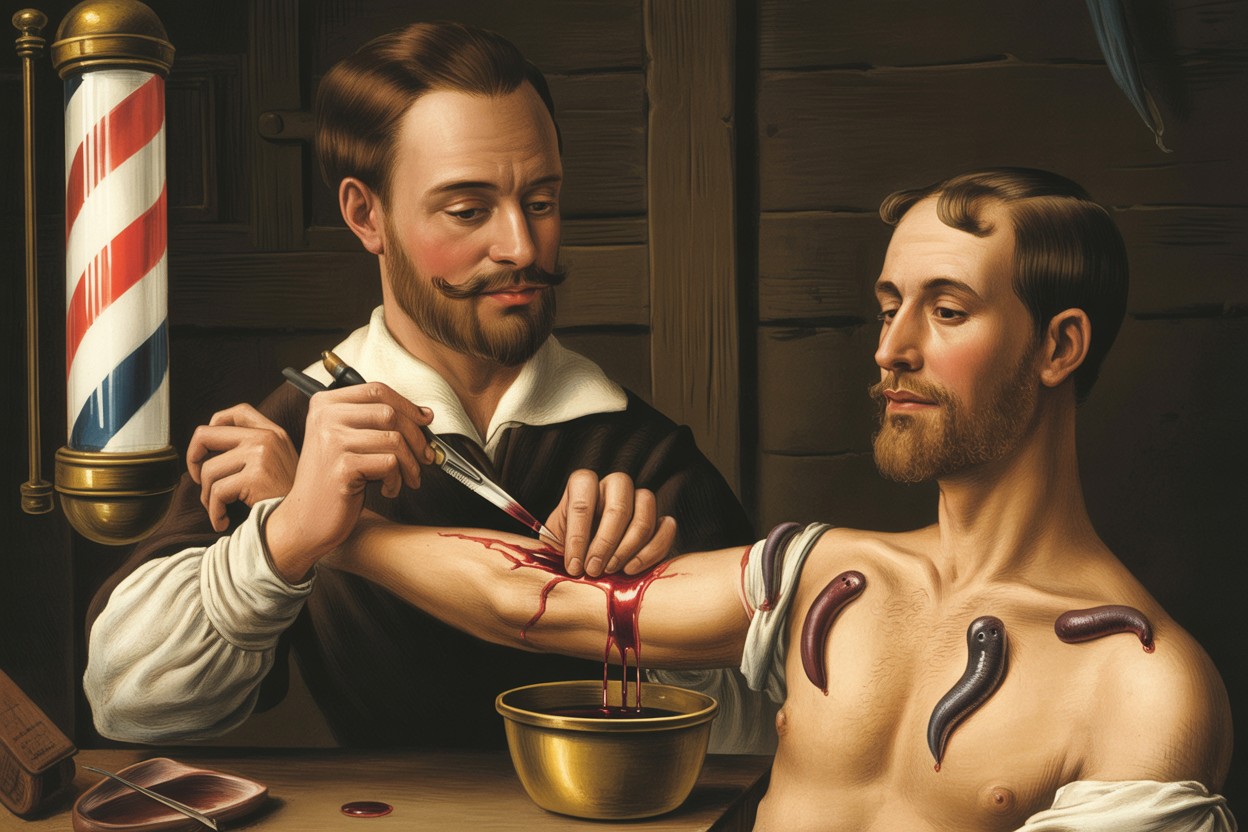
For roughly 2,200 years — give or take a century, depending on which unlucky patient you're counting from — the most sophisticated medical minds in the Western world agreed on one thing: when in doubt, open a vein. Fever? Bleed them. Pneumonia? Bleed them. Headache, melancholy, epilepsy, gout, or just a general sense that your vibes were off? Bleed them, bleed them, bleed them, and then — if they were still alive and looking insufficiently pale — bleed them again. Bloodletting wasn't a fringe practice or a peasant superstition. It was the consensus treatment of physicians who considered themselves scientists. It was performed in royal courts and university hospitals. It was written into medical textbooks that students memorized for centuries. It was, without exaggeration, the most persistently practiced therapeutic intervention in the history of medicine. [2] And it almost certainly killed more people than it ever helped.
That's the thing about bloodletting that doesn't get enough airtime in the sanitized "look how silly old medicine was" version of this story. We're not talking about a weird medieval cult thing that vanished with the Black Death. We're talking about a practice that Hippocrates wrote about in the fifth century BCE, that Galen systematized in the second century CE, that Islamic physicians debated and refined through the medieval period, that barber-surgeons performed in every European city through the Renaissance, and that credentialed physicians with actual medical degrees were still enthusiastically practicing in the 1800s. [1] [8] Bloodletting outlasted the Roman Empire, the Black Plague, the Reformation, the Scientific Revolution, and the discovery of germ theory. It was, to borrow a phrase, a franchise.
This is its story. It's not a story about stupid people. That's the part that should keep you up at night.
The Absolute Clown Car That Is the Four Humors
To understand why bloodletting made sense to smart people for two thousand years, you have to understand the theoretical framework it lived inside — because inside that framework, it was almost logical. Almost. The foundational concept was humoral theory, which held that the human body was governed by four essential fluids: blood, phlegm, yellow bile, and black bile. [3] Health was the balance of these humors. Illness was an imbalance. Treatment was restoration of balance. Clean, elegant, internally consistent, and completely wrong in every direction.
The Hippocratic corpus, assembled around the fifth century BCE, laid out the basic framework: the four humors corresponded to the four elements (blood to air, phlegm to water, yellow bile to fire, black bile to earth), the four seasons, and the four fundamental qualities of hot, cold, wet, and dry. [3] Blood was hot and wet. Spring was blood season. Young men were constitutionally bloodier. If your patient was flushed, feverish, and looked like he was about to explode, the obvious interpretation was that he had too much blood — a condition called plethora — and the obvious solution was to let some of it out.
Here's the uncomfortable part: for a pre-scientific observer with no knowledge of cells, bacteria, oxygen transport, coagulation, or pathophysiology, this was not an insane inference. A man with high blood pressure and a pounding headache does look overpressurized. Inflammation is red. Fever makes people flushed. The pattern-recognition instinct that said "this patient seems full of something and that something seems hot" was working with the available data. It was just catastrophically wrong about what the data meant. [4]
Blood — Hot, wet. Associated with air, spring, youth, the sanguine temperament. Too much blood: fever, flushing, headache, mania. Treatment: bleed the patient.
Yellow Bile — Hot, dry. Associated with fire, summer, the choleric temperament. Too much yellow bile: fever (again), irritability, vomiting. Treatment: purge the patient.
Phlegm — Cold, wet. Associated with water, winter, the phlegmatic temperament. Too much phlegm: lethargy, paleness, respiratory illness. Treatment: expectorants, sweating, or — you guessed it — bleeding.
Black Bile — Cold, dry. Associated with earth, autumn, the melancholic temperament. Too much black bile: depression, fear, cancer (yes, really). Treatment: purging, diet, and occasionally bleeding, because why not.
Note: None of these fluids map onto any actual physiological substance except blood, which the theory still managed to get completely wrong.
Then came Galen, and things really went sideways. Galen of Pergamon — second-century CE physician, prolific writer, and a man so confident in his own correctness that he made modern academic medicine look humble — took the Hippocratic framework and built a cathedral on top of it. [4] He tied humors to organs, to temperaments, to seasons, to ages, to specific anatomical locations. He systematized everything. He wrote so much, so authoritatively, and so persuasively that his texts became the foundational curriculum of Western medicine for the next fourteen centuries. Fourteen. Centuries. If Galen said bleeding was indicated, you bled the patient. If Galen's interpretation of Hippocrates suggested the left arm for liver complaints and the right arm for spleen complaints, that's where you cut.
The genius and the catastrophe of humoral theory was the same thing: it explained everything. Every symptom could be mapped onto a humoral excess or deficiency. Every disease had a logical treatment within the framework. The system was so flexible, so all-encompassing, that it was effectively unfalsifiable. Patient got better after bleeding? The humors were restored. Patient got worse? The disease was too advanced, or you hadn't bled enough, or the wrong vein was opened. Patient died? The illness was fatal regardless. The theory was never wrong because the theory could absorb any outcome. [7] That's not science. That's astrology with a lancet.
The Tools of the Trade (All of Them Are Upsetting)
Let's talk about how this actually worked, because the clinical reality of bloodletting is considerably more disturbing than the abstract theory. The most common method was venesection — the deliberate opening of a vein, usually in the antecubital fossa (the inside of the elbow, where phlebotomists still draw blood today), to allow controlled drainage into a bowl. [1] The physician or barber-surgeon would identify an accessible vein, apply a tourniquet above it to distend it, and make an incision with a lancet. Then they'd watch the blood flow and stop when they judged that enough had been removed.
How much was enough? Excellent question with no good answer. Different practitioners had different opinions. Some used the patient's response as a guide — you bled until they felt faint, which they called the "syncope point," and apparently did not recognize as a sign that you had removed too much blood from a person. [2] Others used set volumes: a pint, two pints, sometimes more. In aggressive treatments, physicians removed a quart or more — roughly 25% of the body's total blood volume — in a single session. [6] In patients who were already weakened by illness, this wasn't treatment. This was a second illness administered on top of the first one.
The lancet was the prestige instrument — small, sharp, elegant in the way that only something designed to cut human flesh can be elegant. But there were other tools, and they are all worse. The fleam was a folding blade with a triangular or wedge-shaped cutting edge, designed to open larger veins quickly, and it looked like something you'd use on livestock. [1] Because you would also use it on livestock. The same instrument. Medieval veterinary and human medicine shared hardware, which is a sentence that should haunt you.
The scarificator was a spring-loaded brass box containing anywhere from 8 to 16 small blades arranged in a circular pattern. You pressed it against the skin, triggered the spring mechanism, and it made a series of rapid, shallow cuts simultaneously. It was, functionally, a bloodletting slap-chop. The device was designed for speed and efficiency — multiple cuts at once meant faster blood flow and less patient resistance, because apparently "less patient resistance" was a design criterion they were optimizing for. Scarificators were typically used in combination with wet cupping: make the cuts, then apply a heated glass cup to create suction and draw blood to the surface. The cups left enormous circular bruises. If any of this sounds familiar, it's because the wellness industry currently sells a version of this as "cupping therapy," which your coworker probably tried last year and described as "so relaxing."
Then there were leeches. Hirudo medicinalis, the medicinal leech, had been used therapeutically since at least ancient Egypt, but they hit their cultural apex in the eighteenth and nineteenth centuries, particularly in France, where leech mania reached a scale that is genuinely difficult to comprehend. [9] At the peak of the leech craze, France was importing approximately 40 million leeches per year for medicinal use. Forty million. French marshes were so thoroughly depleted of native leeches that the country had to import them from Hungary and Poland. There was a leech supply chain. There were leech shortages. The economic and ecological disruption caused by the European appetite for medicinal leeches was measurable and significant. [9]
Leeches had a certain appeal to practitioners because they came with a natural stopping mechanism — a leech feeds until full and then detaches, which felt less arbitrary than a physician guessing how much blood was enough. Leeches also secrete hirudin, a potent anticoagulant, which keeps blood flowing freely during feeding. [9] This is, genuinely, a pharmacologically interesting substance. Hirudin derivatives are used in modern medicine as anticoagulants. Leeches themselves are still used in microsurgery and reconstructive procedures to relieve venous congestion in reattached digits and skin flaps — a legitimate, evidence-based application. [9] The ancient world accidentally stumbled near a real thing, and then, as medical history consistently does, immediately wrapped it in twelve layers of mysticism and applied it to everything including tuberculosis.
Who Did the Cutting: The Barber-Surgeon Problem
Here is something the history books mention but don't fully sit with: for most of the medieval and early modern period, the people performing bloodletting on sick patients were not physicians. They were barbers. Barber-surgeons occupied a peculiar and deeply uncomfortable niche in the medical hierarchy — physicians considered themselves learned men of theory, too refined to perform manual procedures, so they delegated the actual cutting to a separate guild of craftsmen who also happened to cut hair. [1] [8] The barber-surgeon's pole — the red and white spiral you still see outside barbershops — is literally a reference to bloodletting: red for blood, white for the tourniquet bandage, the pole itself representing what patients gripped to make their veins stand out during the procedure.
So your treatment plan was developed by a university-educated physician who had read Galen and Hippocrates and could discourse at length on the philosophy of humoral balance, and then executed by a man who had just finished trimming someone's beard. This was not considered a problem. This was the system working as intended. The physician prescribed the bleed — which vein, which side, how much — and the barber-surgeon made the cut. The division of intellectual and manual labor seemed sensible to everyone involved, which tells you something about how medicine viewed the gap between knowing and doing.
Barber-surgeons also performed tooth extractions, wound care, amputations, and the occasional lithotomy (bladder stone removal, a procedure so horrifying it deserves its own post, and will get one). They worked out of shops that smelled like blood and hair and the specific anxiety of people who are about to have something done to them against their better judgment. The medical establishment looked down on them. Patients had no choice but to trust them. This dynamic — credentialed theorists designing treatments that someone else actually administered — created a system with no good feedback loop. The physician who prescribed the bleed rarely watched the patient deteriorate afterward. [8]
~2,200 years of continuous practice (approximately 400 BCE to the late 1800s) [1]
40 million leeches imported annually by France at peak leech demand [9]
Up to 1 quart of blood removed in a single session — roughly 25% of total blood volume [2] [6]
4 separate bleeds administered to George Washington in his final 12 hours of life [5]
~80 ounces total blood removed from Washington — nearly 40% of his estimated blood volume [5]
0 randomized controlled trials supporting bloodletting for any condition it was used to treat
Legitimate modern uses of leeches: venous congestion in microsurgery. Legitimate modern uses of the four humors: none. [9]
George Washington's Very Bad Last Day
If you want a single case study that illustrates everything wrong with bloodletting — the theory, the practice, the breathtaking confidence, the complete absence of doubt — it's December 14, 1799. George Washington, 67 years old, former commander of the Continental Army, first President of the United States, woke up in the early hours of the morning with severe throat pain, difficulty breathing, and a fever. His condition deteriorated rapidly through the day. By the time his three physicians — James Craik, Gustavus Richard Brown, and Elisha Cullen Dick — had finished treating him, he was dead. [5]
The probable diagnosis, based on retrospective analysis of the clinical record, is acute epiglottitis — a bacterial infection causing severe swelling of the epiglottis, the flap of tissue that covers the airway during swallowing. [5] In modern medicine, this is treated with antibiotics, airway management, and hospitalization. It is survivable. Washington's physicians, working within the humoral framework they had been trained in, treated it with bloodletting. Aggressive, repeated, catastrophic bloodletting.
Over the course of approximately twelve hours, Washington was bled four separate times. [5] The total volume removed has been estimated at somewhere between 80 and 100 ounces — roughly five to six pints, or close to 40% of his total estimated blood volume. To put that in context: losing 30% of your blood volume constitutes Class III hemorrhagic shock. Losing 40% is Class IV, which is immediately life-threatening even in a previously healthy patient with no underlying illness. Washington was elderly, already compromised by a serious infection, and had been bled until he was in hemorrhagic shock. [5]
Dr. Elisha Cullen Dick, the youngest of the three physicians, apparently objected to the aggressive bleeding. He argued that they were taking too much. He was overruled by his senior colleagues, who had more experience, more confidence, and more Galen in their heads. [5] Washington reportedly told his doctors at one point, "I die hard, but I am not afraid to go." Whether that was stoic resignation or a man who had watched them drain him for twelve hours and drawn his own conclusions about the trajectory of events is not recorded.
The historical debate about whether Washington died from his infection or from the treatment has never been fully resolved, because the answer is almost certainly "both." The epiglottitis was serious. Untreated, it might well have killed him. But removing nearly half of his blood volume from a man fighting a severe infection while struggling to breathe did not help. It destroyed whatever physiological reserve he had left. His physicians bled the first President of the United States to death while following the standard of care. [5] No one was negligent. No one deviated from protocol. The protocol was the problem.
The Pushback: When People Started Noticing the Patients Kept Dying
You might expect that two thousand years of patients dying after bloodletting would have generated some skepticism earlier. It did, actually — the problem was that the skeptics kept losing the argument. The history of medicine is full of physicians who noticed that bloodletting seemed to make people worse and said so, only to be ignored, dismissed, or simply drowned out by the institutional weight of Galenism. [7]
Pierre Louis, a French physician working in Paris in the 1820s and 1830s, was one of the first to apply what he called the "numerical method" — what we would now recognize as basic statistical analysis — to bloodletting. He tracked outcomes in pneumonia patients who had been bled versus those who hadn't. His conclusion, published in 1828, was that bloodletting didn't help pneumonia patients and might be making them worse. [7] [8] This seems like it should have been a watershed moment. It was not. The medical establishment's response was essentially: your numbers are interesting, but they can't capture the individual clinical judgment that a skilled physician applies in each case. Which is a polite way of saying: we don't care about your data, we care about our theory.
The resistance wasn't purely stubbornness, though stubbornness was certainly present. It was structural. Humoral theory wasn't just a hypothesis about how disease worked — it was the entire conceptual architecture of medicine. [7] Medical education, clinical practice, the guild structures of barber-surgeons, the social authority of physicians, the relationship between doctor and patient — all of it was built on this framework. Admitting that bloodletting didn't work meant admitting that the foundation was rotten. It meant that everything your teachers had taught you, everything you had practiced for decades, everything you had done to patients in good faith was wrong. That is not an admission that comes easily to any profession, and medicine in the eighteenth century had no particular culture of intellectual humility to draw on.
"The lancet has been a more general instrument of destruction than the sword." — Benjamin Rush, 1800s American physician, who himself was an enthusiastic proponent of aggressive bloodletting and almost certainly did not intend this as self-criticism.
There's also a grimmer explanation for why bloodletting persisted: it gave doctors something to do. Before germ theory, before antibiotics, before any effective pharmacological interventions, a physician standing at a sick patient's bedside had almost no tools that actually worked. [8] Bloodletting, purging, emetics — these were interventions. They produced visible effects. The patient visibly changed after a bleed: pallor, weakness, sometimes a temporary reduction in fever as the body redirected resources. That looked like treatment. It felt like treatment. The physician felt like they were doing something. The patient felt like something was being done. The fact that what was being done was actively harmful was obscured by the genuine complexity of illness — patients died of their diseases all the time anyway, so it was easy to attribute post-bleed deaths to the underlying condition rather than the intervention. [6]
If George Washington's death is the most famous individual bloodletting case, François-Joseph-Victor Broussais may be responsible for the most aggregate damage. The French military surgeon and physician, working in the early nineteenth century, developed an influential theory that virtually all disease was caused by inflammation of the gastrointestinal tract, and that the treatment for virtually all disease was therefore aggressive bleeding — preferably with leeches applied directly to the abdomen. Broussais was enormously influential. His lectures were packed. His books sold widely. Under his influence, French leech imports ballooned to those previously mentioned 40 million animals per year. [9] Pierre Louis's statistical work was partly a direct response to Broussais's methods. Broussais eventually softened his position in later life, but the damage — measured in tens of millions of leeches and an unknowable number of weakened, anemic patients — was already done. He is now primarily remembered as a cautionary tale, which is the medical historian's version of a participation trophy.
The Long, Slow, Embarrassing Death of Bloodletting
Bloodletting didn't die quickly or cleanly. It retreated. It was modified, rebranded, restricted to specific indications, defended by increasingly elaborate theoretical justifications, and finally abandoned piecemeal as each new piece of actual science made the humoral framework harder to maintain. [8] The discovery of the germ theory of disease in the latter half of the nineteenth century — Pasteur, Koch, the slow accumulation of bacteriological evidence — finally provided an alternative explanatory framework that was both more accurate and more useful. When you can point to a specific pathogen as the cause of a specific disease, "excess humoral blood" starts to look like what it always was: a metaphor dressed up as a mechanism.
The development of clinical statistics — the ability to actually count outcomes and compare treated versus untreated patients — also did serious damage. [7] Pierre Louis had started this work in the 1820s, but it took decades for the medical profession to accept that numerical evidence from populations should override individual clinical judgment. This is not a battle that was won once and stayed won. The tension between statistical evidence and clinical intuition is still alive in medicine today, which is either reassuring (we've always struggled with this) or terrifying (we've always struggled with this).
By the late 1800s, bloodletting had largely disappeared from mainstream practice in Europe and North America, surviving mainly in the specific indication of hemochromatosis — a genetic disorder that causes the body to absorb too much iron, storing it in organs and causing progressive damage. [2] The treatment for hemochromatosis is phlebotomy: regular removal of blood to reduce iron stores. It works. It is evidence-based. It is, technically, bloodletting. The one disease that actually benefits from removing blood is the one where the problem is genuinely too much of a specific blood component. The ancients were in the right neighborhood. They just applied the zip code to every address in the city.
Leeches, as previously noted, also survived — not because anyone still believes in humoral theory, but because hirudin is genuinely useful in specific microsurgical contexts. [9] When a surgeon reattaches a severed finger or performs a complex skin graft, venous congestion — the backup of blood in the reattached tissue — can compromise the procedure. Medicinal leeches applied to the area relieve that congestion and give the new venous connections time to establish themselves. It's a real application with real evidence. The leech didn't deserve the two millennia of malpractice it was recruited into.
What Two Thousand Years of Wrong Looks Like From the Inside
The history of bloodletting is not a story about stupid people. That is the version of the story that feels comfortable, because it lets us sit outside it. The physicians who bled George Washington were not stupid. They were educated, experienced, well-read, and genuinely trying to help their patient. They were operating within the best theoretical framework available to them, applying the standard of care as they understood it, and they killed him anyway. [5] The physicians who ignored Pierre Louis's statistical data were not stupid. They had legitimate epistemological concerns about applying population statistics to individual patients — concerns that are still debated in evidence-based medicine today. They were wrong to dismiss him, but they weren't idiots. They were people with a lot invested in a theory that had served as the foundation of their profession for fourteen centuries.
What bloodletting actually demonstrates is how a wrong idea can persist indefinitely when it has the right structural supports: institutional authority, educational entrenchment, a flexible enough framework to absorb contradictory evidence, and the absence of a better alternative. [7] [8] Bloodletting didn't survive for 2,200 years because nobody questioned it. It survived because questioning it required dismantling the entire intellectual architecture of medicine, and nobody had a replacement ready until germ theory showed up with a better offer.
The treatments that future physicians will look back on with the same horrified bemusement we feel about bloodletting are not the obviously wrong ones. Those get caught. They're the ones with internal logic. The ones that fit the current theoretical framework. The ones that give doctors something visible to do for patients who are suffering. The ones where the harm is indirect enough to be attributed to the underlying disease. The ones that have been standard practice long enough that questioning them feels like questioning medicine itself.
We don't know which ones they are. That's not a comforting thought, but it's an honest one, and it's what two thousand years of draining people into bowls should teach us. The confidence of the physician at the bedside has never been a reliable indicator of whether what they're doing is helping. Sometimes the most dangerous thing in medicine is a man with a lancet who is absolutely sure he knows what he's doing.
Phlebotomy as a profession: The word "phlebotomy" — from Greek phlebos (vein) + tome (cutting) — is a direct descendant of bloodletting terminology. Modern phlebotomists draw blood for diagnostic testing, not humoral drainage, but they inherited the vocabulary. [1]
The barber pole: The red and white spiral still hanging outside barbershops worldwide is a direct reference to bloodletting. Red = blood. White = tourniquet bandage. The pole = what patients gripped to raise their veins. Your neighborhood Great Clips is, technically, a monument to medical history's greatest failure. [1]
Medicinal leeches: FDA-approved as a medical device since 2004. Used in microsurgery for venous congestion. The leech is rehabilitated. The humoral theory that deployed it is not. [9]
Therapeutic phlebotomy: The legitimate, evidence-based removal of blood as treatment for hemochromatosis and polycythemia vera. The one place where the ancients were accidentally right, for completely wrong reasons. [2]
The epistemological hangover: The story of how bloodletting persisted despite accumulating evidence against it directly influenced the development of clinical trial methodology and evidence-based medicine. Pierre Louis's "numerical method" is a direct ancestor of the randomized controlled trial. The disaster was, eventually, educational. [7]
The barber pole is still out there. Red and white. Spinning. Most people walk past it without knowing what it means. Which is probably for the best, honestly — there are only so many monuments to catastrophic medical confidence that a person can process in a single afternoon.