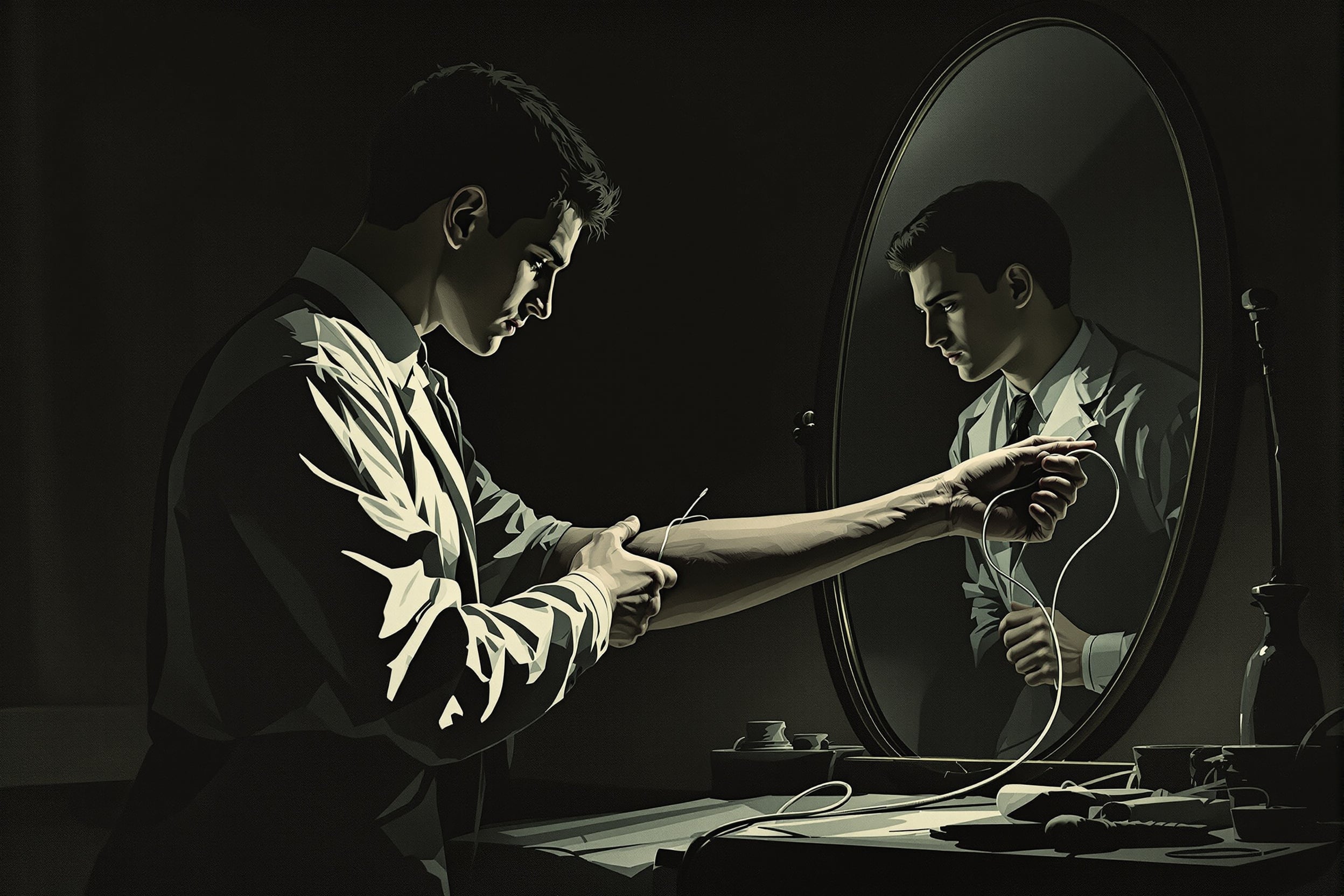
In 1929, a twenty-five-year-old surgical resident in a small German town looked at his own arm, then looked at a catheter, then looked back at his arm, and made a decision that was either the bravest or the most catastrophically stupid thing a physician had done since the last catastrophically stupid thing a physician had done. Werner Forssmann then tied a nurse to a table, cut open his own elbow, threaded a sixty-five-centimeter tube through his venous system, walked himself to the radiology department with the catheter dangling out of his arm like a very medical tail, and took an X-ray to prove the whole thing had worked. [1] He did this without anesthesia, without institutional approval, without his supervisor's knowledge, and — this detail doesn't get enough airtime — without any real plan for what to do if it went wrong. He was twenty-five. Of course he didn't have a plan.
He also, as it turned out, didn't die. Which is the only reason we're discussing him as a pioneer instead of as a cautionary footnote in a German medical ethics textbook.
What Forssmann did that afternoon in Eberswalde would eventually form the technical foundation for an entire branch of modern medicine. Cardiac catheterization — the family of procedures that lets cardiologists thread wires into beating hearts, measure pressures inside living chambers, inject contrast dye into coronary arteries, and deploy stents into blockages that would otherwise kill you over a Tuesday breakfast — all of it traces its lineage back to one unhinged resident with a urology catheter and a complete inability to accept the word "no." [3] He won the Nobel Prize for it in 1956. [5] He deserved it. He was also, by any reasonable modern standard, an asshole. These facts coexist comfortably in the same German body, as they have throughout history with some frequency.
The Heart Was a No-Go Zone, and Everyone Was Fine With That
To understand why Forssmann's stunt was so deranged, you need to understand what the heart meant to medicine in the late 1920s. Not metaphorically. Literally: what did physicians actually believe about touching the heart, and what happened when they tried?
The short answer is: they mostly didn't try, because the ones who had were largely dead or had watched their patients die, and the lesson had been absorbed deeply into surgical culture. The famous quote attributed to surgeon Stephen Paget in 1896 — "Surgery of the heart has probably reached the limits set by Nature to all surgery; no new method, and no new discovery, can overcome the natural difficulties that attend a wound of the heart" — captures the vibe perfectly. [6] The heart was where surgical ambition went to get humbled. It was fast, it was pressurized, it was surrounded by important things, and if you irritated it in the wrong way it simply stopped, and then your patient was dead and you were standing in a room full of blood having a very bad afternoon.
What this meant practically was that cardiac diagnosis in 1929 was an exercise in sophisticated guesswork. You listened through a stethoscope and tried to interpret the sounds. You felt the pulse. You watched the patient's color and breathing and asked them questions about their symptoms. If you were very modern about it, you had an electrocardiograph, which had only been clinically available since around 1902 and which told you about the heart's electrical activity but nothing about its pressures, its anatomy, or the state of its plumbing. [4] Congenital heart defects, valve disease, intracardiac shunts — all of these were diagnosed by inference and educated assumption. You could hear that something was wrong. You had almost no way to see what it was or measure how bad.
The alternative, if you wanted to actually look inside, was surgery. Open the chest, crack the ribs, and go in. This was not a casual undertaking in an era before effective blood transfusion, before antibiotics, before reliable anesthesia, and before intensive care units existed to catch the patients who survived the operation but hadn't quite finished almost dying. Cardiac surgery in the 1920s had a mortality rate that made even surgeons uncomfortable, which is saying something, because surgeons as a species are not easily made uncomfortable by mortality rates.
When Forssmann threaded his catheter, cardiologists had exactly zero ways to directly measure pressure inside a living heart. Diagnosis of conditions like atrial septal defects, mitral stenosis, and pulmonary hypertension relied entirely on physical examination, auscultation, and the physician's intuition. The electrocardiogram existed but was still a large, room-filling machine. Cardiac surgery carried mortality rates that made the procedure itself a significant cause of death. The idea of entering the heart through a vein — causing no incision in the chest, no general anesthesia, no open surgical field — was not just bold. It was, to most of the medical establishment, somewhere between fantasy and lunacy. [4] [7]
Forssmann had read about animal experiments suggesting that catheters could be advanced through peripheral veins into central circulation. The concept wasn't entirely new in the laboratory — physiologists had been doing it in horses and dogs for decades to study cardiovascular function. [3] What nobody had done, or at least nobody had successfully documented doing, was translate that into a human being. The assumption was that the human heart would not tolerate it. That the catheter would cause arrhythmias. That the patient would fibrillate and die. That the whole thing was, to use the technical term, a terrible idea.
Forssmann disagreed. He was twenty-five, he had the confidence that comes from not yet having been wrong about anything that really mattered, and he had a theory that if you advanced a catheter gently enough through the venous system — no cutting, no pressure, just threading — the heart would tolerate it. He wanted to test the theory. His supervisor, Richard Schneider, told him absolutely not. [2] [8]
This is where a sensible person drops it. Forssmann was not a sensible person. He was a surgical resident in 1929 Germany, which means he had the working hours of a Victorian factory child, the job security of a seasonal farmhand, and the ego of someone who had survived medical school and was therefore certain he was smarter than most of the obstacles in his path. He started planning.
The Nurse, the Lie, and the Part Nobody Puts in the Hagiographies
Here is where the story gets complicated in a way that the Nobel Prize citation politely glossed over.
Forssmann needed supplies, and he needed access to the procedure room, and he needed someone who wouldn't immediately run to his supervisor and torpedo the whole enterprise. He found Gerda Ditzen, an operating room nurse. [2] [8] Depending on which account you read — and Forssmann's own memoir is not exactly a model of self-critical reflection — he either told her he wanted to perform the catheterization on her, or he implied it, or he otherwise manipulated her into believing she was going to be the subject. This got her cooperation in gathering the necessary equipment: a catheter (likely a ureteral or urinary catheter, because purpose-built central venous access kits were several decades away from existing), local anesthetic, and the relevant sterile supplies.
Once she understood that he intended to do this to himself rather than to her, she tried to stop him. [2]
He restrained her. Physically. Tied her to a table to prevent her from interfering or alerting anyone.
Let's sit with that for a second, because the popular telling of this story tends to sprint past it on the way to the triumphant X-ray. A physician, in a medical facility, physically restrained a nurse against her will so that she couldn't stop him from performing an unauthorized procedure on himself. In the modern framework, that is assault. It is also, frankly, a preview of the epistemological problem that runs through a lot of heroic-pioneer narratives in medical history: the story gets laundered through the outcome. It worked, therefore it was bold. If he had died, the same actions would be described as reckless endangerment and a violation of the nurse's autonomy. The facts don't change. The framing does, based entirely on whether the protagonist survived.
Gerda Ditzen appears in almost every account of Forssmann's experiment, usually described as a "willing assistant" or "cooperative nurse." Forssmann's own memoir describes restraining her to prevent her from stopping him. [2] She was later brought along to the radiology department — now an unwilling participant in the documentation of the whole affair — and appears in the famous X-ray image as a bystander. Her own account of the experience was never published. She is remembered, when she is remembered at all, as a supporting character in someone else's Nobel Prize story. Medical history is full of Gerda Ditzens.
With Ditzen secured and unable to interfere, Forssmann administered local anesthetic to his own left arm at the antecubital fossa — the crook of the elbow, where the vein sits close to the surface and is relatively easy to access. [1] He made an incision or performed a venous cutdown, exposing the vessel. Then he inserted the catheter.
Think about what that actually feels like. The local anesthetic handles the initial incision, but it doesn't anesthetize the vein itself, and it absolutely doesn't anesthetize anything north of the elbow. The catheter advancing through the subcutaneous tissue and into the lumen of the vein, then pushing centrally through the venous system — past the shoulder, through the subclavian, down the superior vena cava — is not a painless experience. It creates pressure, resistance, a traveling awareness of something moving through your body in a direction that nothing has ever moved before. There are accounts from early catheterization patients describing the sensation as deeply strange, not exactly painful but profoundly wrong, the kind of interoceptive experience that your nervous system has no pre-existing category for. [4] Forssmann felt all of this. He kept going.
The Walk Down the Hallway That Changed Cardiology
When the catheter had been advanced approximately sixty-five centimeters — far enough that Forssmann believed the tip had reached his right atrium — he did not lie down. He did not call for help. He did not pause to reconsider any of the choices that had led him to this moment. [1] [2]
He walked to the X-ray department.
With a catheter in his heart. Down a hospital hallway. In Eberswalde, Germany. In 1929.
The image of this is almost too cinematic to be real: a young resident in surgical dress, catheter tube trailing from his left arm, walking with whatever combination of purpose and barely-contained terror he was managing to project, needing to reach the fluoroscope before anyone senior enough to stop him happened to materialize in the corridor. He brought Ditzen — now freed from her restraints, now apparently resigned to the fact that she was already implicated in whatever this was — along to help position him under the machine. [2]
The fluoroscope was a real-time X-ray imaging device, and it showed Forssmann exactly what he needed to see: the catheter tip, sitting in the right atrium of his beating heart. He had done it. He had accessed the central circulation through a peripheral vein, without opening the chest, without general anesthesia, without killing himself. He had the image to prove it. He took a still X-ray for documentation. [1]
The X-ray still exists. It is one of the more quietly extraordinary images in the history of medicine: a chest film showing a normal-looking thorax, and inside it, the faint ghost of a catheter curving down through the superior vena cava into the cardiac silhouette. Unremarkable to look at if you don't know what you're seeing. Completely insane once you do.
The 1929 fluoroscopic image documented the catheter tip in the right atrium, confirming that venous access to the central circulation was achievable without open surgery. [1] Forssmann noted no significant cardiac arrhythmia, no pain at the cardiac level, and no hemodynamic compromise during the procedure. His heart, apparently, was more tolerant of the intrusion than his supervisor was. The image was published alongside his paper in Klinische Wochenschrift later that year — the same journal that would have published his obituary if things had gone differently. [1]
The Part Where Everyone Is Furious
Forssmann published his findings in Klinische Wochenschrift in November 1929. [1] The paper, "Die Sondierung des rechten Herzens" — "Catheterization of the Right Heart" — described the procedure in the careful, measured language of scientific reporting, which is a remarkable tonal achievement given that the underlying experiment involved tying a woman to a table and threading a tube into one's own heart without telling anyone. The paper documented the technique, presented the X-ray evidence, and suggested that the method could have clinical applications for drug delivery and diagnostic assessment of cardiac function.
The medical establishment's response was not a standing ovation.
Ferdinand Sauerbruch, one of the most prominent surgeons in Germany at the time and a man who had strong opinions about what constituted acceptable surgical behavior, reportedly told Forssmann that he had behaved like a circus performer. [6] This was not meant as a compliment. In the surgical hierarchy of 1929 Germany, being compared to a circus performer was roughly equivalent to being told your work belonged in a sideshow, not a university hospital — which is, in fact, where Forssmann's career went next. His supervisor at Eberswalde was furious. The professional consequences were swift and unambiguous: he was effectively pushed out. [2] [8]
He moved to Berlin, where he attempted to continue his research. He performed additional catheterizations on himself — because once you've done it once, apparently the threshold drops considerably — and tried to develop the technique further. He wanted to use it to inject contrast medium directly into the cardiac chambers, which would have been an early form of angiocardiography. He was blocked. The academic cardiology establishment was not interested in what a disgraced, self-experimenting resident from a provincial hospital had to say about the future of cardiac diagnostics. [6] [8]
There is something particularly bleak about this part of the story. Forssmann had done the thing. He had the proof. He had a published paper with an X-ray showing a catheter in a living human heart, and the medical world looked at it and said, essentially, "Yes, but you're a lunatic, so." He eventually gave up on cardiology entirely and retrained in urology. Urology. The man who invented cardiac catheterization spent the next two decades looking at kidneys and bladders because the cardiology world had closed its doors to him. [2]
Then World War II happened, and Forssmann served as a military physician, and by the time the war ended his original work was nearly twenty years old and he was starting from almost nothing professionally, in a country that was itself starting from almost nothing. He was captured by American forces, spent time as a prisoner of war, and eventually returned to civilian medicine in a small town in the Black Forest. [2] He was, by the early 1950s, a general practitioner in rural Germany. The man who had proven that you could catheterize the human heart was writing referrals and treating sore throats.
Meanwhile, in New York, Two Americans Were Getting Very Rich on His Idea
While Forssmann was being professionally exiled and then conscripted and then imprisoned, two researchers at Bellevue Hospital in New York — André Cournand and Dickinson Richards — were building on the foundation he had laid and turning it into something the medical establishment could actually accept. [4] [5]
Cournand and Richards were not working in secret. They were not tying nurses to tables. They had institutional support, ethics oversight (such as it was in the 1940s), proper equipment, and the significant advantage of working in the United States rather than in a country that was about to spend the better part of a decade in catastrophic political and military collapse. They refined the catheterization technique, developed standardized measurements of intracardiac pressures and oxygen saturations, and demonstrated that the procedure could be used systematically to diagnose and characterize a wide range of cardiac conditions. [3] [4]
Their work transformed cardiac catheterization from a stunt into a science. They published extensively, trained other physicians, and built the methodological scaffolding that turned one man's self-experiment into a reproducible clinical procedure. By the early 1950s, cardiac catheterization labs were appearing in major hospitals. The technique was being used to evaluate patients before cardiac surgery — which was itself finally becoming possible, with the development of bypass technology and improved anesthesia. [3] [7]
In 1956, the Nobel Committee announced the Prize in Physiology or Medicine. It went to Cournand, Richards, and — after someone apparently looked up who had actually started all of this — Werner Forssmann. [5]
Forssmann was in his Black Forest practice when he heard the news. He had not been notified in advance. He learned about the Nobel Prize the way most people learn about things that happen to other people: from a radio broadcast. He was fifty-one years old, he had spent the previous quarter-century in professional exile, military service, captivity, and rural general practice, and he was now being told that the thing he had done at twenty-five — the thing that had gotten him fired and called a circus performer and professionally destroyed — had just won the most prestigious award in medicine.
The 1956 Nobel Prize Award Ceremony presentation had the somewhat awkward task of celebrating Werner Forssmann while also acknowledging that his original experiment was, by any reasonable standard, a violation of every institutional norm that existed. The committee's solution was to describe his work as an act of "self-sacrificing courage" — a framing that tidily sidesteps the assault, the unauthorized use of hospital resources, and the fact that his employer had explicitly told him not to do it. [5] This is a very Nobel way to handle a complicated biography.
What He Actually Built, and Why It Matters More Than the Story
The hagiographic version of the Forssmann story ends with the Nobel Prize and the vindicated maverick. The more interesting version asks what, precisely, he made possible — because the answer to that question is one of the more staggering cause-and-effect chains in twentieth-century medicine.
Cardiac catheterization is not one procedure. It is a platform. It is an access technology that unlocked an entire domain of diagnosis and intervention that would otherwise have required open surgery or remained simply impossible. [3] [7]
The diagnostic applications came first. Once you can reliably place a catheter in the right heart, you can measure pressures in the right atrium, right ventricle, and pulmonary artery. You can sample blood from different chambers and measure oxygen saturation, which tells you whether blood is mixing in places it shouldn't be — the signature of congenital defects like atrial and ventricular septal defects. You can inject contrast and watch it move through the heart in real time. You can, for the first time in medical history, actually see what is happening inside a beating human heart without stopping it. [4] This was not a minor improvement on existing diagnostic methods. It was a category change.
The therapeutic applications took longer to develop, but they are where catheterization became something almost supernatural in its implications. Andreas Grüntzig performed the first balloon angioplasty in 1977, threading a catheter into a coronary artery and inflating a tiny balloon to open a blockage that would otherwise have required open-chest bypass surgery. [3] The concept — use the catheter not just to look but to fix — cascaded into decades of innovation. Stent deployment. Valvuloplasty. Transcatheter valve replacement, which allows surgeons to implant a new aortic valve through a catheter in the femoral artery without ever opening the chest, in patients too frail to survive conventional surgery. [7] Electrophysiology studies and catheter ablation, which can cure arrhythmias by selectively destroying tiny areas of cardiac tissue through electrodes on a catheter tip. Closure of congenital defects with devices delivered through catheters, eliminating the need for open-heart surgery in children who would previously have faced it.
All of it. Every bit of it. Built on the foundation that a twenty-five-year-old resident laid by cutting open his own arm in a hospital in Eberswalde and walking down a hallway with a tube in his heart. [1] [3]
Modern cardiac catheterization laboratories perform approximately 1 million diagnostic catheterizations and 500,000 percutaneous coronary interventions annually in the United States alone. [7] Transcatheter aortic valve replacement (TAVR), first performed in 2002, has been used in over 500,000 patients worldwide and has transformed the treatment of aortic stenosis in elderly and high-risk patients who previously had no good surgical options. Catheter ablation cures certain arrhythmias in over 90% of cases. The entire field of interventional cardiology — a specialty that did not exist when Forssmann was born — employs tens of thousands of physicians worldwide and generates hundreds of billions of dollars in annual healthcare expenditure. The catheter he pushed into his own heart in 1929 is the ancestor of all of it. [3] [7]
The Uncomfortable Accounting
Werner Forssmann died in 1979, fifty years after his experiment. [2] He had spent the last two decades of his life celebrated — invited to conferences, given honorary degrees, photographed with the famous X-ray, asked to tell the story again and again to audiences who received it as an adventure tale. He was good at telling it. His memoir, published in 1972, is a remarkably readable account of a life spent at the intersection of brilliance and poor judgment, and he tells the story of the catheterization with the retrospective confidence of a man who knew how it ended. [2]
What the memoir doesn't quite grapple with — what the Nobel ceremony didn't grapple with, what most retellings of this story don't grapple with — is the question of what we owe to the people who get trampled in the path of revolutionary ideas. Gerda Ditzen was physically restrained. She was made involuntarily complicit in an unauthorized experiment. She appears in the historical record primarily as a prop in Forssmann's story, and her own experience of the event — the fear, the coercion, the strange position of being tied to a table by a physician she presumably trusted — is not recorded anywhere in the literature that celebrates his achievement. [2] [8]
This is not an argument that Forssmann's work doesn't matter. It clearly does, in ways that are almost impossible to overstate. It is an argument that "it worked" is not the same as "it was right," and that medical history has a long, comfortable habit of laundering ethical violations through their outcomes. The Tuskegee syphilis study produced data. The Nazi doctors' hypothermia experiments produced data. The history of medicine is littered with knowledge extracted through coercion, deception, and the exploitation of people who had less power than the researchers. Forssmann's experiment is nowhere near the worst of these. But it's not clean, and the Nobel Prize didn't make it clean, and the millions of lives saved by cardiac catheterization didn't retroactively obtain Gerda Ditzen's consent.
You can hold both things at once. The work was revolutionary. The method included assault. These are not mutually exclusive facts, and the discomfort of holding them together is, arguably, more useful than either simple condemnation or simple celebration.
The Ballad of the Tube in the Heart
Here is what Werner Forssmann actually was: a young physician with a genuinely good idea, the technical courage to test it, the ethical flexibility of someone who had decided the idea mattered more than the rules, and the historical luck to be right in a way that the world eventually had to acknowledge. He was not a saint. He was not a monster. He was a person in a specific historical moment who did something that was simultaneously important and wrong, and then spent twenty-five years in professional purgatory before the world caught up to the importance and quietly forgot about the wrong.
That's a very human story. It's also a very medicine story.
The history of cardiology is not a clean march from ignorance to enlightenment. It's a series of people doing things that seemed insane until they didn't, building on each other's work in ways that were sometimes credited and sometimes stolen, advancing through moments of genuine courage and moments of genuine recklessness that only look distinguishable in retrospect. Forssmann's catheter became Cournand and Richards' methodology became Grüntzig's angioplasty became the transcatheter revolution that is currently allowing surgeons to replace heart valves in ninety-year-olds without cracking their chests. [3] [7] The line from 1929 Eberswalde to a modern cath lab in Houston or Mumbai or São Paulo is direct and traceable and genuinely extraordinary.
It started with a guy who cut open his own arm, tied a nurse to a table, and went for a walk.
The X-ray is still out there, in the archives, showing a catheter in a heart that had no business still being alive. It looks unremarkable. It looks like a routine chest film with a thin white line in it. It looks like nothing happened.
Everything happened.