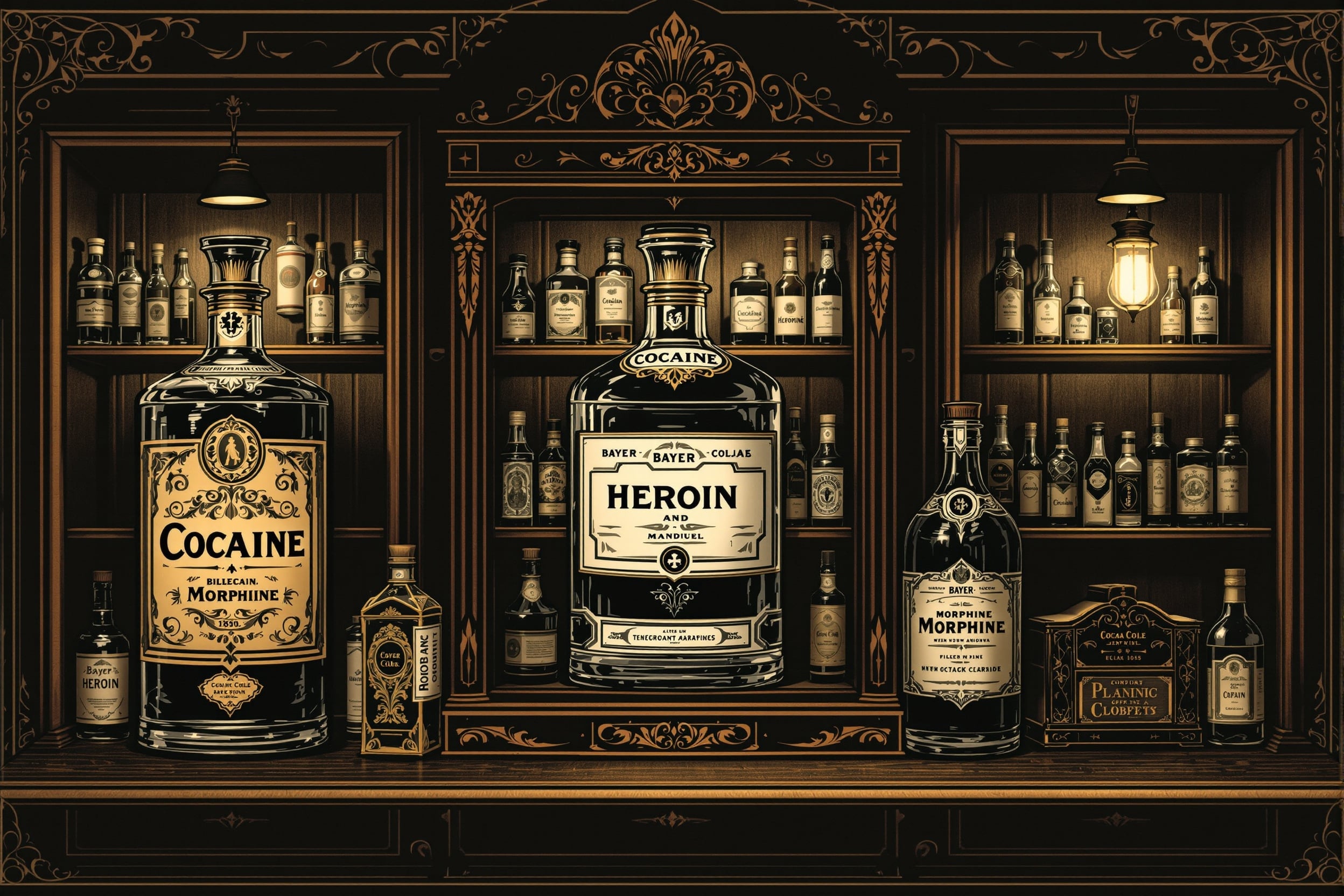
Let's set the scene. It is 1885. You are a respectable middle-class American with a persistent cough, a bad tooth, and what your doctor has diplomatically called "nervous exhaustion" — which is Victorian for "you are extremely anxious and we have absolutely no idea what to do about that." You walk into a pharmacy. The pharmacist, a man with magnificent facial hair and the unshakeable confidence of someone who has never once been wrong about anything, hands you a small brown bottle. The label features a cherub. Maybe a sunrise. The copy promises relief from fatigue, melancholy, and general malaise. You take it home, follow the directions, and within twenty minutes you feel, genuinely, like a new person. Better than a new person. You feel like the best version of yourself that has ever existed. You feel like you could write a symphony and also run a footrace.
Congratulations. You just took heroin. Or cocaine. Possibly both, depending on which bottle you grabbed. Your doctor recommended it. Bayer made it. The government was fine with it. And absolutely nobody involved — not the pharmacist, not the physician, not the chemist who synthesized the compound — thought any of this was going to be a problem.
They were, to use the precise medical terminology, catastrophically, spectacularly, historically wrong.
This is not a story about evil people doing evil things. That would be simpler. This is a story about smart, credentialed, well-intentioned people who looked at two of the most addictive substances ever to enter the human body and collectively concluded: yes, this seems fine, give it to the children too. It is a story about what happens when financial incentive, genuine scientific excitement, and a near-total ignorance of addiction pharmacology all arrive at the same party. It is also, if you squint at it from a certain angle, a story that is still happening right now. But we'll get to that.
The Wild West Was a Pharmacy: Medicine Before Regulation
To understand how cocaine and heroin became respectable medicine, you need to understand what medicine looked like before they arrived. In the latter half of the nineteenth century, American medicine was operating in a regulatory vacuum so complete it makes the current FDA approval process look like a paranoid surveillance state. There was no federal agency vetting drug safety. There were no randomized controlled trials. There was no requirement that a medicine actually do what it claimed to do, or that it not, say, kill you. [9]
What existed instead was a thriving market in patent medicines — a phrase that sounds innocuous until you understand what it actually means. "Patent medicine" did not mean the formula was patented. It meant the name and the label were trademarked, so competitors couldn't copy your branding, while the actual contents remained a proprietary secret. Nobody was required to list ingredients. Nobody was required to disclose that your "Soothing Syrup for Nervous Children" was, nutritionally speaking, mostly alcohol and opium. [7]
And here is the genuinely insidious part: a lot of these medicines worked. Not because they treated underlying disease — they didn't — but because they contained pharmacologically active compounds that produced real, immediate, subjective improvement. Opium suppresses cough and relieves pain. Cocaine provides energy and numbs tissue. Alcohol, in sufficient quantity, makes everything feel manageable. If your child had a relentless cough and you gave them a spoonful of syrup containing morphine, the cough would stop. You would conclude the medicine worked. You would buy more. The medicine manufacturer would get richer. Your child would quietly develop a physiological dependence that nobody had a framework to recognize or name. Outcome achieved, as one might say.
By 1900, Americans were spending an estimated $75 million annually on patent medicines — roughly $2.5 billion in today's money. Common active ingredients included: alcohol (often 20–40% by volume), opium, morphine, heroin, cocaine, cannabis, chloroform, and arsenic. Labeling requirements: essentially none. Federal oversight: none until the Pure Food and Drug Act of 1906. Number of manufacturers required to prove their product was safe before selling it to the public: zero. [7] [9]
The alternatives to these medicines were, it must be said, not great. Surgical anesthesia existed — ether had been demonstrated at Massachusetts General Hospital in 1846 in a procedure now so famous the room is called the Ether Dome — but local anesthesia was primitive to nonexistent. If you needed a tooth pulled or a small growth excised, the options were essentially: bite down on something, drink until insensible, or experience the procedure in its full unmedicated glory. Systemic pain management meant morphine or nothing. Depression, anxiety, and what we would now recognize as PTSD were poorly understood and worse treated. Into this landscape of genuine suffering and therapeutic inadequacy walked cocaine and heroin, both of them actually doing something, both of them doing it immediately, and both of them carrying a hidden cost that would take a generation to fully reckon with.
Cocaine: From Sacred Leaf to Surgical Miracle to Catastrophic Overreach
Cocaine's story begins, as so many European medical disasters do, with colonialism and an almost touching inability to leave well enough alone. Indigenous peoples of the Andes had been chewing coca leaves for at least a thousand years — for altitude sickness, for stamina during labor, for ritual purposes, for the entirely reasonable goal of making a difficult life slightly more manageable. [3] Spanish conquistadors noticed that indigenous laborers worked harder and needed less food when given coca leaves, and promptly used this information to extract more labor from them. This is not a great origin story, but it is a historically accurate one.
The purified alkaloid cocaine was isolated from coca leaves in the mid-nineteenth century, and by the 1880s European and American physicians had gotten their hands on it in quantity. The initial medical excitement was, it must be acknowledged, not entirely unfounded. In 1884, a Viennese ophthalmologist named Carl Koller demonstrated that a cocaine solution dropped into the eye could produce complete local anesthesia, allowing surgery on the eye while the patient remained fully conscious and the eye remained completely still. [2] This was, genuinely, a significant advance. Before cocaine, ophthalmic surgery was performed on patients who were either systemically anesthetized — with all the mortality risk that entailed — or simply restrained. The eye, for those fortunate enough never to have thought about this, does not stop moving just because someone is cutting it. Cocaine changed that.
Cocaine also causes vasoconstriction — it shrinks blood vessels — which reduces surgical bleeding. It is, considered purely as a local anesthetic, a pharmacologically elegant compound. This is why, in a fact that will ruin cocktail parties, topical cocaine still has limited, carefully controlled use in certain ENT procedures today. There is, somewhere in a hospital formulary right now, a locked cabinet containing actual pharmaceutical cocaine. The DEA knows about it. It is legal. Medicine is strange.
1884: Freud publishes Über Coca, enthusiastically endorsing cocaine for depression, fatigue, indigestion, asthma, and morphine addiction. Uses it himself. [1]
1884–1885: Recommends cocaine to his friend Ernst von Fleischl-Marxow, who has severe pain and morphine dependence, as a "cure."
1885–1891: Fleischl develops severe cocaine addiction, experiences cocaine-induced psychosis, suffers dramatically worsening health, and dies in 1891 at age 45.
Later career: Freud quietly distances himself from cocaine advocacy. Pivots to theories about your mother.
Historical verdict: Brilliant in some areas. Spectacularly wrong in others. Possessed, throughout, of extraordinary confidence. [1] [8]
But Koller's demonstration did not stay confined to ophthalmology. It couldn't, not in a medical culture that had just discovered something that actually worked. Within months, physicians were experimenting with cocaine for dental procedures, throat surgery, nasal surgery, and nerve blocks. The American surgeon William Halsted — a genuinely transformative figure in the history of surgery, the man who essentially invented the residency training system, who pioneered radical mastectomy, who introduced rubber surgical gloves — began experimenting with cocaine nerve blocks in 1884. [2] He injected it into nerves to produce regional anesthesia. It worked brilliantly. He also injected it into himself repeatedly in the course of his experiments, because the nineteenth century had a very different relationship with the concept of "control group."
Halsted became addicted. Profoundly, life-alteringly addicted. His colleagues noticed the change — the erratic behavior, the disappearances, the trembling hands that had previously been so famously steady. He was eventually sent to a sanitarium, where he was treated for cocaine addiction with morphine, which is either darkly funny or just dark depending on your mood. He recovered enough to resume his career and became one of the most influential surgeons in American history, but he struggled with substance dependence — eventually morphine — for the rest of his life. [2] [8] This is not a footnote in his biography. This is a central fact about one of surgery's most celebrated figures, and medicine spent about a century quietly coughing over it.
Meanwhile, cocaine was expanding far beyond surgery. Physicians prescribed it for depression, fatigue, asthma, hay fever, and morphine addiction — that last one with a breathtaking lack of self-awareness that would become something of a theme. [1] [3] Sigmund Freud, then a young and ambitious Viennese neurologist, published his essay Über Coca in 1884, a document so enthusiastically wrong about so many things that it has become something of a collector's item in the history of medicine. [1] Freud described cocaine as producing "exhilaration and lasting euphoria, which in no way differs from the normal euphoria of the healthy person." He recommended it for an impressive range of conditions. He used it himself. He sent some to his fiancée. He encouraged colleagues to try it.
"I have tested this effect of coca, which wards off hunger, sleep, and fatigue and steels one to intellectual effort, some dozen times on myself." — Sigmund Freud, Über Coca, 1884 [1]
The case of Ernst von Fleischl-Marxow is where Freud's cocaine enthusiasm stops being merely embarrassing and becomes genuinely tragic. Fleischl was a brilliant physiologist, a close friend of Freud's, and a man in serious trouble: he had severe chronic pain following a thumb amputation, and had developed a significant morphine dependence in the process of managing it. Freud, convinced that cocaine could cure morphine addiction, encouraged Fleischl to use it as a substitute. Fleischl did. He rapidly escalated his cocaine use to enormous quantities administered by injection. He developed what contemporaries described as cocaine psychosis — hallucinations of insects crawling under his skin, a symptom so characteristic of stimulant psychosis that it later acquired the clinical name formication. He deteriorated steadily over several years and died in 1891. Freud, to his credit, eventually acknowledged his role in this disaster, though "eventually" is doing some work in that sentence. [1] [8]
While physicians were discovering cocaine's darker dimensions, the commercial sector was having an absolute field day. Angelo Mariani, a French chemist, introduced Vin Mariani in 1863 — a Bordeaux wine infused with coca leaves that delivered a meaningful dose of cocaine with every glass. [3] [8] It was enormously successful. Mariani was a marketing genius who collected celebrity endorsements with the enthusiasm of a modern influencer campaign, except his influencers included Pope Leo XIII, who awarded the product a Vatican gold medal and appeared in an advertisement. Thomas Edison. Ulysses S. Grant. Jules Verne. The actress Sarah Bernhardt. Mariani published these endorsements in bound volumes called Mariani Album, which are, if you can find them, extraordinary artifacts of a specific historical delusion. [8]
In Atlanta in 1886, a pharmacist named John Pemberton introduced a non-alcoholic alternative — he was working in a dry county — that contained coca leaf extract and kola nut caffeine. He called it Coca-Cola. [3] [7] The early formula contained cocaine in amounts that were small but pharmacologically real, which is why it was marketed as an "invigorating" beverage and why that marketing was, technically, accurate. The cocaine was removed from the formula around 1903 as the legal and social climate shifted, but the coca leaf extract — decocainized — remains an ingredient to this day. The most popular soft drink in human history is, in its genealogy, a cocaine tonic that survived by removing the cocaine. History is genuinely strange.
Physicians of the late nineteenth century prescribed cocaine for: toothache, throat inflammation, hay fever, asthma, depression, fatigue, "nervous exhaustion," seasickness, indigestion, nausea, whooping cough, and — with extraordinary irony — morphine addiction. It was available in wines, tonics, lozenges, nasal sprays, injections, suppositories, and at least one brand of cigarette. The 1897 Sears catalog sold cocaine tooth drops. A cocaine-containing "catarrh powder" meant to be snorted was marketed specifically for nasal congestion. The nineteenth century was, in this respect, extremely on-brand. [3] [7] [8]
Bayer's Masterstroke: Inventing a Drug to Solve the Problem of the Last Drug
If cocaine's story is about genuine medical utility that got catastrophically out of hand, heroin's story is something more structurally deranged. Heroin was not discovered accidentally. It was not a folk remedy that got industrialized. Heroin was invented, deliberately, by one of the most prestigious pharmaceutical companies in the world, as the solution to a drug addiction problem that medicine had created with its previous drug. This is the kind of recursive catastrophe that, if you wrote it as fiction, an editor would send back with a note saying "this is too on the nose."
The backstory requires morphine. Morphine had been isolated from opium in the early nineteenth century and became, over the following decades, the most powerful pain management tool medicine possessed. During the American Civil War, it was used extensively — hypodermic injection had been introduced in the 1850s, making systemic delivery fast and reliable. [6] The war produced somewhere between 600,000 and 750,000 dead and an enormous, uncounted population of wounded survivors with chronic pain, amputations, and injuries that would not fully heal. Morphine kept them functional. It also made many of them dependent, so thoroughly that post-Civil War morphine addiction was sometimes called "the soldier's disease" or "army disease." [6] [10]
By the late nineteenth century, morphine addiction was a recognized social problem. Physicians knew — or should have known — that morphine was habit-forming. And into this awareness stepped Bayer, the German pharmaceutical company that had already given the world aspirin, and that apparently felt this entitled them to a certain amount of hubris about what they could accomplish with a molecule.
In 1895, Bayer chemist Heinrich Dreser began working with diacetylmorphine, a compound first synthesized in 1874 by the English chemist C.R. Alder Wright. [4] [5] Dreser's team found that it was significantly more potent than morphine and appeared, in their testing, to produce less of the nausea and respiratory depression associated with morphine. The compound also seemed, based on early trials, to produce less physical dependence. This last conclusion was wrong in a way that is almost admirable in its completeness. Diacetylmorphine crosses the blood-brain barrier approximately twice as efficiently as morphine, converts to morphine in the brain, and produces a faster, more intense effect that creates more powerful conditioned associations and more severe physical dependence. [6] [10] It is, pharmacologically, a more efficient delivery mechanism for morphine to the brain, which makes it more addictive in virtually every measurable way.
Bayer named the compound "heroin," reportedly derived from the German heroisch — heroic — reflecting the feelings reported by early test subjects. [4] [5] This is, in retrospect, an extraordinary piece of accidental honesty. The drug did produce heroic feelings, briefly, before producing everything else. In 1898, Bayer launched heroin commercially as a cough suppressant and respiratory sedative, marketing it aggressively as a safe, non-addictive alternative to morphine and codeine. They sent free samples to physicians. They published clinical reports. They advertised in medical journals. The tagline, in various formulations, emphasized safety and the absence of addiction risk. [4] [5]
"Heroin hydrochloride... is superior to morphine in that it does not have the disagreeable secondary effects of that drug, and its use does not lead to the formation of a habit." — Bayer promotional literature, circa 1898 [4]
Bayer marketed heroin for coughs, bronchitis, tuberculosis, and asthma. They also marketed it for children. This is the part that tends to produce a specific kind of silence when people encounter it for the first time. Heroin-containing cough preparations were recommended for pediatric use. The logic was not entirely insane by the standards of the time — opiates do suppress cough, and children's coughs can be serious, particularly in an era when tuberculosis and whooping cough were significant killers. The problem was that the logic stopped there, at "it suppresses the cough," without continuing to "and it also creates physical dependence in children, who are smaller and therefore reach toxic doses faster." [5] [6]
You could walk into an American pharmacy in 1900 and buy heroin over the counter. No prescription required. It was available in tablet form, in elixirs, in cough syrups. It was cheaper than morphine. It worked faster. It felt better, which was, of course, precisely the problem.
1898: Year Bayer launched heroin commercially [4]
1899: Bayer exported heroin to 23 countries in its first year
~2x: How much more efficiently heroin crosses the blood-brain barrier compared to morphine [6] [10]
"Non-habit forming": Bayer's official marketing claim [4] [5]
~12 years: How long it took for the U.S. government to begin restricting it [9]
Concurrent product: Bayer was simultaneously marketing aspirin. One of these products they got right.
The Epidemic in the Doctor's Office: Who Actually Got Addicted
The popular image of nineteenth-century drug addiction is a particular kind of person in a particular kind of place — opium dens, urban poverty, moral weakness made visible. This image was not accidental. It was constructed, partly, because it was useful. If addiction was something that happened to certain kinds of people in certain kinds of places, then it was a social problem located safely elsewhere, not a medical consequence that could reach anyone who received a prescription.
The actual epidemiology of late nineteenth-century addiction was considerably more uncomfortable. Studies conducted in the 1880s and 1890s found that the majority of opiate addicts were white, middle-class, and female — not because women were morally weaker, but because they were the primary consumers of patent medicines and the primary recipients of physician-prescribed opiates for conditions like "neurasthenia," menstrual pain, and the catch-all Victorian diagnosis of "hysteria." [6] [9] A woman who went to her physician with anxiety and chronic pain might leave with a morphine prescription that she would still be filling twenty years later. She would not be recognized as an addict. She would be recognized as a patient with an ongoing medical need.
Heroin added a new population to this existing crisis. People prescribed heroin for coughs, for respiratory infections, for pain, found that the cough resolved and the dependence did not. The mechanism is worth being specific about, because it clarifies why so many people were caught entirely off guard. Heroin's withdrawal symptoms — the sweating, the cramping, the bone-deep aching, the insomnia, the desperate craving — would have been interpreted by patients and physicians alike not as signs of addiction, but as signs of the original illness returning, or of a new illness emerging. The prescription would be renewed. The dose would increase. The cycle would deepen. [6] [10]
Nobody had a working model of addiction as a physiological process. The dominant framework understood addiction as a moral failing — a deficiency of will, a weakness of character. This framework was not merely scientifically wrong; it was operationally catastrophic, because it meant that the correct response to addiction was shame and moral exhortation rather than recognition that the drug itself was causing a physiological state that made stopping genuinely, biologically difficult. A patient who reported difficulty stopping their heroin cough syrup was not seen as someone experiencing opioid withdrawal. They were seen as someone who lacked the character to stop. [9] [10]
By the early 1900s, the scale of the problem had become impossible to ignore. Estimates of the number of Americans addicted to opiates in 1900 range from 250,000 to over 1 million, in a country of 76 million people. [9] [10] These were not underground statistics. Physicians were seeing it in their practices. Pharmacists knew which customers were coming back daily. Newspapers were beginning to cover it. The question was no longer whether there was a problem. The question was what kind of problem it was.
The Government's Solution: Make It Illegal and Declare Victory
The legislative response to the opioid and cocaine epidemic of the early twentieth century was, in its broad outlines, a decision to transform a medical problem into a criminal one. The Harrison Narcotics Tax Act of 1914 required physicians and pharmacists to register and pay a tax to dispense opiates and cocaine, effectively making non-medical use illegal. [9] [7] The Pure Food and Drug Act of 1906 had already required that patent medicines list their ingredients and that medicines sold across state lines be accurately labeled — a modest reform, but one that produced an immediate, dramatic decline in patent medicine sales when consumers discovered what was actually in the bottles. [7] [9]
Bayer lost the trademark on "heroin" as part of World War I reparations in 1919. [4] [5] The word, coined in a German laboratory to sell a pharmaceutical product, became a generic term for a controlled substance. The American Medical Association reversed its earlier support for heroin as a medicine and recommended it be banned entirely. The people who were already addicted — the middle-class women with their cough syrups, the veterans with their pain prescriptions, the patients who had done everything their doctors told them to do — found themselves reclassified from patients into criminals.
This is the part that tends to get glossed over. The Harrison Act did not create a treatment system. It did not fund rehabilitation. It did not provide a medical pathway for people who were physiologically dependent on substances that had been legally prescribed to them by licensed physicians acting in good faith. It made their continued drug use a criminal matter and left them to resolve their dependence through willpower, which the previous fifty years of evidence had thoroughly demonstrated was not equal to the task. [9] [10]
The underground market that developed to supply addicts who could no longer access pharmaceutical-grade drugs was not an unintended consequence. It was the predictable, foreseeable, actually predicted result of eliminating supply without eliminating demand. Several physicians said exactly this at the time. They were overruled by people who believed, with the same unshakeable confidence that had characterized the heroin-is-safe advocates fifteen years earlier, that criminalization would solve the problem.
The Pattern That Medicine Refuses to Learn
There is a particular kind of historical myopia that medicine has demonstrated, with impressive consistency, in its relationship with addictive substances. It goes like this: a new compound is discovered or synthesized. Early results are promising. Pharmaceutical companies invest in production and marketing. Physicians, trained to believe in pharmacological progress, adopt the compound enthusiastically. The compound is promoted as superior to whatever came before, with special emphasis on its safety and non-addictive properties. This claim is made with confidence inversely proportional to the evidence supporting it. The compound is prescribed widely. A population of dependent patients develops. The scale of the problem becomes undeniable. The compound is restricted or criminalized. Medicine moves on to the next compound.
Cocaine and heroin were the nineteenth century's version. Barbiturates were the early twentieth century's version — introduced as safe sleeping aids, widely prescribed, widely abused, responsible for a wave of overdose deaths that prompted their eventual restriction. [9] Benzodiazepines were the mid-twentieth century's version, Valium becoming so ubiquitous that the Rolling Stones wrote a song about it. And then, in the 1990s, the cycle completed itself with an almost elegant literalness: Purdue Pharma introduced OxyContin, an opioid painkiller, with aggressive marketing to physicians emphasizing its safety and low addiction potential. [10] The claims were wrong. The marketing was effective. Hundreds of thousands of Americans became addicted. Tens of thousands died each year. The legal response was to restrict the prescription drug, which drove dependent patients to heroin and fentanyl, which killed more of them.
This is not a coincidence. It is not bad luck. It is a structural feature of a system in which pharmaceutical companies profit from prescriptions, physicians are trained to believe in pharmacological solutions, addiction is still not fully understood or adequately treated, and the lessons of previous disasters are treated as historical curiosities rather than active warnings. Heinrich Dreser at Bayer did not know he was creating the twentieth century's defining drug problem. Arthur Sackler, who built the marketing model that Purdue Pharma used to sell OxyContin, had access to a hundred years of evidence that he chose not to find persuasive. [10]
1860s–1900s: Morphine prescribed widely; addiction epidemic among Civil War veterans and patent medicine users [6]
1884–1914: Cocaine prescribed as safe, non-addictive treatment including for morphine addiction [1] [3]
1898–1914: Heroin marketed by Bayer as safe, non-addictive alternative to morphine [4] [5]
1930s–1960s: Barbiturates prescribed as safe sleep aids; addiction and overdose epidemic follows
1960s–1980s: Benzodiazepines prescribed as safe anxiolytics; dependence epidemic follows
1996–present: OxyContin and related opioids marketed as safe, low-addiction-risk pain management; 500,000+ overdose deaths follow [10]
Common thread in marketing across all six episodes: "This one is different. This one is safe. This one is not addictive."
What makes the cocaine and heroin story worth dwelling on is not that it happened. Catastrophic medical errors happen; the history of medicine is substantially a history of catastrophic errors interrupted by occasional genuine progress. What makes it worth dwelling on is the specific texture of the error — the confidence, the financial interest, the genuine belief that this time the miracle drug was real, the transformation of addicted patients into moral failures rather than victims of bad medicine. That texture is not historical. It is contemporary. It is present-tense. It is, right now, playing out in emergency departments and county courthouses and obituary columns in every state in the country.
The physicians who prescribed heroin to their patients in 1902 were not villains. They were practitioners operating with the best available evidence, which had been shaped by pharmaceutical marketing, which had been shaped by profit motive, which had been insulated from accountability by the absence of adequate regulation and the presence of a cultural framework that blamed addiction on the addict. Their patients suffered for it. And then, rather than build systems designed to prevent the same error from recurring, medicine largely moved on, carrying the same structural vulnerabilities into the next pharmaceutical era.
The baby got the heroin cough syrup. The cough stopped. The mother was satisfied. The doctor was confident. The Bayer shareholders were pleased. And somewhere in the architecture of that transaction — the gap between what the drug was claimed to do and what it actually did, between the confidence of the prescriber and the ignorance of the consequences — is a problem that a hundred and twenty years of subsequent medical history have not yet fully solved.
That's not just fucked up medicine. That's the kind of fucked up that keeps a pattern going long after everyone involved should have known better. And the worst part? Every generation of physicians has believed, with complete sincerity, that they are the ones who finally got it right.
They haven't all been wrong. But the ones who were wrong said exactly the same thing.