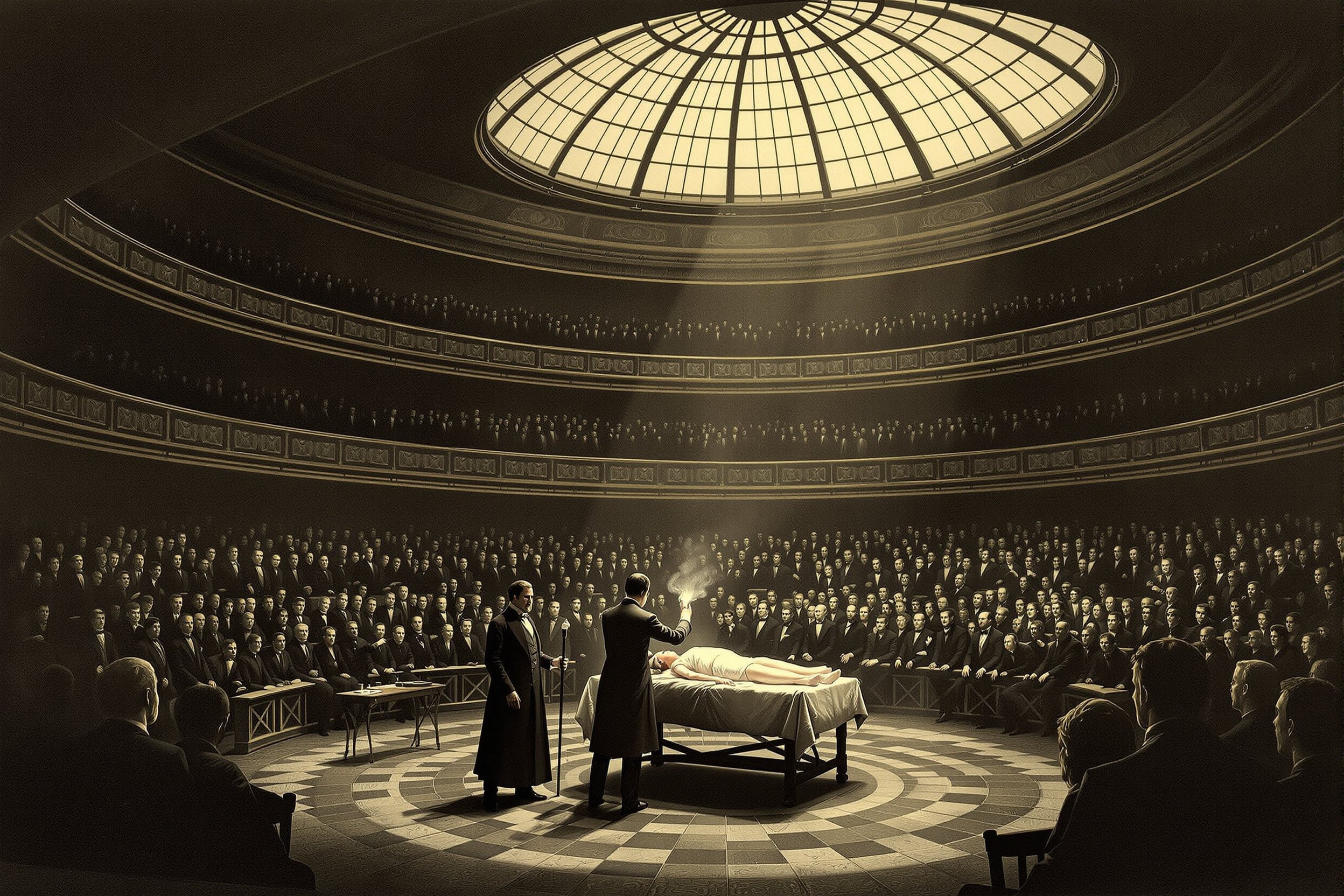
Before we get into the part where a Boston dentist accidentally invented modern surgery while also sparking one of medicine's first major drug crises, let's talk about what surgery actually looked like in 1845. Not the sanitized textbook version. The real version. The version where the screaming was so loud and so constant that hospitals in cities deliberately built their operating theaters on upper floors to muffle the sound from the street below. The version where surgical speed wasn't a flex — it was a moral necessity, because every extra second you spent with your hands inside a conscious human being was another second of agony you were personally inflicting on another person. The version where the best surgeons in the world were essentially racing against the limits of human suffering, and losing anyway.
This is the world ether walked into. And it didn't just improve things. It broke the entire paradigm in half.
Speed-Running Amputation: Surgery Before Anyone Gave a Damn About Pain
The pre-anesthesia operating theater was not a place of healing. It was a place of controlled violence performed by skilled men who had simply made peace with the fact that their patients were going to suffer terribly, and the best they could do was make it brief. [7] The surgical amphitheater at places like Guy's Hospital in London or Massachusetts General in Boston was exactly that — a theater. Tiered seating. An audience. Medical students, visiting physicians, sometimes curious civilians who had paid for the privilege of watching. The patient was the performance.
Robert Liston, the Scottish surgeon who operated at University College Hospital London, was the rock star of this world. [7] He could amputate a leg at the thigh in under two and a half minutes. His technique was described by witnesses as almost balletic — a single smooth arc of the knife, the bone saw already in his other hand before the flap was even folded back. He reportedly held the knife in his teeth during the handoff so he didn't lose a second. Spectators who attended Liston's operations said they sometimes missed the critical moments because they'd looked away to take notes. Blink and the leg was already in the bucket. He was celebrated for this. Celebrated. Because in a world without anesthesia, speed wasn't showing off. Speed was mercy.
The alternatives to suffering through surgery conscious were, to put it charitably, garbage. Alcohol in large quantities could dull the edges but not the substance of pain, and a drunk patient was also a combative patient, which meant your four assistants holding the person down now had to contend with erratic flailing. Opium helped somewhat — it reduced the terror and blunted the sharpest edges of agony — but it didn't produce unconsciousness, and it didn't prevent the physiological shock response that killed patients as reliably as the surgery itself. [7] You could die on the table not because the surgeon cut something vital, but because your nervous system simply gave up trying to process what was happening to your body. Shock was the silent co-killer in every operating room, and nobody had a good answer for it.
What this meant practically was that surgery was reserved for situations where the alternative was certain death. Tumors that could be ignored, were ignored. Bladder stones that were agony but not immediately fatal stayed in the bladder. Dentistry — and we'll come back to dentistry, because dentists are absolutely unhinged and they basically invented modern anesthesia — was performed with a pair of forceps, a strong grip, and the patient's screaming as the only feedback mechanism. Elective surgery was not a concept that existed. [5] If you went under the knife, you had run out of other options.
- Pain management options: Alcohol (ineffective), opium (partial), biting a leather strap (psychological), praying (results varied)
- Average amputation time, elite surgeon: 2–3 minutes [7]
- Cause of death beyond the surgery itself: Neurogenic shock from pain and blood loss
- Patient restraint method: Four or more assistants physically holding the person down
- Ambient soundtrack: Screaming, audible from the street
- What surgeons were evaluated on: Speed, not outcomes
And then — slowly, chaotically, through a process involving party drugs, dueling egos, and at least one man who would eventually lose his mind completely — someone figured out that you could just turn the pain off. The whole thing. Like a switch.
Ether Frolics: When Getting Absolutely Zonked Was Accidentally Scientific
Diethyl ether had been synthesized since the 1500s. Valerius Cordus gets credit for the first documented synthesis around 1540, though he called it "sweet oil of vitriol" because naming things was apparently not his gift. For the next three centuries, chemists knew it existed, knew it had interesting properties, and largely used it for nothing particularly useful. It sat in the chemical literature the way a lot of things sit in the chemical literature: technically known, practically ignored.
What changed in the early nineteenth century was that Americans discovered it was fun to inhale.
Ether frolics — and yes, that was the actual term, used without irony by the people participating in them — were social gatherings where groups of mostly young people, often college students and medical students who had access to the chemical, would pass around ether-soaked rags and take turns getting magnificently, helplessly high. [5] The effects were immediate and dramatic: a brief, intense euphoria, a sense of floating detachment from the body, followed by a period of stumbling, giggling, colliding with furniture, and saying things that seemed profound and were not. Sound familiar? Every era invents its own version of whippets. The nineteenth century's version just happened to be slightly more flammable.
Humphry Davy had already published his famous observations on nitrous oxide in 1800, noting explicitly that the gas might have surgical applications because it abolished pain. [10] He wrote this down. In a book. That people read. And then the medical establishment collectively shrugged and moved on, because apparently "we could stop cutting people open while they're awake and screaming" wasn't a compelling enough pitch. This is one of medicine's more spectacular failures of imagination, and it had a body count.
But here's what the ether frolic crowd noticed, between fits of laughter and walking into doorframes: when people fell down and hurt themselves during a frolic, they frequently didn't notice until they sobered up. Bruises. Cuts. One documented account describes a participant who gashed his shin on a table leg during a frolic, danced for another ten minutes, and only discovered the wound when someone pointed at the blood on his stocking. [5] The pain was simply absent. Not dulled. Absent.
This observation — this incredibly obvious, right-in-front-of-everyone observation — is what eventually produced modern anesthesia. Not a carefully funded research program. Not a prestigious academic investigation. A bunch of people getting high at parties and noticing that getting hurt while high didn't hurt.
Crawford Long: The Man Who Invented Anesthesia and Then Forgot to Tell Anyone
The first person to actually put these observations to surgical use was not a Boston physician with a prestigious hospital behind him. He was a country doctor in Jefferson, Georgia, and his name was Crawford Williamson Long, and history has treated him with the kind of benign neglect usually reserved for people who discover things and then fail to file the paperwork.
Long had attended ether frolics as a medical student and, like any reasonable person watching people stumble through pain without noticing it, made the logical connection. [3] On March 30, 1842, he administered ether to a patient named James Venable and removed a small cystic tumor from the back of Venable's neck. Venable reported feeling no pain. Long charged him twenty-five cents for the ether and two dollars for the surgery, which is either charming or insulting depending on how you feel about the relative value of not feeling someone cut into your neck.
Long went on to use ether for multiple subsequent procedures — more tumor removals, amputations of fingers, obstetric cases. It worked every time. He had, functionally, invented surgical anesthesia four years before the famous Boston demonstration that history decided to remember instead.
He didn't publish until 1849. [3]
Seven years. He sat on one of the most important medical discoveries in human history for seven years, operating quietly in rural Georgia, telling nobody outside his immediate practice. The reasons are debated — some historians suggest he was cautious, wanting more evidence; others suggest he simply wasn't connected to the publishing networks that would have disseminated the finding; Mick from our podcast suggests it's coastal elite bias, which, while entertaining, is not a peer-reviewed position. [4] The brutal truth of the history of science is that discovery without dissemination is closer to a private success than a world-changing event. Long discovered anesthesia. Morton and the Boston crowd changed the world. These are different things, and the difference is a printing press.
Long performed the first documented ether anesthesia for surgery on March 30, 1842 — four years before the famous Ether Dome demonstration. He used it successfully multiple times. He charged his patient twenty-five cents for the ether. He did not publish his findings until 1849, three years after Morton's public demonstration had already transformed surgery worldwide. [3] Long has a statue in the US Capitol's National Statuary Hall, representing Georgia. Morton's name is on the plaque at Massachusetts General Hospital. History, as usual, rewards the person who sent the press release.
The Chaos Trio: Wells, Morton, Jackson, and the World's Worst Group Project
Meanwhile, in the genteel nightmare of Boston's medical establishment, three men were about to have a priority dispute so vicious it would end careers, destroy friendships, consume decades of legal energy, and drive at least one of them to a genuinely operatic mental collapse. Their names were Horace Wells, William Thomas Green Morton, and Charles Thomas Jackson, and together they form one of history's most spectacular examples of what happens when enormous historical significance meets catastrophic human ego.
Horace Wells was a Hartford dentist, which means he was already a man accustomed to people flinching away from him and his tools. [3] In December 1844, Wells attended a public nitrous oxide demonstration by a traveling showman named Gardner Quincy Colton — the nineteenth century had a robust market for chemistry-based entertainment, because again, every era invents whippets — and watched a volunteer named Samuel Cooley injure his leg while under the gas and fail to notice. Wells, to his enormous credit, immediately grasped the implication. He arranged for Colton to administer nitrous oxide to him personally the next day while a colleague extracted one of his own teeth. It worked. Wells felt nothing.
"A new era in tooth-pulling," Wells reportedly said afterward, which is either the most understated description of a paradigm-shifting medical discovery or proof that dentists have terrible PR instincts.
Wells attempted a public demonstration at Massachusetts General Hospital in January 1845. The patient — a medical student, which tells you something about the volunteer pool — was given nitrous oxide, and Wells extracted a tooth. The patient cried out. Whether this was residual pain, a reflexive vocalization, or just the particular indignity of having a tooth yanked from your head even under partial anesthesia is debated. [7] What is not debated is that the audience of Boston physicians, who had come specifically to be impressed and were primed to be skeptical, saw a patient make noise during a supposedly painless procedure and declared the demonstration a failure. Someone reportedly shouted "Humbug!" and that was that.
Wells was publicly humiliated. He retreated to Hartford, abandoned his practice, and began a years-long spiral that would eventually involve self-experimentation with chloroform, a chloroform-fueled arrest in New York for throwing acid at two women (which he later claimed he had no memory of), and his suicide in the Tombs prison in 1848 using a straight razor on his femoral artery after first anesthetizing himself with chloroform so he wouldn't feel it. [6] He was thirty-three years old. He had been right about anesthesia. He just failed demo day, and the nineteenth century medical establishment was not a forgiving audience.
Enter William T. G. Morton. Morton had been Wells's business partner and dental student, knew the nitrous oxide work, and had the particular combination of ambition and shamelessness that tends to produce either great men or spectacular frauds, and in Morton's case produced something interestingly in between. [4] Morton consulted Charles Jackson, a Boston physician and chemist with a talent for ideas and an even greater talent for later claiming credit for other people's ideas, who pointed him toward sulfuric ether as a more reliable anesthetic agent than nitrous oxide.
Morton began testing ether on himself, on his dental patients, and reportedly on his goldfish, which is the kind of detail that either confirms his scientific rigor or raises questions about his judgment that I'll leave to the reader. He developed a custom inhaler — a glass globe with a wooden mouthpiece — and on September 30, 1846, he used ether to anesthetize a patient named Eben Frost for a dental extraction. Frost reported feeling nothing. Morton, who understood something about timing that Long had not, immediately wrote to John Collins Warren at Massachusetts General Hospital and asked for a chance to demonstrate the technique in a surgical setting. [1]
- Crawford Long: First documented surgical use, 1842. Didn't publish for seven years. Georgia. [3]
- Horace Wells: First public demonstration attempt, 1845. Patient made noise. Declared "humbug." Spiraled tragically. [7]
- William Morton: First successful public surgical demonstration, October 16, 1846. Published immediately. Got famous. Also tried to patent ether and charge hospitals licensing fees, which is historically consistent with his character. [1] [4]
- Charles Jackson: Claimed he told Morton about ether and therefore deserved credit. Spent years litigating this. Eventually had a breakdown at Morton's grave, was committed to an asylum, and died there. [4]
- Winner: Surgery. Also: nobody.
October 16, 1846: The Day the Screaming Stopped
The operating theater at Massachusetts General Hospital — the Ether Dome, as it's now known, and yes it's still there, still intact, you can visit it — was full on the morning of October 16, 1846. [9] John Collins Warren, one of the most prominent surgeons in America, was scheduled to remove a vascular tumor from the jaw of a twenty-year-old printer named Gilbert Abbott. Abbott had agreed to be the demonstration subject, which either speaks to his trust in Morton or his desperation about the tumor, and given the medical options available in 1846, probably both.
Morton was late. He'd been at his instrument maker's, finalizing the design of his ether inhaler, and arrived after the scheduled start time to a room full of skeptical physicians who had already watched Horace Wells fail in this exact setting less than two years earlier. Warren reportedly said something cutting about Morton's tardiness — accounts vary on the exact phrasing — and the atmosphere was, charitably, not welcoming. [3]
Morton administered the ether. Abbott breathed it in through the glass inhaler. Within minutes, he was unconscious.
Warren operated. He removed the tumor from Abbott's jaw. Abbott did not move. Abbott did not scream. Abbott did not thrash against the assistants holding him down, because there were no assistants holding him down, because there was nothing to hold down against. He lay still on the table while a surgeon cut into his face, and he felt none of it.
When it was over, Warren turned to the audience of physicians who had come to watch another humiliating failure and said words that have been quoted in every anesthesia history written since: [1]
"Gentlemen, this is no humbug."
Abbott, coming out of the ether, said he had felt something like a scratching sensation but no pain. Henry Bigelow, who was present and who would publish the first major account of the demonstration, described the scene in terms that even filtered through nineteenth-century scientific restraint convey something like stunned disbelief. [2] These were men who had spent their entire careers operating on screaming patients, who had built their surgical technique around the absolute certainty that what they were doing caused agony, and they had just watched a colleague cut into someone's face while the patient lay there peacefully. The conceptual framework of surgery had just been demolished in about four minutes.
Bigelow's paper appeared in the Boston Medical and Surgical Journal within weeks. [2] Warren published shortly after. [1] The news moved at the speed of ships and letters, which in 1846 was still surprisingly fast when the information was important enough. By the end of 1846, ether anesthesia was being used in hospitals in London. By 1847, it was spreading through Europe and beyond. [5] The adoption curve was essentially vertical, because the benefit was so obvious, so immediate, and so undeniable that even the most conservative medical establishment couldn't find a principled objection. You could slow down. You could think. You could attempt procedures that had been impossible when the patient's suffering imposed a time limit on your work. The entire surgical imagination expanded overnight.
The Part Where Everyone Started Getting High at Work
Here is the thing about ether that the triumphant narrative of October 16, 1846 tends to gloss over: ether is extremely fun to inhale. Not in a subtle, pleasant way. In a "your brain is now briefly doing something it has never done before and you feel like you understand everything" way. The euphoria is rapid, intense, and followed by a dreamy dissociation that nineteenth-century users described in terms that sound less like medical documentation and more like particularly enthusiastic Romantic poetry. It produces a sense of weightlessness. Colors become vivid. There is frequently laughter. There is, for a brief window, a feeling of profound well-being that is chemically indistinguishable from happiness.
And it was now in every hospital in the industrialized world.
Medical professionals — surgeons, anesthesiologists before that was formally a specialty, nurses, orderlies, anyone with access to the supply cabinet — began using it recreationally almost immediately. [5] This is not a salacious rumor from hostile sources. It is documented in medical literature, in hospital records, in the professional correspondence of the period. The same properties that made ether useful for surgery made it appealing for recreation, and the people with the most reliable access to ether were the people working in hospitals.
Ether abuse among medical professionals became serious enough that it entered the medical literature as a recognized problem within years of ether's introduction. [5] The pattern that would repeat itself with cocaine in the 1880s, with heroin in the 1890s, and with opioids in the twenty-first century was already fully established by 1850: medicine discovers a compound with genuine therapeutic value, deploys it widely, and discovers too late that the people deploying it are not immune to its other effects.
Outside hospitals, ether found a second recreational market that had its own particular social logic. In certain communities — particularly in rural Ireland, where a temperance movement had reduced alcohol availability and ether was cheap and accessible — ether drinking became a significant phenomenon. [5] Not inhaling: drinking. Small doses of liquid ether in water, producing a rapid intoxication that metabolized quickly, leaving no smell on the breath. For populations where alcohol consumption carried social stigma or legal risk, ether was an appealing alternative. The Draperstown district in County Londonderry reportedly had ether use rates that alarmed public health observers in the 1870s and 1880s. Women, in particular, found ether useful because a woman smelling of alcohol in Victorian society was a fallen woman, while ether left no detectable trace. [7]
Pre-1840s: Ether frolics common at American colleges and among medical students. Recreational use documented but not medically significant. [5]
1846–1850: Surgical ether spreads worldwide. Hospital staff gain easy access. Recreational use among medical professionals begins almost immediately.
1850s–1870s: Ether drinking emerges in Ireland and elsewhere as an alcohol substitute. Women use it specifically because it leaves no smell. [7]
1870s–1880s: Ether abuse documented as a public health problem in multiple countries. Medical literature begins publishing case studies of ether addiction among physicians and nurses.
Late 1800s: Ether gradually replaced by chloroform and later by safer agents. Recreational use declines as availability decreases. [6]
Chloroform, the Dangerous Upgrade Nobody Should Have Trusted
Ether had problems beyond its recreational appeal. It was violently flammable in the concentrations needed for anesthesia — operating theaters that used gas lighting were essentially waiting for someone to make a mistake that would turn the surgical demonstration into a very different kind of spectacle. It caused significant nausea in many patients, which in the context of someone recovering from surgery was not merely unpleasant but potentially dangerous. It had a long induction time, meaning patients took a while to go under, and the transition could be combative — the excitatory phase of ether anesthesia, before full unconsciousness, could produce agitation, hallucinations, and attempts to climb off the table. [5]
Chloroform, introduced by James Young Simpson in Edinburgh in 1847, appeared to solve most of these problems. [6] It was faster. It wasn't flammable. The induction was smoother. Simpson, who had tested it on himself and several dinner guests at a memorable evening in November 1847 — they all passed out at the table, which Simpson interpreted as a promising result — became its enthusiastic champion, and the medical establishment largely followed his lead.
Chloroform was also, as it turned out, far more dangerous than ether. The therapeutic window — the gap between the dose that produces anesthesia and the dose that stops your heart — was narrow enough to be genuinely terrifying in retrospect. [6] Patients died on the table from chloroform-induced cardiac arrest at rates that, by modern standards, would have shut down the practice within months. The first documented chloroform death occurred in 1848, when a fifteen-year-old girl named Hannah Greener died during a minor procedure on an ingrown toenail. She had been healthy. The surgery was trivial. The chloroform killed her.
This did not stop chloroform's adoption. Queen Victoria used it for the birth of her eighth child in 1853, administered by John Snow — who was simultaneously doing the foundational work on cholera epidemiology that would make him famous for a completely different reason — and the royal endorsement effectively ended the religious and moral objections to obstetric anesthesia that had been simmering in certain quarters. [6] If the Queen could use it to have a baby, the argument that pain in childbirth was divinely ordained and medically necessary was going to need a better spokesperson than it had.
Chloroform's death rate was documented, debated, and largely tolerated for decades because the alternative — conscious surgery — remained so much worse. [6] This is a useful reminder that medical risk tolerance is always relative. A drug that kills some percentage of patients is acceptable if the condition it treats kills a higher percentage. The math is brutal but it is the math that medicine has always operated on.
What Ether Actually Changed (Beyond the Obvious)
The immediate effect of anesthesia on surgery was obvious: patients stopped screaming, surgeons could slow down, and the operating theater became something other than a torture chamber with professional supervision. But the second-order effects were at least as significant, and they took longer to become visible. [5]
When you remove the time pressure imposed by a conscious, suffering patient, you change what surgery is capable of. Procedures that required exploration — going into the abdomen to look for something, taking time to identify and preserve structures, doing the delicate work of reconstruction rather than just amputation — became possible for the first time. [8] Abdominal surgery, which had been essentially impossible in a conscious patient for obvious reasons, began to develop as a field. The surgical imagination, which had been constrained for millennia by the absolute ceiling of what a person could endure while awake, suddenly had no ceiling.
Anesthesia also changed who could be operated on. Before ether, surgery was reserved for people who had no other option, because the suffering was so severe that subjecting someone to it for anything less than a life-or-death indication was ethically indefensible. After ether, surgery could be offered to patients who were suffering but not dying, to patients who had conditions that were debilitating but not immediately fatal, to patients who simply wanted a better quality of life. [5] The concept of elective surgery — which sounds almost trivial now — represents a fundamental expansion of what medicine could offer.
And then Joseph Lister figured out antisepsis in the 1860s, and suddenly surgery wasn't just bearable — it was survivable at rates that would have seemed miraculous to anyone operating in 1845. [5] Ether and antisepsis together are the foundation of modern surgery. Remove either one and you're back in the screaming, septic nightmare. Together, they transformed the operating room from a place you entered as a last resort into a place you could enter with a reasonable expectation of coming out the other side.
The Pattern That Never Stops Repeating
Here is what ether's story actually is, stripped of the triumphalist medical history framing: a drug that was being used recreationally for decades was eventually applied to a medical problem it was perfectly suited to solve, changed the world in ways that are difficult to overstate, and simultaneously created a drug abuse problem within the profession that adopted it most enthusiastically. The people who benefited most from ether's medical applications were also the people most exposed to its addictive potential. Some of them became addicted. Some of them died from it. Some of them continued practicing medicine while impaired, and their patients never knew.
This is not a story unique to ether. It is the story of cocaine, which was introduced as a local anesthetic and an antidepressant and produced a generation of addicted physicians. [5] It is the story of heroin, which Bayer marketed as a non-addictive morphine substitute in 1898 and which was prescribed enthusiastically by physicians who then became its most prominent casualties. It is the story of benzodiazepines, of OxyContin, of every pharmaceutical compound that sits at the intersection of genuine therapeutic value and neurological reward. Medicine keeps finding this intersection and keeps being surprised by what's there. The surprise is, at this point, the most remarkable part.
Horace Wells, who recognized the principle of anesthesia before anyone else got public credit for it, died in a jail cell having anesthetized himself so he wouldn't feel the razor. [6] Charles Jackson, who gave Morton the chemical suggestion that led to the Ether Dome demonstration, died in an asylum after a breakdown at Morton's grave. Morton himself died at forty-nine, exhausted and broke from decades of legal battles trying to extract financial benefit from his discovery. Crawford Long, who did it first and told nobody, lived to seventy-two, practiced medicine quietly in Georgia, and watched the rest of them destroy each other over credit for something he'd done in a country office with a handkerchief and a bottle of chemicals. [3] [4]
- Years between Davy's published suggestion that nitrous could prevent surgical pain and the first successful public anesthesia demonstration: 46 years [10]
- Days between Morton's Ether Dome demonstration and Bigelow's published account: Weeks [2]
- Years between Long's first use and his publication: 7 years [3]
- Age at death of Horace Wells, who identified the principle: 33 [6]
- Fate of Charles Jackson, who suggested ether to Morton: Asylum [4]
- Fate of William Morton, who demonstrated it publicly: Died broke and litigating [4]
- Fate of Crawford Long, who did it first and kept quiet: Long, quiet life. Died at 72. [3]
The Ether Dome at Massachusetts General Hospital is still there. They still use it for lectures. Medical students sit in the same tiered seats where Boston physicians watched Gilbert Abbott not scream in 1846, and someone explains what happened there, and the students nod and move on to the next thing because they have Step 1 to worry about and the history of anesthesia is not heavily tested. [9] The dome itself is quiet and a little musty and entirely unremarkable unless you know what it is, which is the room where surgery became something a human being could survive not just physically but psychologically — where the fundamental transaction of medicine, the one where you make yourself vulnerable to another person's knives in exchange for the possibility of healing, stopped requiring a level of courage that most people simply didn't have.
That's not nothing. That's not even close to nothing. It's one of the most significant rooms in the history of medicine, and it smells like old wood and bureaucracy, and somewhere in the story of how it got there are a Georgia country doctor who didn't publish, a Hartford dentist who died in a jail cell, a Boston opportunist who died broke, and a chemist who died in an asylum, and a whole generation of hospital workers who got high on the supply and paid for it in ways that the triumphant historical narrative tends not to linger on.
Every solution creates new problems. Every drug that works also does something else. Every revolution in medicine carries its casualties with it, sometimes in the ward, sometimes in the supply closet, sometimes in the coroner's report that nobody thought to archive.
That's not just fucked up medicine. That's all of it, all the way down.