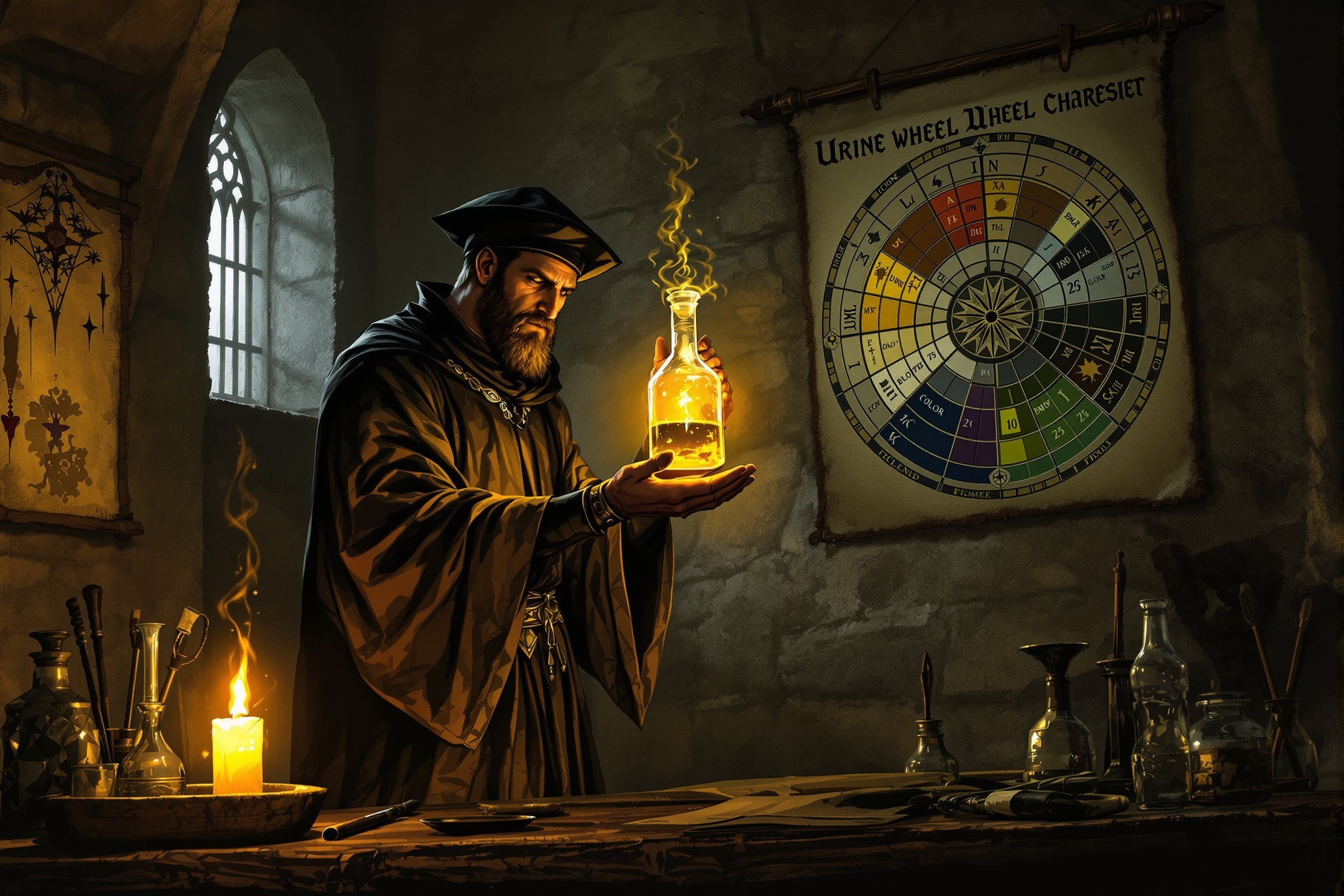
Let's establish something important before we begin: the medieval physician holding a flask of your urine up to the light, swirling it thoughtfully, sniffing it like a wine sommelier at a particularly challenging vintage, and then — yes — putting it in his mouth, was not considered a maniac. He was considered a professional. He had studied for years. He had charts. He had a whole system. The flask was so synonymous with the medical profession that it appeared in portraits, on guild seals, in satirical woodcuts, on the covers of serious academic texts. If you wanted to signal "learned physician" in medieval Europe, you painted a man holding a round-bottomed bottle of golden liquid and looking extremely pleased with himself. This was their stethoscope. This was their MRI. This was the pinnacle of diagnostic sophistication, and it tasted like exactly what it was.
Welcome to uroscopy — the art, science, theater, and occasionally criminal fraud of diagnosing disease through the examination of urine. It dominated Western medicine from roughly the ninth century through the seventeenth, survived the Renaissance, outlasted the Black Death, and was still being practiced by serious physicians while Shakespeare was writing plays and Galileo was pointing telescopes at Jupiter. It was not a fringe practice. It was not the medieval equivalent of essential oils. It was the mainstream, the curriculum, the thing you learned in medical school, and the thing patients specifically requested when they came to see you. [2]
And yes, sometimes the doctor drank it.
The Flask That Launched a Thousand Misdiagnoses
The instrument at the center of all this was called the matula — a round-bottomed glass flask specifically designed to hold urine samples, shaped roughly like a human bladder, because medieval physicians believed that the vessel should reflect the organ. [3] This was not incidental. The shape was intentional, symbolic, deeply meaningful to practitioners who saw the body as a closed system of correspondences where form and function mirrored each other at every scale. The matula was so ubiquitous, so central to medical identity, that it became the profession's unofficial logo. Doctors were sometimes called "piss prophets" or "water casters" — terms that started as mockery but became so normalized that even legitimate physicians used them without apparent embarrassment.
The flask would arrive at the physician's office — and here's where it gets immediately strange — without the patient. This was considered completely normal. A servant, family member, or occasionally the patient themselves would deliver a sealed flask of urine, collected the previous night or early morning, sometimes after a period of fasting, and the doctor would perform his entire diagnostic routine on the sample alone. No pulse. No symptoms. No physical examination. Just the piss. [5]
Think about what this means. The physician had no idea if the sample was fresh. No idea if it had been contaminated, diluted, swapped, or collected from the wrong person entirely. No idea if the dog had gotten into it. He would hold the matula to the light, inspect the layers — top, middle, and bottom, each supposedly corresponding to different parts of the body — and begin his pronouncement. It was diagnosis as stage magic, and the audience expected a show.
The Matula: Medieval Medicine's Weirdest Status Symbol
The urine flask (matula) was so central to medical identity in medieval Europe that it appeared on physicians' guild seals, in illuminated manuscripts, and in formal portraits of learned doctors. Holding a round-bottomed flask of someone else's urine was the medieval equivalent of wearing a stethoscope around your neck — it immediately communicated professional authority. Some historians argue the matula's deliberate bladder-like shape was symbolic, reflecting the doctrine of correspondence between vessels and organs. It was also, by the sixteenth century, a punchline. Satirists had a field day. [3] [6]
The examination protocol, as codified in medieval medical texts, was elaborate and serious. [1] The physician would first observe the urine in natural light — candlelight distorted color, and color was everything. He would note whether the sample was clear or cloudy. He would look for sediment at the bottom, which supposedly corresponded to conditions of the lower body. He would look for foam at the top, which pointed toward the upper organs. He would observe the middle layer for particulate matter. Then he would smell it — different diseases were thought to produce characteristic odors, and a physician who could detect the sweetish smell of advanced diabetes or the ammonia reek of a serious infection was demonstrating genuine diagnostic skill, even if his theoretical framework for interpreting those smells was completely insane. And then, depending on the physician and the suspected condition, he might taste it. Not every doctor tasted every sample — let's be precise about this — but tasting was a recognized, documented, academically endorsed technique that appeared in serious medical literature without apology. [2]
The Color Wheel from Hell
Medieval uroscopy was not casual guesswork. It had infrastructure. The centerpiece was the urine color wheel — a circular chart, often illustrated in gorgeous illuminated manuscripts that now sit in museum collections where curators probably don't explain what they're looking at to school groups — showing somewhere between twenty and thirty distinct urine colors, each linked to specific diseases, humoral imbalances, and recommended treatments. [6]
The colors ranged from the very pale and watery (indicating cold, phlegmatic conditions, possible kidney weakness) through various shades of yellow (healthy to concerning depending on exact hue) to deep orange, red, brown, greenish, and finally — in the truly alarming territory — black. Black urine meant you were probably dying of something involving severely disrupted black bile, and the physician's job at that point was less diagnosis and more last rites coordination. [4]
Each color had a name. Physicians memorized these names the way modern medical students memorize dermatome maps — with great effort, significant suffering, and the persistent suspicion that this information would haunt them professionally. The pale colors had names evoking water and milk. The middle range evoked gold, honey, and amber. The darker shades evoked saffron, fire, and blood. The terminal colors evoked, essentially, despair. A physician who could look at a flask of urine and say "ah, this is rubicund with nebulous sediment, indicating hepatic inflammation with sanguine excess" sounded like an absolute genius. He had the vocabulary, the charts, the confident manner. He was also, in most cases, making a guess dressed in very expensive Latin. [1]
What's genuinely remarkable is that some of these observations had real diagnostic value, even if the interpretation was garbage. Dark concentrated urine does indicate dehydration. Blood in urine is a real clinical finding that indicates something worth investigating. Frothy urine can correlate with proteinuria — a sign of kidney disease — though medieval physicians didn't know about proteins, kidneys as we understand them, or anything about the actual mechanism. They just knew that bubbly piss was bad news, which is, at minimum, a correct conclusion reached by the world's worst reasoning process. [7]
The Urine Wheel: Medieval Pantone for Piss
Medieval urine color charts documented up to 30 distinct shades, each supposedly indicating a different disease or humoral state. These charts were reproduced in medical textbooks, carried by physicians as reference tools, and taught in universities from Salerno to Paris to Oxford. The colors ranged from near-clear ("white as spring water") through honey-gold, saffron, and red, to the deeply alarming "livid" and "black" categories at the terminal end of the spectrum. At least one medieval text described green urine as a sign of bilious fever — which, to be fair, green urine can actually indicate biliary obstruction. They were right for the absolute worst reasons. [6] [4]
The Theoretical Framework (Or: Why Smart People Did This for Eight Hundred Years)
To understand why uroscopy persisted, you have to understand the humoral theory that made it make sense. Medieval medicine inherited from ancient Greek and Alexandrian sources a model of the body built around four humors: blood, phlegm, yellow bile, and black bile. [8] Disease was not caused by bacteria, viruses, or genetic mutations. Disease was caused by imbalance — too much of one humor, too little of another, humors in the wrong place, humors of the wrong quality. Health was a dynamic equilibrium, and illness was that equilibrium disrupted.
Within this framework, urine made perfect sense as a diagnostic window. The body was constantly processing and expelling excess humors, and urine was one of the primary routes of excretion. If your blood was too hot and thick, that would show in your urine. If your phlegm was excessive and cold, that would show too. The urine wasn't just waste — it was a message, a daily report from your internal humoral economy, written in color and smell and taste and sediment. [4] [5]
This is actually not a stupid framework if you accept the premises. The problem is that the premises were entirely wrong. But the internal logic was sound: if the body is a system of fluid balances, and urine is the primary fluid output, then urine should reflect the state of the system. Medieval physicians weren't idiots. They were applying rigorous reasoning to a false model. The results were exactly as useful as you'd expect — occasionally accidentally correct, systematically disastrously wrong, and always performed with tremendous confidence.
The university curriculum at medieval medical schools like Salerno, Bologna, and Montpellier included uroscopy as a core diagnostic discipline. [5] Students studied the texts of Galen and Avicenna, who had both written extensively on urine examination. They learned the color charts. They learned the smell categories. They practiced on samples. They graduated and set up practices where patients brought them flasks of urine and expected authoritative pronouncements, and the physicians delivered, because the alternative — admitting that medicine had no reliable way to know what was wrong with you — was commercially inadvisable.
The Piss Prophet Problem: When Diagnosis Becomes Theater
Here's where it gets genuinely dark, and I don't mean dark in the "ha ha, they drank pee" sense. I mean dark in the "a systematic fraud infrastructure developed around this practice and people died because of it" sense.
Because uroscopy required no physical examination of the patient, it was extraordinarily easy to fake. Any person with a flask, a color chart, and the confidence of a carnival barker could set up as a uroscopist. And many did. The "piss prophet" — the term used by contemporary satirists and skeptics — was a recognizable figure in medieval and early modern European culture: a man (almost always a man) who claimed to diagnose all diseases from urine alone, charged substantial fees for the service, and was wrong essentially all the time in ways that couldn't be immediately proven because the actual disease process was also invisible. [3]
The fraud was structurally enabled by the same features that made legitimate uroscopy appealing. The patient wasn't there, so they couldn't contradict the diagnosis with symptoms. The sample could have come from anyone, so there was no way to falsify the reading. The diagnosis was couched in learned Latin terminology that patients couldn't evaluate. And the treatment recommendations — bloodletting, dietary changes, herbal preparations, rest — were generic enough that they could be applied to almost any condition and interpreted as either working or not working depending on what the disease did next.
"The uroscopist would hold the flask aloft, turn it in the light, and speak of colors and sediments with the authority of a man who had spent years studying exactly this — which he had, which was the tragedy of it."
Medieval satirists noticed. Chaucer took shots. Later writers piled on. The piss prophet became a stock comic figure — pompous, fraudulent, holding his little bottle of someone else's bodily fluid and speaking with godlike confidence about the state of the cosmos visible therein. The jokes were contemporary, which means people at the time knew something was wrong with the system, even if they couldn't articulate what, exactly, and even if they kept bringing their flasks to the doctor anyway because what else were you going to do. [2]
Remote Diagnosis: Medieval DoorDash for Piss
One of the most structurally bizarre aspects of medieval uroscopy was that the patient frequently never appeared. A servant would deliver the urine flask, the physician would perform his full diagnostic examination in front of witnesses, and the servant would return with a diagnosis and treatment plan — all without the doctor ever seeing, speaking to, or touching the actual patient. This created obvious opportunities for fraud (send the servant with anyone's urine) and obvious diagnostic failures (no symptoms, no history, no physical findings). Contemporary critics noted this was insane. Physicians defended it as a demonstration of the method's power. Both positions were correct. [5] [6]
The performance element was real and deliberate. A physician who received a urine sample would often examine it in front of an audience — family members, servants, other patients, interested bystanders — because the theatrical display of expertise was itself a form of treatment. Patients who watched their doctor perform a careful, learned examination felt they were receiving sophisticated care. The ceremony communicated competence. The Latin communicated education. The color chart communicated science. None of it communicated accurate diagnosis, but accuracy was only one of the things patients were purchasing.
What They Actually Got Right (The Annoying Part)
Let's be honest about the parts that work, because intellectual honesty demands it and also because it makes the parts that don't work more interesting.
Urine is a real diagnostic specimen. Modern urinalysis tests for glucose, protein, blood, ketones, nitrites, leukocyte esterase, pH, specific gravity, and about fifteen other things that can indicate real diseases. [7] The medieval physicians who were poking around in piss with their eyes and noses and occasionally their tongues were working with a genuinely informative specimen — they just had no way to correctly interpret what they were finding.
The diabetes example is the famous one, and it's famous for good reason. Diabetic urine, in uncontrolled diabetes mellitus, contains glucose — because the kidneys are dumping excess blood sugar that the body can't process. This glucose makes the urine taste sweet. The term mellitus literally means "honey-sweet" in Latin, and the condition was named for this characteristic. [1] [3] The physician most explicitly credited with tasting urine to diagnose diabetes is Thomas Willis, working in the seventeenth century, who described the sweet taste in his 1674 text and helped cement the name — but the observation predates Willis considerably. Medieval physicians noted the sweetness. Ancient Indian physicians noted that diabetic urine attracted ants, which is perhaps the most disgusting clever observation in the history of medicine: you didn't taste it yourself, you just watched to see if insects were interested. [1]
That's genuinely brilliant, by the way. If you can't do a glucose assay, outsourcing the sugar detection to ants is an elegant solution. The ants don't care about your theoretical framework. The ants just know there's sugar in the cup. The ants, in this scenario, are doing better medicine than the physician.
Beyond diabetes, the observational record has other defensible moments. Physicians noted that some urine was frothy and associated this with poor prognosis — frothy urine can indicate proteinuria, a real sign of kidney disease, and the poor prognosis association isn't wrong. [7] They noted that dark, concentrated urine often preceded deterioration — correct, that's dehydration and systemic stress. They noted that bloody urine indicated something serious in the urinary tract — also correct, though their explanation for what that something was would make a nephrologist weep. They were, in a narrow observational sense, doing real medicine. They were just translating their real observations into a completely false explanatory framework and then deriving treatment recommendations from the false framework rather than the real observations.
The Tasting: Let's Actually Talk About This
We've been circling it. Let's land.
Tasting urine was documented as a diagnostic technique in serious medieval medical literature. It was not universal practice — not every physician tasted every sample, and the sources suggest it was used selectively, for specific suspected conditions rather than as a routine step in every examination. [2] But it was in the textbooks. It was taught. It was defended academically. When Thomas Willis tasted diabetic urine in the seventeenth century and described the sweetness in a published medical text, he was not doing something shocking or transgressive — he was applying a recognized technique to a specific diagnostic question and reporting his findings like a professional. [1]
The logic was internally consistent. If different diseases produce different chemical compositions in urine — which they do, though medieval physicians didn't know about chemistry — and if taste can detect differences in chemical composition — which it can, within limits — then tasting urine could theoretically distinguish between disease states. This is not crazy reasoning. It's just reasoning applied to a specimen that you really, really don't want in your mouth.
Medieval physicians also used smell extensively, and smell is actually a more defensible diagnostic tool than taste in some respects. The characteristic fruity, acetone smell of diabetic ketoacidosis can be detected in urine and on the breath. The ammonia smell of certain infections is real and clinically significant. The smell of phenylketonuria — a metabolic disorder — is distinctive enough that it was historically detected by smell before any chemical test existed. [2] These physicians were working at the absolute limits of human sensory capability applied to biological specimens, and they were finding real signals in the noise. The tragedy is that they were then feeding those real signals into a theoretical machine that turned everything into humoral imbalance and prescribed bloodletting.
The Smell Test: Actually Not Entirely Stupid
While urine-tasting gets all the attention, medieval physicians' use of smell in diagnosis was arguably more defensible. The fruity, acetone odor of diabetic ketoacidosis is detectable in urine. The ammonia smell of urinary tract infections is real. The musty smell of phenylketonuria is distinctive enough to have been used as a diagnostic clue before chemical testing existed. Medieval physicians couldn't explain why these smells indicated specific conditions, but they correctly observed that certain smells correlated with certain disease states. This is, technically, evidence-based medicine — just without the evidence about mechanisms. [2] [7]
The Long Decline: How Medicine Stopped Drinking Your Pee
Uroscopy didn't die quickly or cleanly. It didn't get disproven in a dramatic experiment and then vanish overnight. It faded over roughly two centuries as better tools, better anatomy, and better chemistry gradually made the piss flask look increasingly inadequate. [3]
The anatomical revolution of the sixteenth century — Vesalius cutting open actual human bodies and describing what was actually inside them — helped, because it gave physicians a more accurate model of what the body was doing and why. [5] If you understand that the kidneys are filtration organs processing blood and producing urine as a waste product, rather than mysterious vessels reflecting humoral balance, your interpretation of urine findings starts to change. You start asking different questions. You start being less impressed by color charts and more interested in what specific substances the urine contains.
Chemistry was the real killer. As the seventeenth and eighteenth centuries developed increasingly sophisticated chemical analysis — Robert Boyle applying chemical tests to urine in the 1680s, subsequent researchers identifying specific compounds — the gap between what a physician's senses could detect and what chemical analysis could detect became impossible to ignore. [7] By the nineteenth century, urine test strips and chemical reagents were replacing the matula. By the twentieth century, the matula was in a museum and the urine was in a centrifuge. [7]
But here's the thing: uroscopy didn't fail because physicians stopped taking urine seriously. It failed because they started taking it more seriously — seriously enough to demand better tools than their own tongues. The instinct was right. The specimen was right. The practice of medicine improving until the crude sensory examination was replaced by precise chemical analysis is not a story of medicine abandoning a mistake. It's a story of medicine following the right thread until it got somewhere real. [2] [3]
The Fraud Economy: Piss Prophets and Their Victims
We should spend more time with the fraud, because the fraud was consequential.
The structural features of uroscopy — remote diagnosis, no patient examination, learned vocabulary inaccessible to patients, outcomes that were hard to definitively attribute to treatment — created a perfect environment for exploitation. And medieval and early modern Europe had no shortage of people willing to exploit it. [6]
A typical fraud scenario: a traveling practitioner arrives in a town with no physician. He carries a matula and a color chart. He sets up in the market square or at an inn. People bring him their urine. He examines each sample with tremendous theater — holding it to the light, sniffing carefully, consulting his chart, furrowing his brow in learned concern — and delivers diagnoses. He recommends treatments, which he happens to sell. He takes payment. He moves on before anyone can report that the treatments didn't work.
This wasn't rare. It was common enough that municipal authorities in various European cities attempted regulation — requiring practitioners to demonstrate credentials before offering uroscopic diagnosis, limiting who could legally examine urine for pay. [5] These regulations were imperfectly enforced and widely ignored, because the demand for diagnosis was real and the supply of legitimate physicians was limited and expensive. The piss prophet filled a market gap, and the market didn't care much about outcomes.
The legitimate physicians hated the frauds, not primarily because the frauds were hurting patients, but because the frauds were undercutting their business and degrading their professional reputation. The guild politics of medieval medicine are deeply human in this way: the doctors were worried about their brand. They published critiques of uroscopic fraud. They lobbied for stricter licensing. They wrote pamphlets explaining how you could tell a real physician from a piss prophet. The pamphlets noted, with unintentional irony, that the real physician would examine your urine much more carefully and charge more for it.
"The satirists of the sixteenth century had a simple test for distinguishing the legitimate physician from the water-caster: the legitimate physician would also bleed you. This was considered a point in his favor."
Why a System This Wrong Lasted This Long
Eight hundred years. Roughly eight hundred years of mainstream Western medicine using urine examination as a primary diagnostic tool, with taste and smell as accepted techniques, with color charts as reference materials, with the matula as the professional symbol. That's a long time for something to persist despite being mostly wrong.
The persistence wasn't stupidity. It was structural. [5]
First: the system produced outcomes that couldn't be easily falsified. If a physician examined your urine and diagnosed humoral imbalance and recommended bloodletting and you got better, that confirmed the system. If you got worse, the disease was severe and the physician had done his best. If you died, God's will intersected with medical reality in ways that were not the physician's fault. There was no control group. There was no follow-up study. There was no mechanism for the system to learn from its failures.
Second: the system conferred genuine social and psychological benefits independent of its diagnostic accuracy. Patients who received a careful, elaborate, learned examination felt cared for. They felt that their illness was being taken seriously by someone who understood it. The ceremony of uroscopy — the flask, the light, the Latin, the color chart, the thoughtful pause before the pronouncement — was therapeutic in a placebo sense that should not be dismissed. Medicine has always been partly theater, and the theater of uroscopy was genuinely good. [4]
Third: there was no better alternative. The competition for uroscopy was not modern evidence-based medicine. The competition was pulse-taking, astrology, prayer, and physical examination by a physician who had no understanding of germ theory, no stethoscope, no imaging, and no blood tests. In that context, uroscopy — which at least produced real sensory data from a real biological specimen — wasn't obviously worse than anything else available. It was the least bad option in a field where all the options were terrible. [8]
The Persistence Problem: Why Smart People Kept Doing This
Uroscopy lasted roughly 800 years as mainstream medical practice for reasons that are uncomfortably familiar: unfalsifiable outcomes (you got better = treatment worked; you got worse = disease was severe), genuine ceremonial value (patients felt cared for by elaborate examination regardless of accuracy), absence of better alternatives (the competition was astrology and prayer), and self-reinforcing professional culture (physicians trained in uroscopy taught uroscopy, and questioning the foundation of your training is hard). The system wasn't maintained by stupidity. It was maintained by the same forces that maintain bad practices in every era of medicine. [4] [5]
The Legacy: From Matula to Mass Spectrometry
Here's what's strange and a little beautiful about where this ends up.
Modern urinalysis is extraordinary. A routine urine dipstick test checks for ten or more analytes in about sixty seconds. A full urine microscopy can identify bacteria, white blood cells, red blood cells, casts, crystals, and cellular debris. Mass spectrometry can identify hundreds of metabolites in a single urine sample, mapping the body's metabolic state with a precision that would have seemed like magic to any physician before the twentieth century. [7] The urine test strip — invented in the 1950s and continuously refined since — is one of the most cost-effective diagnostic tools in modern medicine, cheap enough to deploy in resource-limited settings, fast enough to use at the bedside, accurate enough to change clinical decisions.
The medieval physicians who held their matulas up to the light and squinted at the color and, yes, sometimes tasted the specimen were doing something real. They were doing it badly, with wrong theory and inadequate tools and a professional culture that rewarded confidence over accuracy. But they were doing it. They were insisting that the body left evidence of its internal state in its excretions, and that a physician's job was to read that evidence. They were right about that. Everything else they got wrong, but that instinct — that urine is a message, that the message can be read, that reading it is medicine — that instinct was correct.
The matula became the test strip became the mass spectrometer. The piss prophet became the laboratory physician. The color chart became the reference range. The trajectory is unbroken, even if the methods are unrecognizable.
What changed was not the specimen. What changed was the ability to read it accurately, to replace sensory impression with chemical measurement, to replace humoral theory with biochemistry, to replace the physician's confident tongue with a reagent pad that doesn't have opinions about your humors.
The medieval physician tasting your urine was doing medicine at the absolute limit of what medicine could do with the knowledge and tools available to him. He was also wrong about almost everything. Both of these things are true, and sitting with that discomfort — the discomfort of recognizing genuine effort and genuine failure in the same act — is probably the most useful thing medical history has to teach us. Every era of medicine is practicing at the limit of its knowledge and tools. Every era is confident. Every era is wrong about things it doesn't yet know it's wrong about.
The question is not whether the medieval physician with his matula was an idiot. He wasn't. The question is what we're currently holding up to the light, swirling thoughtfully, and preparing to put in our mouths — and whether the people two hundred years from now will be able to say, with the same uncomfortable mixture of respect and horror, that we were doing our best.
They will. They definitely will.
At least we stopped tasting it.