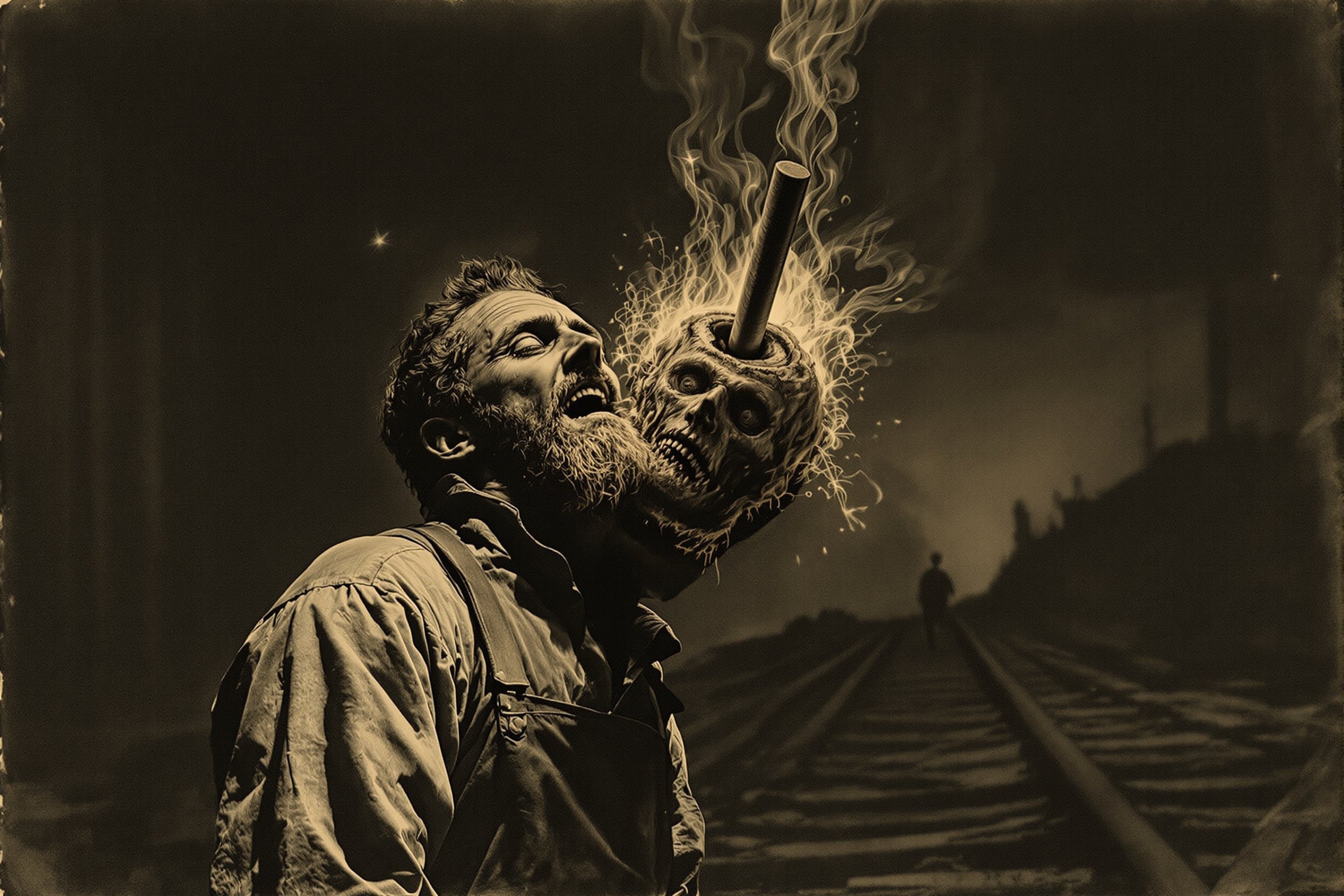
On September 13, 1848, the universe decided to run a controlled experiment on the human brain using a thirteen-pound iron rod, one unlucky foreman, and absolutely zero ethical oversight. [1] The result was not a dead man. It was, improbably, a walking, talking, occasionally profane proof of concept that would rewrite everything physicians thought they understood about personality, cognition, and the squishy three-pound organ responsible for both. Phineas Gage didn't just survive having a railroad spike blasted through his skull. He survived it, recovered from it, changed completely because of it, and then spent the next twelve years being a living argument about the nature of the human soul — all without ever knowing that's what he was doing.
He was twenty-five years old. He was good at his job. He had no idea he was about to become the most famous brain injury in the history of medicine.
Vermont, 1848: The Absolute State of Everything
To understand just how insane this story is, you need to understand the world Phineas Gage was operating in. Not just the literal blasting site outside Cavendish, Vermont — though we'll get there — but the broader intellectual landscape of medicine in 1848, which was, to put it charitably, a work in progress. [4]
Germ theory didn't exist yet. Louis Pasteur was still a young chemist in Paris, and the idea that invisible organisms caused infection was considered fringe lunacy. Anesthesia had only been publicly demonstrated two years earlier, in 1846, when William Morton administered ether at Massachusetts General Hospital to a patient having a neck tumor removed — and even that was still controversial, with plenty of surgeons insisting that pain was spiritually necessary for healing. Antiseptic technique was almost two decades away. Joseph Lister wouldn't publish his work on carbolic acid until 1867. In 1848, if you got a serious wound, your doctor cleaned it with whatever was handy, hoped your constitution was robust, and started mentally drafting your obituary.
The understanding of the brain was, if anything, worse. The dominant framework for understanding personality and cognition wasn't neuroscience — it was phrenology. Developed by Franz Joseph Gall in the early nineteenth century and enthusiastically embraced by people who should have known better, phrenology held that the shape of your skull revealed the contours of your personality. Bumps over your ear meant musical talent. A ridge above your eye meant combativeness. Your forehead's slope determined your intellect. Practitioners charged good money to run their hands over your cranium and tell you things about yourself, which is essentially the nineteenth century's version of a personality quiz that somehow got tenure. [4]
This is what passed for neuroscience. This is the intellectual context into which Phineas Gage's case exploded — literally.
When Phineas Gage was injured, the standard treatments available to his physician included: wound irrigation with water or mild solutions, manual drainage of abscesses, opium for pain, and hope. There were no antibiotics (penicillin was 80 years away), no imaging of any kind, no understanding of sterile technique, and no neurosurgeons — the specialty didn't formally exist. The leading theory of brain function was phrenology. The second leading theory was also wrong. Harlow was working essentially from first principles, and the fact that he kept Gage alive through what followed is itself a minor miracle of nineteenth-century medicine. [2] [4]
Meanwhile, in Vermont, a railroad was being built. The Rutland and Burlington Railroad was pushing through some of the most geologically stubborn terrain in New England, which meant blasting. Lots of blasting. And for blasting, you needed men who knew what they were doing — foremen who could manage crews, read rock faces, and handle explosives with the kind of careful, methodical competence that keeps everyone's limbs attached. [1]
Phineas Gage was that man. By all accounts, he was exceptional at it.
The Tamping Iron: A Love Story That Ends Badly
Let's talk about the instrument of destruction, because it deserves its own moment of horrified appreciation.
The tamping iron was not a little pokey stick. It was forty-three inches long — that's just over three and a half feet — and one and a quarter inches in diameter. It weighed approximately thirteen pounds. [1] [3] One end was blunt; the other was tapered to a point. It had, in fact, been custom-made for Gage himself, which means somewhere there's a blacksmith who spent an afternoon crafting a murder weapon with a man's name on it and had absolutely no idea. The rod is now at Harvard's Warren Museum, where it sits next to Gage's actual skull like the world's most upsetting reunion. [9]
The job of the tamping iron was straightforward: once blasting powder had been poured into a drilled hole in the rock face, and a fuse inserted, sand was poured over the powder to contain the explosion directionally. Then you used the tamping iron to compact it — pushing the sand down firmly around the fuse so the blast would go into the rock rather than back out the hole at you. It's painstaking, repetitive work. You do it dozens of times a day. You get good at it. You stop thinking about the fact that you are manually pressing a metal rod onto a pile of explosive powder with your face approximately eighteen inches away.
On September 13th, 1848, something went wrong. The exact cause has been debated — the most likely explanation is that the sand hadn't been fully poured, or hadn't been poured at all, before Gage began tamping. [1] [4] The iron struck rock. There was a spark. The powder detonated.
The tamping iron became a projectile.
It entered below Gage's left cheekbone, fractured the upper jaw, passed behind the left eye — destroying it completely — and drove upward through the front of his skull, exiting through the top of his head. [1] [3] It traveled in a fraction of a second. It landed, according to witnesses, some distance away — covered in blood and what the clinical literature carefully describes as "cerebral matter," and what everyone else on the worksite described with considerably less restraint.
Bone fragments went in multiple directions. Some lodged in the brain tissue. Some exited with the rod. Some were found later in ways nobody was prepared for.
Phineas Gage fell backward. And then, after a brief period of convulsions, he sat up and started talking.
The tamping iron that passed through Gage's skull was traveling fast enough to land approximately 25-30 meters from the blast site. [3] Modern forensic reconstructions suggest the rod entered at roughly the angle of a slightly upward trajectory through the left frontal lobe, exiting through the superior aspect of the skull. The 2012 PLoS ONE study by Van Horn et al. used diffusion imaging on a digital reconstruction of Gage's skull to estimate that the injury damaged not just the cortical tissue in the path of the rod, but also the white matter connectivity of the frontal lobe — the long-range wiring that connects the prefrontal cortex to the rest of the brain. [6] You can destroy the hardware. Turns out you can also destroy the cables. Either way, the executive function goes offline.
The Part Where He Should Have Died (But Didn't, Annoyingly)
The first physician to reach Gage was Dr. Edward Williams, who found him sitting in an oxcart, upright, conscious, and describing his own injury with the kind of calm that suggests either profound shock, nineteenth-century New England stoicism, or both. [2] Williams later wrote that he initially doubted the story he'd been told — a rod through the skull seemed impossible — until Gage looked at him and said, essentially, here is the hole, here is what happened, do you see it now.
Williams saw it.
"The wound in the top of the head was funnel-shaped, the edges of the bone being everted, and the brain protruding."
— Dr. John Martyn Harlow, 1848 [1]
Dr. John Martyn Harlow took over as the primary treating physician, and his two published accounts of the case — one from 1848 and a far more detailed retrospective from 1868 — are the foundational documents of this entire story. [1] [2] Harlow was not a famous doctor. He was a general practitioner in a small Vermont town who suddenly had the most interesting patient in the history of neurology sitting in front of him leaking brain matter, and he had the presence of mind to document everything. We owe him enormously for that. His 1868 paper in particular reads like a man who spent twenty years processing what he witnessed and finally felt ready to tell the whole story.
What Harlow found on examination was, by any measure, catastrophic. The entry wound had shattered the left cheekbone and upper jaw. The left eye was functionally destroyed — displaced and damaged beyond recovery. The exit wound at the top of the skull was, in Harlow's words, funnel-shaped, with bone edges forced outward, and brain tissue visibly protruding. [1] There were bone fragments throughout the wound. The brain itself was exposed to the open air, to whatever was on Harlow's hands, to whatever was in the environment of a mid-nineteenth-century Vermont examination room, which was not sterile.
Harlow cleaned the wound as best he could. He removed accessible bone fragments. He dressed the injury. He did not have antibiotics. He did not have a sterile field. He did not have a neurosurgeon on call or a CT scanner or an ICP monitor or any of the tools that would make this survivable in a modern trauma bay. He had water, some basic instruments, lint dressings, and the kind of methodical competence that keeps a man functional when he's looking at something that should not exist.
Gage, for his part, walked up a flight of stairs to his room with assistance. That evening, he was still conscious and responsive. He reportedly told people he expected to return to work within a few days.
He was not correct about the timeline. But the confidence was remarkable.
The Infection Chapter, Or: The Nineteenth Century Always Brings Pus
For about a week, things went surprisingly well. Then, as was essentially inevitable given the era and the injury, they went terribly wrong.
Infection set in. [2] The wound became septic. Gage developed fever, delirium, and what Harlow described as fungal-like protrusion — almost certainly herniation of brain tissue through the skull opening, which is a sentence that should not exist in the English language but does, because 1848 was like that. Abscess formation followed. There were collections of pus that required drainage. Harlow performed this manually, cleaning the wound repeatedly, removing infected material, and somehow managing to do enough of the right things that his patient did not die from what would have killed virtually anyone else.
There's a moment in Harlow's 1868 account where he essentially admits that during this phase, he believed Gage would die. [2] The family apparently prepared for it. A coffin was, by some accounts, made ready. Gage was delirious and unresponsive, running a fever that in any modern emergency department would have the team moving fast and talking faster.
And then he turned the corner.
Within weeks, the fever broke. The infection — somehow, improbably — resolved without killing him. The wounds began to heal. The herniated tissue receded or was managed. By late 1848, Phineas Gage was ambulatory, communicative, and physically recovering in ways that his physician found genuinely astonishing. [2]
A 2004 study in the New England Journal of Medicine by Ratiu and Talos used digital reconstruction of Gage's skull to produce high-resolution imaging of the injury. [8] A modern trauma team receiving this patient would: secure the airway immediately, obtain CT head/neck/chest, activate neurosurgery, start broad-spectrum IV antibiotics, administer seizure prophylaxis, place an intracranial pressure monitor, perform surgical debridement of the wound and likely a craniectomy to manage swelling, and admit to a neurosurgical ICU. Survival with aggressive modern management is plausible. Full neurological recovery would not be expected. Harlow did approximately none of these things and still kept the man alive. The nineteenth century occasionally produced extraordinary physicians. It also produced a lot of dead patients, but let's appreciate the wins when we have them.
He Walked Out. He Was Not the Same Man.
By 1849, Phineas Gage was physically recovered enough to leave medical care and attempt to resume his life. The wounds had closed. He could walk, talk, eat, dress himself, and carry on a conversation. His grip strength had returned. He had no obvious motor deficits. The physical healing was, by any reasonable measure, extraordinary.
The problem was everything else.
Dr. Harlow, who had known Gage before the accident and continued to observe him afterward, documented the change in terms that are still quoted in every introductory neuroscience textbook: [2]
"He is fitful, irreverent, indulging at times in the grossest profanity (which was not previously his custom), manifesting but little deference for his fellows, impatient of restraint or advice when it conflicts with his desires, at times pertinaciously obstinate, yet capricious and vacillating, devising many plans of future operation, which are no sooner arranged than they are abandoned... His mind was radically changed, so decidedly that his friends and acquaintances said he was 'no longer Gage.'"
— Dr. John Martyn Harlow, 1868 [2]
No longer Gage. Think about what that means for a moment. The body healed. The brain kept the lights on. But whatever configuration of neural tissue had made Phineas Gage Phineas Gage — the reliable foreman, the competent professional, the man his employers trusted to manage men and explosives — that was gone. Destroyed. Punched out by a thirteen-pound iron rod and scattered across a Vermont rock face.
He couldn't get his old job back. The railroad company that had employed him, by all accounts, declined to rehire him — the man who showed up asking for work was not the man they'd trusted with their blasting operations. [4] He couldn't maintain employment elsewhere, either. He made impulsive decisions. He abandoned plans as quickly as he made them. He was inappropriate in social situations in ways that alienated people who'd known him. He was, by the standards of his time and ours, profoundly changed in the specific domains of executive function, impulse control, and social judgment.
He could tell you what two plus two was. He could tell you the date. He could describe his own accident in coherent sentences. The intelligence was intact, the memory was largely intact, the language was intact. What was gone was the part of him that made good decisions, maintained relationships, and behaved in ways that made sustained employment possible.
He was, in the clinical language that would be developed partly because of him, a case of acquired sociopathy secondary to prefrontal cortex damage. [5] [6]
The Prefrontal Cortex: What It Does and Why You Miss It When It's Gone
The tamping iron destroyed — or more precisely, burned, shredded, and structurally obliterated — the ventromedial prefrontal cortex. [5] This is the region sitting just behind your forehead, roughly where your fingers land when you press them to your temples and pretend you're thinking very hard. It's not the most glamorous part of the brain. It doesn't do anything as obviously impressive as controlling your hand or producing speech. What it does is considerably more subtle and considerably more important: it integrates emotion into decision-making.
The 1994 study by Damasio and colleagues — the one that used computer modeling to reconstruct the rod's trajectory through a surviving cast of Gage's skull — confirmed what Harlow had observed clinically: the primary damage was to the ventromedial prefrontal cortex, bilaterally. [5] The 2012 Van Horn et al. study went further, using diffusion tensor imaging on a digital skull reconstruction to map the white matter damage — the connectivity damage — and found that the injury had disrupted major fasciculi connecting the prefrontal cortex to limbic structures, the basal ganglia, and the rest of the frontal lobe. [6] It wasn't just that the hardware was damaged. The wiring was severed. The prefrontal cortex was, in a very real sense, disconnected from the rest of the system it was supposed to regulate.
Antonio Damasio's somatic marker hypothesis — developed in part as a direct result of studying cases like Gage's — proposes that the ventromedial prefrontal cortex is where emotional signals get attached to decisions. [5] When you're about to do something stupid, there's a feeling that stops you. A visceral sense of wrongness, a gut-level hesitation that functions as a brake. That brake lives, in part, in the ventromedial prefrontal cortex. Without it, you can still reason. You can still understand, abstractly, that a given course of action has consequences. You just can't feel it. And it turns out that feeling is doing a lot of the actual work.
Gage couldn't feel it anymore. The iron took it with it when it left.
Historian Malcolm Macmillan spent years tracing the actual historical record of Phineas Gage's post-injury life and found that the popular narrative had been significantly distorted over time. [4] [7] The most extreme claims — that he became a violent drunk, that he was completely nonfunctional, that he died in poverty — are not well-supported by primary sources. What the evidence actually shows is more nuanced and, in some ways, more interesting: Gage worked as a stagecoach driver in Chile for several years, managed horses competently, and maintained employment in ways that suggest his impairment, while real, was not total. Macmillan's 2008 piece in The Psychologist argues that Gage may have shown some degree of social recovery over time — that the brain, given years and new environments, adapted to some extent. [7] The man was more complicated than the myth. He always is.
The Wandering Years: Stagecoaches, Circus Sideshows, and South America
After the railroad wouldn't take him back, Gage spent a period in New England doing odd jobs, none of which lasted. He appeared for a time at Barnum's American Museum in New York — yes, that Barnum — where he was exhibited as a curiosity, sometimes with his tamping iron, sometimes demonstrating the wounds. [4] This was not considered exploitative in 1849 in the way it would be now. It was considered commerce. Gage apparently participated willingly, which says something about either his agency or his options, and possibly both.
He worked for a time in New Hampshire. He tried farming. He tried various other things. Then, in the early 1850s, he went to Chile, where he spent approximately seven years working as a stagecoach driver in Valparaíso. [4] [7] This is the part of the story that tends to get left out of the textbook version, because it complicates the clean narrative. A man with catastrophic prefrontal damage, managing a team of horses, navigating roads, maintaining a schedule, holding down employment for years in a foreign country. Macmillan's careful historical work suggests this period represents something real — not full recovery, but adaptation. The brain finding new routes around the damage. Neuroplasticity doing what it does, slowly, imperfectly, over years. [7]
He returned to the United States around 1859, his health deteriorating. He moved to San Francisco, where his mother and sister had relocated. He began having seizures — the late, predictable consequence of the scarring and structural damage in his brain. [2] The seizures increased in frequency and severity. On May 21, 1860, approximately twelve years after a tamping iron passed through his skull and the universe decided not to kill him, Phineas Gage died during a prolonged seizure. He was thirty-six years old. [2] [4]
He was buried in San Francisco. No autopsy was performed at the time.
Five years later, Harlow — who had spent nearly two decades thinking about his most famous patient — contacted the family and requested that the skull be exhumed for examination. They agreed. The skull, along with the tamping iron, was sent to Harlow, who then donated both to Harvard Medical School, where they remain today in the Warren Museum of Anatomical Artifacts. [9]
The skull confirmed everything. The damage was exactly as catastrophic as the clinical picture had suggested: massive scarring, significant tissue loss, permanent structural alteration. [2] [8] The entry and exit wounds were still visible. The bone had healed around the insult, grown over the damage, done what bone does — but the evidence of what had happened was preserved in calcium and collagen, waiting for Harlow, waiting for Damasio, waiting for Van Horn, waiting for every neuroscience student who has ever stood in front of that display case and thought, quietly, oh.
What He Actually Gave Us
Here is the thing about Phineas Gage's contribution to neuroscience: it was not what most people think it was.
The popular version says Gage proved that the brain is modular — that different regions do different things — and that this was a revolutionary idea. That's partially true, but it's sloppy. Localization of function had been proposed before Gage. Paul Broca's work on language and the left hemisphere came in 1861, thirteen years after the accident, and was far more rigorously documented. The debate between localizationists and holists had been going on for decades. [4]
What Gage actually gave neuroscience was something more specific and, in retrospect, more important: he demonstrated that the frontal lobes were involved in personality and social behavior in ways that had nothing to do with intelligence, motor function, or sensory processing. He showed that you could lose the most distinctly human aspects of yourself — judgment, empathy, the capacity to make decisions that your future self wouldn't regret — while retaining everything that looked, from the outside, like a functioning person. [5] [6]
That distinction matters enormously. It matters for how we understand what makes us who we are. It matters for how we think about criminal behavior and moral responsibility. It matters for how we approach patients with frontal lobe injuries today — the stroke patients, the TBI patients, the people who come out of the ICU physically intact and behaviorally transformed, whose families sit in conference rooms and say, quietly, that this person isn't who they were before. [5]
Harlow knew it mattered. He wrote his 1868 paper specifically because he'd watched the medical community fail to fully reckon with what his patient represented. [2] He was not a famous man making a famous argument. He was a country doctor saying: I saw something. It meant something. Here it is, twenty years later, and I still think you should pay attention.
Phineas Gage's skull and the tamping iron that passed through it have been at Harvard's Warren Museum of Anatomical Artifacts since the 1860s. [9] The 2004 digital remastering by Ratiu and Talos produced the clearest imaging of the skull's damage ever achieved, allowing precise measurement of the entry and exit wounds and confirmation of the rod's trajectory. [8] The skull shows the healed entry wound below the left orbit and the larger exit wound at the vertex — the bone grown over both, the body's patient, indifferent repair work. The tamping iron is displayed alongside it. The juxtaposition is, depending on your disposition, either deeply moving or deeply unsettling, and probably both. It is the most famous patient-object pairing in medical history, and it sits in a room at Harvard where medical students can look at it and understand, viscerally, what the textbooks are actually talking about.
The Man Behind the Case Study
There's a tendency in medical history to flatten the people into their injuries. Phineas Gage becomes "the tamping iron case," a teaching tool, a proof of concept. Harlow's papers refer to him in clinical language that occasionally obscures the fact that there was a twenty-five-year-old man who woke up one morning in September, went to work, and came home with a hole through his head and a fundamentally different relationship to his own future.
He carried the tamping iron with him for the rest of his life. [4] He brought it to the Barnum exhibit. He kept it when he drove stagecoaches in Chile. It went to San Francisco with him. When he died, his family buried him with it — the rod and the man together — before Harlow later requested the skull alone. The iron ended up at Harvard. Gage ended up in the textbooks.
What he seems to have understood, even with a damaged prefrontal cortex, is that the rod was his story. That whatever he was after the accident was inseparable from what had happened to him. He didn't hide it. He exhibited it. He kept it close. Whether that represents insight or compulsion or something the damaged frontal lobe made inevitable, we can't know. But there's something in it — some quality of acknowledgment, of carrying the thing that broke you rather than pretending it didn't.
He was, by all accounts, not a happy man after 1848. He was impulsive and unreliable and difficult. He lost the career he was good at and the reputation he'd built. He spent years drifting between jobs and continents. He died young, in seizures, in a city far from the Vermont rock face where everything changed.
But he also drove stagecoaches in South America for seven years. He took care of horses. He navigated foreign roads in a foreign country with a brain that had been functionally redesigned by a thirteen-pound iron rod, and he managed. Not well, maybe. Not the way he would have managed before. But he managed.
The brain adapted. Imperfectly, slowly, incompletely — but it adapted. [7] And that, too, is part of what Phineas Gage gave us: not just the evidence of what the frontal lobe does, but the evidence of what the brain does when part of it is gone. It compensates. It reroutes. It finds new ways to keep the lights on, even when the original wiring is scattered across a Vermont hillside.
Why This Story Still Matters, and Why It Always Will
Every year, somewhere in a neuroscience lecture hall, a professor puts up a picture of Phineas Gage — the daguerreotype portrait, the one where he's holding the tamping iron and looking directly at the camera with an expression that is difficult to read — and explains what happened to him. Every year, a new cohort of students encounters the case for the first time and has the same reaction: disbelief, then horror, then something approaching wonder.
Because the Gage case is not really about brain injury. It's about identity. It's about the question that every serious engagement with neuroscience eventually forces you to confront: if the physical structure of your brain determines your personality, your judgment, your behavior, your capacity for empathy and self-control — then what, exactly, is you? What is the self, if it can be altered by a rod moving at high velocity? What is moral responsibility, if the organ responsible for moral reasoning can be damaged or destroyed? What does it mean to be "no longer Gage," if the body that was Gage is still walking around, still talking, still looking out of the same eyes?
These are not questions that medicine has fully answered. They are questions that Phineas Gage, by surviving something unsurvivable, forced medicine to start asking. [4] [5]
His skull is at Harvard. His story is in every introductory neuroscience textbook ever written. His case is cited in papers on decision-making, moral cognition, acquired personality disorders, frontal lobe function, and the philosophy of personal identity. Harlow's 1868 paper has been read by more people than almost any other document in the history of neurology. [2]
And somewhere in a museum at Harvard, the tamping iron sits next to the skull it passed through, and the juxtaposition is either the most eloquent thing in medical history or the most terrible, depending on how you're feeling about the universe on any given day.
Phineas Gage died at thirty-six. The case he became will outlast everything else in this article, everything in this blog, probably everything any of us will ever write. He didn't choose it. He didn't understand it. He just went to work one morning and became, through catastrophic misfortune and the sheer stubbornness of the human body, the man who showed us what we're made of.
Turns out we're made of something that can be changed by a rod. And something that keeps going anyway.
That's the most fucked up part. And also, somehow, the most remarkable.