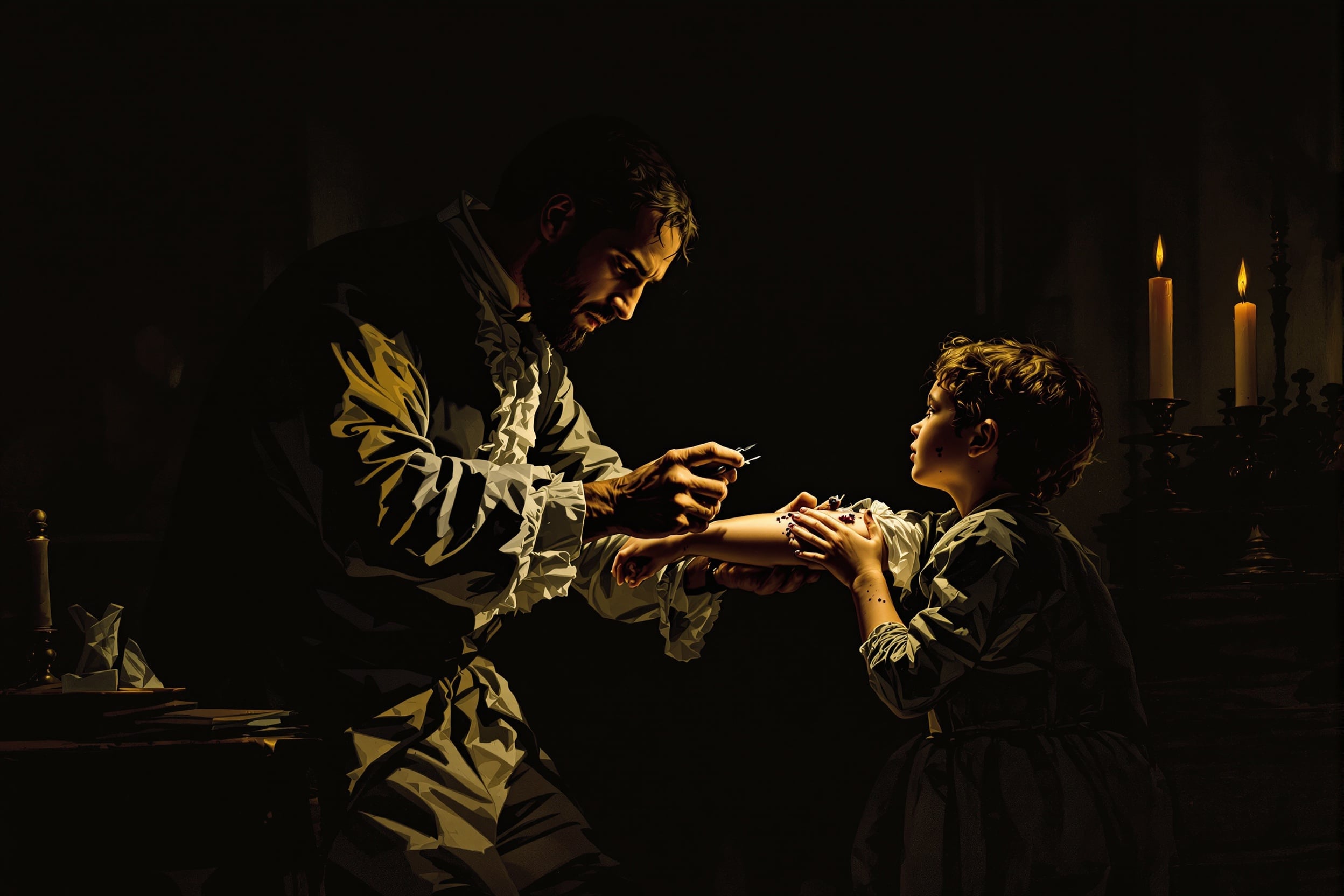
Let's get one thing straight before we begin: smallpox was not a disease that politely requested your presence. It kicked down the door, ate everything in the refrigerator, and left the house on fire. Variola major — the dominant strain — killed roughly 30 percent of everyone it touched, and that number climbs steeply when you're talking about infants, pregnant women, or any population encountering it for the first time [2] [10]. The survivors got off "easy." They just had to live the rest of their lives wearing the evidence — deep, pitted scars cratering the face, clouded eyes, the permanent billboard of a body that had been through something genuinely unspeakable. Historians estimate smallpox killed somewhere between 300 and 500 million people in the twentieth century alone, before eradication [7]. Not in all of human history. In the twentieth century. The one with antibiotics and running water.
So when people in the seventeenth and eighteenth centuries decided the smart play was to deliberately infect themselves with smallpox — to have a doctor scratch infected pus into an open wound in their arm, or to snort powdered scabs up their nose like some kind of plague sommelier — you have to understand: this was not stupidity. This was not the medical equivalent of eating tide pods. This was a calculated, data-driven, frankly ingenious act of desperation from people who understood, with absolute clarity, that the disease was coming for them regardless. The only question was whether they got to pick the terms.
That practice was called variolation. And it worked. Not perfectly, not safely by any standard we'd recognize today, but well enough that people kept doing it for over a century, fought religious wars over it, smuggled it across borders, and used it to inoculate armies. It is one of the most fascinating, most morally complicated, and most genuinely effective acts of pre-modern medicine in human history. It also, occasionally, killed the people it was trying to save.
Welcome to smallpox parties. Bring a dish to share. Leave your immune naivety at the door.
What Smallpox Actually Did to a Human Body (Because You Need to Understand the Stakes)
Before we get to the parties, we need to spend some time with the disease itself, because the sanitized version — "it caused a rash and some people died" — does not adequately prepare you for why rational adults were lining up to have infected material introduced directly into their bloodstream.
Smallpox began, insidiously, like nothing in particular. Fever, headache, backache, the general feeling of having been hit by a horse-drawn carriage. For two to four days, you felt terrible in a completely non-specific way. Then the rash appeared — first in the mouth, the tongue, the throat — and you became infectious before you had any idea what was happening [2]. This is one of the reasons it spread so efficiently. You were already exhaling virus-laden droplets while you still thought you had a cold.
Then the skin lesions arrived. They spread from the face outward, covering the arms, the legs, the palms of the hands and the soles of the feet in a pattern that distinguished it from chickenpox, which clusters on the torso. The lesions progressed through stages — flat spots to raised bumps to fluid-filled vesicles to pustules — and they all progressed together, in lockstep, which is another distinguishing feature and also one of the most horrifying aspects of the disease to witness [10]. Survivors described the pustules as feeling like BBs embedded under the skin. On severe cases, the lesions were so dense they merged, forming sheets of destroyed skin across the face. The smell was reportedly distinctive and nauseating — a sweetish, rotting odor that nurses and physicians who worked smallpox wards described as impossible to forget [7].
In hemorrhagic smallpox — a particularly savage variant — bleeding occurred under the skin and from mucous membranes. The skin turned dark. Patients often died before the characteristic pustules even fully formed, and when they did, the case fatality rate approached 100 percent [2]. Physicians who encountered hemorrhagic cases in the twentieth century, during eradication campaigns, described them in terms usually reserved for war wounds.
For survivors of ordinary smallpox, the aftermath included scarring on roughly 65 to 80 percent of cases severe enough to be permanent and visible [10]. Corneal involvement caused blindness in a significant minority. In pregnant women, smallpox caused miscarriage at catastrophic rates. There were no antivirals. There were no antibiotics to treat the secondary bacterial infections that colonized the open skin lesions. There was no intensive care unit to manage fluid loss or respiratory compromise. There was a bed, a bucket, and whoever loved you enough to stay in the room.
The Actual Numbers, Which Are Genuinely Horrifying
Natural smallpox (Variola major) mortality: ~30% overall; up to 80% in uncontacted populations [2]
Smallpox-related blindness: A leading cause of acquired blindness in 18th-century Europe [7]
Variolation mortality: ~1–3% — roughly 10 to 15 times safer than natural infection [3]
Estimated total smallpox deaths, 20th century alone: 300–500 million [7]
Year of eradication: 1980, certified by the WHO [2]
Current locations of remaining live Variola virus: Two. CDC in Atlanta and VECTOR in Russia. Sleep tight.
This is the context. This is what you were looking at when someone suggested maybe letting a practitioner scratch infected material into your arm wasn't the craziest idea on the table. The alternative wasn't "stay home and probably be fine." The alternative was "smallpox is endemic, you live in a city, and you will almost certainly encounter this disease under conditions you cannot control, probably during an epidemic, when the viral load is high and the nursing care is overwhelmed." Given those options, variolation wasn't recklessness. It was triage logic applied in advance.
China Invented This Centuries Before Europe Admitted It Worked
The Western medical establishment's relationship with variolation follows a depressingly familiar arc: a non-European civilization develops an effective medical practice, Europeans encounter it, Europeans dismiss it as primitive superstition, Europeans eventually adopt it, Europeans take credit for it. We'll be revisiting this theme. Repeatedly.
The earliest documented evidence of deliberate smallpox inoculation comes from China, where the practice appears to have been established by at least the sixteenth century and possibly earlier — some accounts trace it to the reign of the Longqing Emperor in the 1560s, though the evidence for earlier practice is suggestive rather than definitive [4]. Chinese practitioners developed at least two distinct methods. The first involved taking dried scab material from a person recovering from a mild case of smallpox, grinding it to a fine powder, and insufflating it — blowing it — into the nose of the person being inoculated. The right nostril for boys, the left for girls, because medicine has always had opinions about things it has absolutely no reason to have opinions about [4].
The second method involved taking fresh material from a pustule and applying it to cloth, which was then placed inside the nostril. Practitioners understood, in practical if not mechanistic terms, that material from mild cases produced better outcomes than material from severe cases — an empirical observation about viral attenuation that preceded the germ theory of disease by several centuries [4]. This wasn't magic. This was careful observation over generations of practice, the kind of knowledge that accumulates when you are paying attention to outcomes rather than waiting for a theoretical framework to validate what you are seeing.
India had parallel traditions. Brahmin practitioners in Bengal were documented by British physician J.Z. Holwell in 1767, describing a practice of inoculation performed by traveling Brahmin inoculators who worked seasonally, selecting material from mild cases and applying it to multiple superficial scratches on the arms [3]. Holwell's account is remarkable for its specificity and for his genuine respect for the sophistication of what he was observing — unusual, frankly, for a British colonial physician of that era.
The Ottoman Empire had its own well-developed inoculation practice by the early eighteenth century, and this is where our story pivots toward the West, because the conduit was one of the most interesting figures in the entire history of medicine, and she is almost never in the textbooks.
Lady Mary Wortley Montagu: The Woman Who Dragged Britain Into the Eighteenth Century Against Its Will
Lady Mary Wortley Montagu arrived in Constantinople in 1717 as the wife of the British Ambassador to the Ottoman Empire, and she did something that a shocking number of educated Europeans failed to do when encountering Ottoman culture: she paid attention [9]. She spoke the language. She was admitted into spaces closed to male diplomats. And she witnessed something that stopped her cold.
Ottoman women had developed a community-based inoculation practice that was, by the standards of the time, remarkably systematic. Groups of older women — practitioners in every meaningful sense of the word, though they would never have been called physicians — would gather in the autumn, when the weather was cool enough to reduce secondary infection risk. They brought with them nutshells or small vessels containing material collected from mild smallpox cases. They would make a series of small scratches on the arms or legs of the people being inoculated, introduce a small amount of the infected material, bind the wounds, and send everyone home to develop a controlled infection [9].
"The small-pox, so fatal and so general amongst us, is here entirely harmless by the invention of engrafting, which is the term they give it. There is a set of old women who make it their business to perform the operation every autumn, in the month of September, when the great heat is abated... the old woman comes with a nutshell full of the matter of the best sort of small-pox, and asks what veins you please to have opened."
— Lady Mary Wortley Montagu, letter to Sarah Chiswell, April 1, 1717 [9]
Lady Mary had personal reasons to take this seriously that went beyond intellectual curiosity. She had contracted smallpox in 1715, two years before arriving in Constantinople. She survived. Her brother had not. And the disease had left her — a celebrated beauty who moved in circles where appearance was social currency — permanently scarred, with her eyelashes gone and her complexion destroyed [7]. She knew exactly what she was looking at when she saw the Ottoman inoculation practice. She wasn't watching an exotic folk ritual. She was watching a solution.
She had her five-year-old son inoculated in Constantinople in 1718, performed by the Embassy surgeon Charles Maitland with an Ottoman practitioner present [6]. When she returned to England and smallpox epidemic threatened, she had her four-year-old daughter inoculated in 1721 — in front of an audience of royal physicians, because if you want to win an argument with the British medical establishment, apparently the correct move is to use your child as a live demonstration. The physicians were impressed despite themselves. Maitland subsequently inoculated six condemned prisoners at Newgate Prison, with the Crown's permission, in a trial that would today require approximately four hundred ethics board reviews [6]. The prisoners survived and were pardoned. The practice began, slowly, to gain traction.
Lady Mary Wortley Montagu: A Quick Accounting
✦ Lost her brother to smallpox. Survived it herself with permanent scarring. Had her son inoculated at age 5 and her daughter at age 4.
✦ Spent years advocating for variolation against sustained opposition from physicians, clergy, and people who thought deliberately infecting yourself with a deadly disease was playing God. (They weren't entirely wrong. They were just missing the point.)
✦ Received essentially no formal credit in British medical history for the next two centuries. Jenner got a statue. Lady Mary got a footnote. [5]
✦ Is now, correctly, recognized as one of the most important figures in the history of immunization. The footnote situation is being corrected. Slowly.
Onesimus, Cotton Mather, and the Part of the Story American Textbooks Tend to Skip
Across the Atlantic, a parallel and largely independent introduction of variolation was happening in Boston, and it has a far more complicated provenance than the Lady Montagu story — complicated in ways that are important and not flattering to how we typically narrate medical history.
Cotton Mather is the name that appears in most American accounts. Mather was a Puritan minister in Boston, a man of genuine intellectual curiosity operating in a framework of ferocious theological certainty, and he became one of the earliest and most vocal advocates for variolation in the American colonies. During the Boston smallpox epidemic of 1721 — the same year Lady Montagu was demonstrating the practice on her daughter in London — Mather pushed for its adoption over the furious objections of Boston's medical establishment, which was both a genuine public health intervention and a spectacular act of institutional trolling [3].
But here is where the standard account requires significant revision. Mather's knowledge of variolation came substantially from a man named Onesimus, an enslaved African man whom Mather owned. Onesimus had described to Mather, years before the 1721 epidemic, a practice he knew from Africa — he had been inoculated as a child, and he carried the scar to prove it. He described the procedure in enough detail that Mather was able to recognize it when he later encountered accounts from Turkish sources, and to understand that what Onesimus had described and what Ottoman practitioners were doing were versions of the same thing [3] [7].
Mather wrote about Onesimus in his diary, describing him as the source of this critical knowledge. That acknowledgment did not translate into how the history was subsequently told. The story became "Cotton Mather, visionary minister, brought inoculation to America." Onesimus became a footnote, then disappeared from the narrative almost entirely for two centuries. He has been recovered by historians of medicine in recent decades, and his contribution is now increasingly recognized — but the erasure itself is worth sitting with [7]. One of the foundational acts of American public health was made possible by knowledge held by an enslaved man from Africa, knowledge that came from a continent whose medical traditions European practitioners were simultaneously dismissing as primitive.
The physician who actually performed the inoculations in Boston, Zabdiel Boylston, inoculated 247 people during the 1721 epidemic. Six died — a mortality rate of around 2 percent. Of the roughly 5,800 Bostonians who contracted smallpox naturally during the same epidemic, 844 died — a mortality rate of about 14 percent [3]. The numbers were unambiguous. They didn't stop the controversy, because the controversy was never entirely about the numbers.
The Actual Procedure, Which Is As Bad As You're Imagining
Let's talk technique, because the clinical details are both important and genuinely awful, and you came here for both.
The most common European and American method of variolation involved taking material — either fresh pustular fluid or dried scab material — from a person in the active stages of smallpox, ideally someone with a mild case, ideally of the discrete rather than confluent variety [3]. The practitioner would then make one or more incisions or punctures in the skin of the recipient, typically on the arm or leg, and introduce the material directly into the wound. Some practitioners used a lancet dipped in fresh material. Some packed dried material into the incision. Some used thread that had been drawn through a pustule, then threaded through a fold of the recipient's skin — the original slow-release drug delivery system, if your drug is a potentially lethal virus [5].
The recipient would then develop smallpox. Not a simulation of smallpox. Actual smallpox, caused by actual Variola virus, with actual pustules and actual fever and actual infectious potential. The hope — the entire premise of the procedure — was that introducing the virus through the skin rather than through respiratory exposure would produce a milder systemic illness, with fewer lesions, lower fever, and reduced mortality [3]. This hope was largely borne out by practice. Variolated patients typically developed a localized reaction at the inoculation site, then a mild systemic illness with pustules numbering in the dozens rather than the thousands, and then, if everything went according to plan, recovery and lifelong immunity [2].
The Chinese nasal insufflation method — blowing powdered scab material into the nose — worked on a similar principle and appears to have produced comparable outcomes, with practitioners preferring material from mild cases and often aging the material before use, which may have reduced viral virulence, though they had no framework to understand why this helped [4].
How to Variolate Someone (Please Don't)
Step 1: Locate a person with a mild case of smallpox. "Mild" is doing a lot of work here. They still look terrible.
Step 2: Collect material from a mature pustule. Fresh fluid preferred. Dried scab acceptable. Try not to think about what you're holding.
Step 3: Make one or more incisions in your patient's arm. Introduce the material. Options include: lancet dipped in fluid, dried material packed into the wound, or infected thread pulled through a skin fold. [5]
Step 4: Wait. Your patient will develop fever, feel terrible, and erupt in pustules within one to two weeks. This is the plan working.
Step 5: Isolate your patient for the duration, because they now have actual smallpox and can absolutely infect others. This step was not always followed with the rigor it deserved. [3]
Step 6: Approximately 1–3% of the time, your patient dies. This was considered an acceptable outcome. Context is everything.
The recovery period required genuine management. Practitioners who took variolation seriously — and by the mid-eighteenth century there was a substantial literature on best practices [5] — prescribed preparatory regimens before inoculation: dietary restriction, purging, bloodletting (because this was the eighteenth century and no medical procedure was complete without removing some blood), and rest. The post-inoculation period required isolation, careful nursing, and attention to secondary infections, which could turn a mild variolation case into a fatal one. The wealthy could afford all of this. They had physicians, private rooms, servants to provide nursing care, and the economic security to spend three weeks recovering without financial catastrophe [5].
The poor got a scratch and good luck to them.
The Parties: Social Events with a Body Count
The "party" framing isn't entirely metaphorical, though it requires some unpacking. Formal variolation as practiced by physicians was a medical procedure with a recovery protocol. But in communities where the practice was normalized — particularly in parts of New England and in certain English social circles by the mid-eighteenth century — inoculation became a communal event with genuine social dimensions [7].
Families who had decided to variolate their children would sometimes do so collectively, gathering at a household where a mild smallpox case was present, exposing multiple children simultaneously so that the nursing burden and the isolation period could be shared. Parents would bring children to the home of someone currently ill and manage the exposures together — shared beds, shared utensils, the deliberate engineering of transmission that would cause a modern infection control nurse to have a full neurological event. There was, in some accounts, an almost festive quality to the proceedings, at least in the early stages before everyone started getting sick, which is either a testament to human resilience or a very dark commentary on what people can normalize when the alternative is worse [7].
The etiquette, such as it was, involved staying in the house for the duration of the infectious period — roughly two to three weeks — and avoiding contact with people who hadn't been inoculated. This rule was followed with wildly variable conscientiousness. There are documented cases of recently variolated individuals attending church, visiting neighbors, and going about their business while actively shedding Variola virus, which is one of the reasons critics of variolation were not entirely paranoid when they worried about inoculated people seeding outbreaks [3]. They were, in fact, sometimes correct.
This is the part of the variolation story that gets glossed over in the triumphalist version: it was not a clean intervention. Variolated people had real smallpox. They could transmit it. There are documented cases of variolation-associated outbreaks in eighteenth-century England and America, where a chain of transmission began with an inoculated person who did not observe adequate isolation [5]. The practice saved more people than it killed, almost certainly. The math supports it. But the math also includes people who died of smallpox they caught from someone who was variolated, and those people are also real, and their deaths were also caused by variolation, and the ethical accounting is genuinely complicated in ways that the "brave pioneers of immunization" framing doesn't capture.
The Opposition: Not All Idiots, Some Idiots
The resistance to variolation in England and America was fierce, sustained, and came from multiple directions that it's worth disentangling, because the easy narrative — ignorant religious conservatives vs. enlightened men of science — is both inaccurate and, frankly, a little self-congratulatory on the part of history.
The religious objections were real and not entirely stupid. If God sent smallpox as a visitation, deliberately inducing a milder version was, in some theological frameworks, an attempt to subvert divine judgment. Increase Mather — Cotton Mather's father, a man not known for his flexibility — was among those who questioned whether variolation was a form of hubris. This view looks foolish in retrospect, but it was theologically coherent within its own framework, and dismissing everyone who held it as an anti-science troglodyte misses the genuine moral questions about risk imposition that the practice raised [7].
The medical opposition was more interesting. Many physicians objected not to the principle of variolation but to the practice — specifically, to the fact that variolated patients could and did transmit smallpox to unvaccinated people who had not consented to the risk. This is not a crazy concern. It is, in fact, the same concern that drives modern infectious disease policy around isolation and quarantine. The physicians who raised it were not wrong about the mechanism. They were wrong about the conclusion — that the risk of transmission outweighed the benefit of immunization — but the concern itself was legitimate [3] [5].
There was also straightforward professional jealousy, which is a constant in medical history and requires no further analysis. And there was the class dimension: variolation was expensive, and the people most vigorously promoting it were wealthy, which made it easy to frame as a luxury procedure that the elite were foisting on a skeptical public without bearing the costs themselves. This framing was not entirely unfair. The wealthy got inoculated by trained physicians with proper preparation and nursing care. Servants and laborers, if they were inoculated at all, often got a scratch and were sent back to work. The mortality rates were probably not equal across those groups, though the data to prove it is fragmentary [5].
The Royal Endorsement That Changed Everything (And the Orphans Nobody Mentions)
The turning point in Britain came in 1721 and 1722, when the practice received royal attention in the most eighteenth-century way possible: a series of escalating human experiments that would today result in criminal charges but which, at the time, were considered perfectly reasonable due diligence.
Following the success of the Newgate prisoner trial, Maitland inoculated seven charity children at the parish of St. James's, again under observation from royal physicians [6]. The children survived. The physicians were cautiously impressed. Caroline, Princess of Wales — a woman of genuine intellectual curiosity who corresponded with Leibniz and took medicine seriously — then arranged for her own children to be variolated, after the prisoners and the charity children had demonstrated the procedure's relative safety [5]. The sequencing here is worth noting: first the condemned, then the orphans and charity cases, then the royal children. The social hierarchy of acceptable experimental risk, laid out in perfect historical clarity.
Royal endorsement transformed the practice's social acceptability among the British upper class almost overnight. By the 1740s and 1750s, variolation was sufficiently mainstream among the English gentry that it was discussed in correspondence the way we might discuss a medical procedure today — with opinions about which practitioners were best, which preparatory regimens worked, and what to expect during recovery [5]. The Sutton family — a father and son team of inoculators operating in the 1760s — claimed to have inoculated nearly 300,000 people with a mortality rate under one percent, using a modified technique that involved smaller incisions, less preparatory purging, and fresh rather than dried material [3]. Whether those numbers are precise is debatable. That the Suttons made variolation faster, cheaper, and safer than the standard practice of the time is not.
The Sutton Method: Eighteenth-Century Inoculation Gets Its First Franchise
Robert Sutton and his son Daniel operated what was effectively the first commercial inoculation network in England in the 1760s. Their innovations — smaller inoculation wounds, fresher material, less aggressive pre-treatment, outdoor exercise during recovery — produced measurably better outcomes than the standard method. [3]
Daniel Sutton alone claimed to have inoculated over 40,000 people. The family was wealthy, secretive about their technique, and widely resented by the medical establishment. So, basically: they invented the medical startup, complete with trade secrets and institutional hostility.
In the American colonies, variolation became a military necessity. George Washington ordered the Continental Army variolated in 1777, after smallpox devastated his forces during the siege of Boston and the disastrous Canadian campaign [7]. This was a genuinely bold decision — the practice was still controversial, the logistics of inoculating an entire army were formidable, and the risk of variolation-associated outbreaks in camp was real. It was also probably one of the most consequential public health decisions in American military history. The Continental Army's smallpox problem was severe enough to threaten the Revolution itself. Washington's mass variolation order addressed it [7].
Edward Jenner and the Cowpox Upgrade
In 1796, Edward Jenner did something that variolation had always been trying to do, but hadn't quite managed: he found a way to produce immunity to smallpox without using smallpox [1] [8].
The observation that milkmaids who contracted cowpox seemed to be protected from smallpox was not original to Jenner — it was folk knowledge in the English countryside, and at least one other practitioner, Benjamin Jesty, had acted on it years earlier by inoculating his family with cowpox material in 1774 [1]. What Jenner did was test the hypothesis systematically, document it rigorously, and publish it in a form that the medical establishment could engage with — even if the engagement initially consisted largely of rejection [8].
His famous experiment involved inoculating eight-year-old James Phipps with material from a cowpox lesion on the hand of a milkmaid named Sarah Nelmes, then, six weeks later, inoculating Phipps with actual smallpox material [8]. Phipps did not develop smallpox. Jenner repeated the challenge multiple times over the following years. Phipps remained immune. The experiment worked. It also involved repeatedly exposing a child to a lethal disease without his meaningful consent, which is the part of the Jenner story that tends to get omitted from the hagiographic versions, but which is worth acknowledging if we're being honest about the ethics of medical history.
Vaccination — from vacca, Latin for cow, a naming convention that delighted Jenner's critics and gave satirists material for years — spread rapidly after the publication of Jenner's Inquiry in 1798 [8]. The advantages over variolation were obvious: cowpox was not smallpox, vaccinated individuals did not develop transmissible smallpox, the procedure was safer, and the recovery was less debilitating [1]. Variolation didn't disappear immediately — habits of practice, especially in communities where variolation was deeply embedded, die hard — but it faded over the following decades as vaccination became available and as legislation in Britain and elsewhere began to restrict and eventually prohibit variolation [5].
The last known case of naturally occurring smallpox was in Somalia in 1977. In 1980, the World Health Organization certified the global eradication of smallpox — the only human infectious disease ever to be deliberately driven to extinction [2]. The chain of causation runs, improbably but directly, from an Ottoman woman with a nutshell of infected material, through an enslaved man in Boston describing the medical knowledge of his homeland, through a scarred English aristocrat willing to infect her own children in front of skeptical physicians, through a country doctor in Gloucestershire watching a milkmaid's hands, to one of the greatest public health achievements in human history.
What the Smallpox Parties Actually Tell Us
Here is what I want you to take away from this, beyond the visceral satisfaction of knowing that people once blew ground-up scabs into their own noses for medical purposes.
Variolation was not the product of ignorance. It was the product of careful observation, accumulated over generations, in multiple cultures simultaneously, about how immunity worked — long before anyone had the conceptual vocabulary of germ theory, viruses, or adaptive immune responses. The Ottoman women with their nutshells, the Brahmin inoculators traveling the Bengali countryside, the Chinese practitioners selecting material from mild cases and aging it before use: these were people doing rigorous empirical medicine without the theoretical framework that we now use to explain why it worked. The framework came later. The observation came first [4] [3].
It was also not the product of a single heroic individual, which is