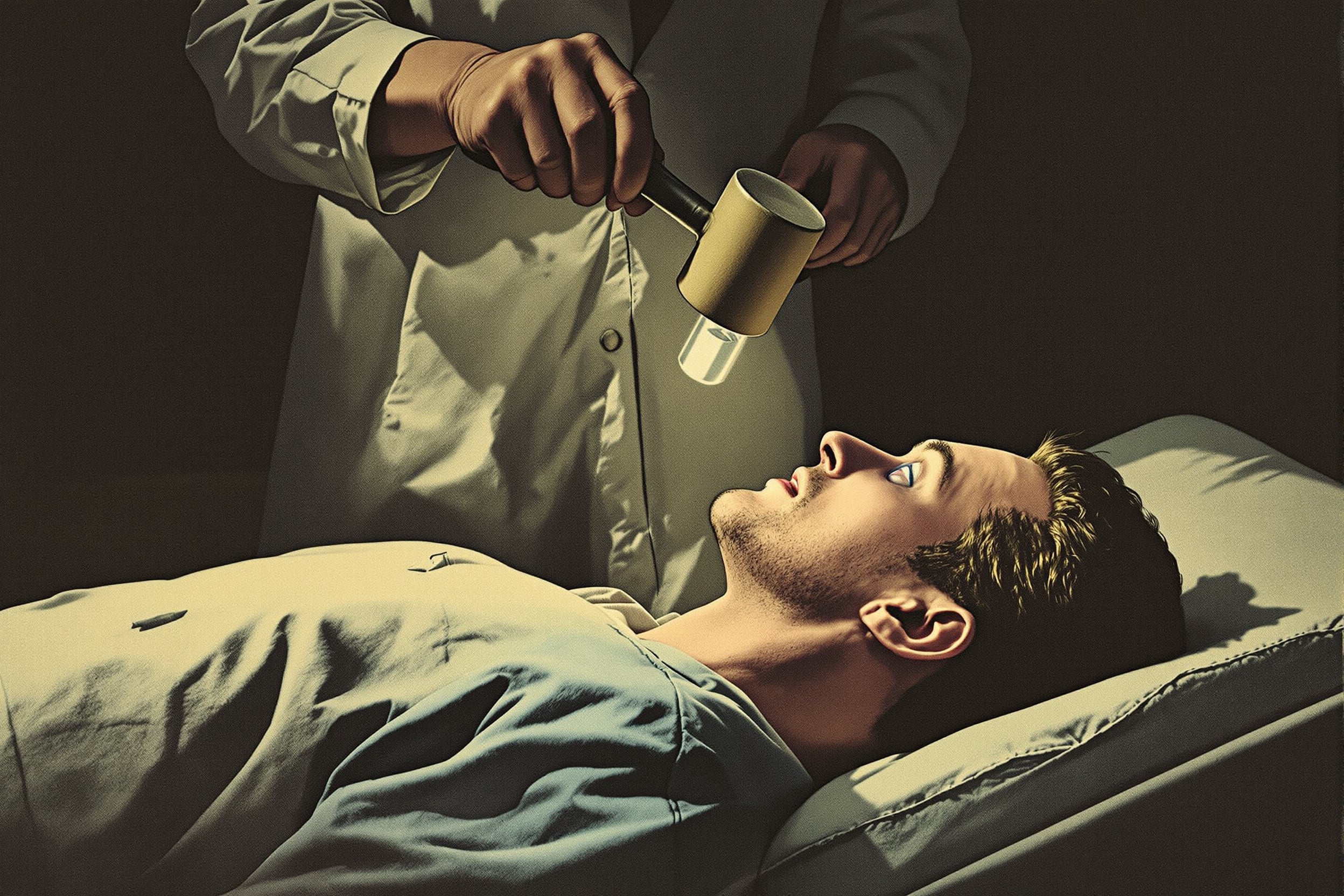
The lobotomy is the Mount Everest of medical fuckups. Not because it was the bloodiest procedure in history, not because it killed the most people outright, but because it represents something far more unsettling than simple butchery: it was celebrated. Championed. Awarded. Doctors gave speeches about it at conferences. Families wept with gratitude. A man won a Nobel Prize for it. And the whole time, surgeons were taking an instrument that looked like an ice pick, sliding it under a patient's eyelid, punching it through the thin bone of the eye socket with a hammer, and wiggling it around inside the frontal lobes of a living human brain. For depression. For anxiety. For being a difficult woman. For being gay. For being, in the clinical parlance of mid-century American psychiatry, a problem.
Tens of thousands of people had this done to them. [4] Many of them were not incapacitated before the surgery. Many of them were afterward. And the medical establishment looked at the results — the blank stares, the incontinence, the personality-erased husks of people who used to laugh and plan and argue — and said, essentially, good enough. This is the story of how that happened. Buckle up, because it's going to get worse before it gets worse.
Psychiatry in the 1930s: A Menu of Bad Options
To understand how lobotomy became a thing, you need to understand what psychiatry looked like before it. And the answer is: bleak. Genuinely, structurally, institutionally bleak in a way that makes modern psychiatric care look like a spa weekend by comparison. [8]
If you were severely mentally ill in 1930s America or Europe, your options were roughly as follows. Option one: a state asylum, which by the 1930s was so catastrophically overcrowded that the average patient-to-staff ratio made the word "care" feel like a cruel joke. American state hospitals were warehousing hundreds of thousands of patients in facilities built for a fraction of that number. [4] Patients slept in hallways. Violence was common. Restraints were routine. The smell — and contemporary accounts do mention the smell — was apparently something that never quite left the people who worked there.
Option two: insulin coma therapy, introduced in 1933 by Manfred Sakel, which involved deliberately inducing hypoglycemic coma in schizophrenic patients by injecting large doses of insulin. Repeatedly. The theory was that the coma somehow reset the brain. The evidence was, to put it generously, anecdotal. Patients occasionally died. Some improved. Nobody was entirely sure why anything happened. [8]
Option three: Metrazol convulsive therapy, where doctors injected a drug called Metrazol to induce grand mal seizures. Patients described the experience as a sensation of impending death so intense that many begged not to have it done again. The seizures were so violent that vertebral compression fractures were a known complication. Medicine looked at "we are accidentally breaking patients' spines" and classified that as an acceptable side effect profile. [8]
Option four: electroconvulsive therapy, introduced in 1938, which at least didn't involve injecting terror-chemicals. Early ECT was administered without anesthesia or muscle relaxants, so patients seized fully and violently, and the fractures continued. It would eventually be refined into something genuinely useful. In 1938, it was not that yet.
There were no antipsychotics. There were no antidepressants. Chlorpromazine — the drug that would eventually empty the asylums — wouldn't arrive until 1952. [8] So when a Portuguese neurologist stood up in 1935 and said he had a surgical solution for mental illness, people in desperate institutions with chained patients and no budget listened. They listened very, very hard.
By the late 1940s, American state psychiatric hospitals held over 400,000 patients — nearly double their intended capacity. Staff ratios at some facilities ran as high as 1 nurse to 200 patients on night shifts. In that context, a 10-minute procedure that made patients "manageable" wasn't just attractive. It was, to administrators watching people deteriorate in hallways, something close to salvation. [4] [8]
Egas Moniz: The Man Who Won a Nobel Prize for Brain Damage
António Egas Moniz was not a hack. That's what makes this so complicated. He was a distinguished Portuguese neurologist and politician — he'd helped negotiate the Treaty of Versailles, which is either impressive context or evidence that he was comfortable making decisions with catastrophic long-term consequences — and he was a genuine intellectual who had made real contributions to neuroscience. He developed cerebral angiography, a technique for imaging blood vessels in the brain, which was legitimately important and is still the basis of modern cerebrovascular imaging. [5] The man could do real science. He just also believed he could cure mental illness by destroying parts of the brain, which is where things went sideways.
Moniz's theoretical framework, such as it was, held that certain mental illnesses — severe depression, obsessive states, psychosis — were caused by fixed, pathological neural circuits in the prefrontal cortex. If you could interrupt those circuits, you might relieve the symptoms. It wasn't completely insane as a hypothesis. The prefrontal cortex is deeply involved in emotional regulation, rumination, and the kind of locked, recursive thinking that characterizes severe OCD and depression. The problem was that Moniz's solution to "bad circuits in the prefrontal cortex" was "destroy the prefrontal cortex," which is a bit like fixing a car's faulty GPS by removing the dashboard. [1]
Working with his surgical colleague Almeida Lima — because Moniz himself had severe gout that made his hands shake too badly to operate, a detail that should perhaps have given everyone pause — he introduced prefrontal leucotomy in 1935. The original procedure involved drilling burr holes in the skull, then either injecting absolute alcohol directly into the frontal white matter to destroy it, or using a custom instrument called a leucotome: a cannula with a retractable wire loop that could be rotated to cut circular cores of white matter. [1] [9]
The early results, as reported by Moniz, were striking. Patients with severe agitation became calm. Patients consumed by obsessive thoughts seemed quieter, less tortured. He published his initial findings in 1936, reporting on twenty cases with what he characterized as significant improvement in the majority. [1] What those reports did not adequately capture — what the follow-up did not adequately measure — was what had been taken away. Patients weren't just less anxious. They were less everything. Less spontaneous, less curious, less emotionally present, less themselves. They had traded their suffering for a kind of permanent, affectless calm that was not recovery. It was subtraction. [5]
Critics said so. There were neurologists and psychiatrists at the time who looked at the methodology — no control groups, inconsistent follow-up, outcomes defined almost entirely by whether the patient was easier to manage — and called it what it was: weak evidence for a drastic and irreversible intervention. [5] They were largely ignored. In 1949, Egas Moniz won the Nobel Prize in Physiology or Medicine "for his discovery of the therapeutic value of leucotomy in certain psychoses." [6]
Let that sentence sit for a moment. The Nobel Prize. For cutting up brains to make people compliant.
"The therapeutic results are encouraging and we believe that frontal leucotomy, carried out by a surgeon with sufficient experience, deserves to be tried when other methods have failed." — Egas Moniz, 1936 [1]
"When other methods have failed" was doing a lot of heavy lifting in that sentence. Within a decade, "other methods have failed" had been quietly expanded to mean "we've tried this for a few weeks and the patient is still inconvenient."
Walter Freeman: American Medicine's Most Enthusiastic Monster
Enter Walter Freeman. If Moniz was the reluctant architect of prefrontal leucotomy — a man who at least had academic credentials, a surgical partner, and an operating room — Freeman was what happened when you took that idea, removed all the friction, and handed it to someone with the energy of a pharmaceutical rep and the ethical guardrails of a carnival barker.
Freeman was a neurologist, not a neurosurgeon. [3] This is not a minor distinction. Neurologists diagnose conditions of the nervous system. Neurosurgeons cut into them. The difference is roughly analogous to a cardiologist deciding to perform open-heart surgery because he's read a lot about it and feels confident. Freeman had partnered with neurosurgeon James Watts to perform standard prefrontal lobotomies in the United States starting in 1936, following Moniz's technique. [2] Watts was the one with surgical training. Watts was the one who could actually operate. And Watts, eventually, would be the one who quit in disgust.
But Freeman was the one who wanted to scale this. He was charismatic, media-savvy, and possessed of a missionary's absolute conviction that he was changing psychiatry forever. He wasn't wrong about the "changing" part. He was catastrophically wrong about the "for the better" part. [3]
His problem with standard lobotomy was its inconvenience. It required an operating room. It required a neurosurgeon. It required general anesthesia and a sterile field and all the infrastructure of a proper surgical procedure. Freeman wanted something faster, cheaper, and deployable anywhere — including, as it turned out, hotel ballrooms and state hospital corridors. [3] [5]
Entry point: Under the upper eyelid, above the eyeball, through the orbital roof (a paper-thin bone at the top of the eye socket)
Instrument: An orbitoclast — essentially an ice pick, sometimes literally a repurposed household ice pick in early experiments [3]
Anesthesia: Electroconvulsive shock to render the patient briefly unconscious, or occasionally just local anesthetic, or occasionally nothing
Technique: Insert instrument, advance into frontal lobe, sweep laterally to sever white matter connections
Duration: Approximately 10 minutes per side
Setting: Operating room, outpatient office, state hospital ward, hotel conference room
Indications: Depression, schizophrenia, anxiety, OCD, "intractable pain," homosexuality, general "difficult behavior"
What Freeman called it: A revolution in psychiatric care
What it was: Brain damage, administered at scale
In 1945, inspired in part by an earlier Italian transorbital technique developed by Amarro Fiamberti, Freeman developed his version of the procedure. [3] He practiced on cadavers first, then — and this is a detail that will live rent-free in your head — reportedly practiced on fruit, specifically a grapefruit, to get the feel of the instrument penetrating the orbital roof. The distance from "practicing on a grapefruit" to "performing this on a living human being" was, for Freeman, apparently a short and untroubled walk.
The instrument he used was called an orbitoclast. In early experiments, he used an actual household ice pick. [3] The procedure worked like this: the patient was rendered unconscious, usually with electroconvulsive shock — not therapeutic ECT as we understand it now, but a jolt of electricity sufficient to produce a brief seizure and a few minutes of unconsciousness. Freeman would then lift the upper eyelid, insert the orbitoclast into the conjunctival fold above the eyeball, and tap it upward with a mallet until it penetrated the orbital roof. The bone there is thin — about the consistency of an eggshell, by several accounts — and it gave way with what witnesses variously described as a crunch or a pop. The instrument would then be advanced approximately five centimeters into the frontal lobe and swept in a lateral arc, severing the white matter connections between the prefrontal cortex and the thalamus. Both sides. Ten minutes. Done. [2] [3]
Watts, his neurosurgeon partner, was horrified. He thought the procedure was reckless, unsanitary, and being performed by someone with no surgical training in settings with no surgical infrastructure. He was correct on all counts. He quit the partnership. Freeman continued without him. [3]
The Roadshow: Freeman Takes His Ice Pick on Tour
What Freeman did next is where this story transitions from "tragic medical history" to something that feels more like a fever dream. He took the procedure on the road.
Freeman traveled the United States in a vehicle he called his "lobotomobile" — a camper van — visiting state psychiatric hospitals and performing transorbital lobotomies in bulk. [3] He would arrive, assess patients he'd never met before, and operate on them, sometimes dozens in a single day. He performed lobotomies in hospital wards, in outpatient offices, in front of audiences of medical students and hospital staff. He liked audiences. He was a showman in the most profoundly unsettling sense of that word.
Photographs from these sessions exist. Freeman, often without a surgical gown or mask, leaning over a conscious or semi-conscious patient, both hands on the orbitoclast, a look of focused satisfaction on his face. Onlookers in the background. Sometimes a camera on a tripod, because Freeman documented his work extensively and saw himself as a figure for posterity. [3] He was right about that, at least, though perhaps not in the way he imagined.
His speed increased over time. By the late 1940s and early 1950s, Freeman was performing transorbital lobotomies in under ten minutes per patient. At West Virginia's Lakin Hospital in 1952, he reportedly performed 228 lobotomies in twelve days. [3] [5] That is not a typo. Two hundred and twenty-eight people. Twelve days. An assembly line of brain damage moving through wards of a state hospital, and Freeman at the center of it, mallet in hand, utterly convinced he was doing good.
"It seemed to me that the greatest service I could render to humanity was to rid the world of mental illness." — Walter Freeman [3]
The mortality rate from the procedure was not trivial. Freeman's own data showed roughly 1-3% of patients died from the surgery itself — from hemorrhage, from infection, from seizures. [3] At the scale he was operating, that means dozens of people died directly on or shortly after his table. Among the survivors, the outcomes ranged from "somewhat calmer but recognizably themselves" to "completely transformed into a dependent, incontinent, personality-erased stranger." [5] Freeman tracked the former and was less meticulous about the latter.
Over his career, Walter Freeman performed or directly supervised approximately 3,500 lobotomies. [3] He continued performing the procedure until 1967, when his final patient died of a cerebral hemorrhage — his third operation on the same person. That death finally resulted in his hospital privileges being revoked. He was 72 years old. He did not, by any available account, believe he had done anything wrong. [3] [5]
What Was Actually Happening in the Brain
Here's the neuroanatomy, because understanding what was being destroyed makes this considerably more horrifying than the abstract phrase "brain damage" conveys.
The prefrontal cortex — specifically the white matter connections between it and subcortical structures, particularly the thalamus and the cingulate cortex — is not some redundant backup system you can excise without consequences. It is, in a very literal sense, the seat of executive function: the capacity to plan, to inhibit impulses, to hold multiple things in working memory simultaneously, to regulate emotion, to maintain a coherent sense of self across time. [9] It is the part of the brain that makes you a person with a future rather than just a creature responding to the present moment.
When Freeman swept his orbitoclast through that territory, he wasn't selectively eliminating the pathological circuits Moniz had theorized. He was destroying tissue indiscriminately. The sweep of the instrument through white matter didn't distinguish between the connections involved in depressive rumination and the connections involved in personality, judgment, and will. It severed them all. [9] [10]
The post-lobotomy syndrome that resulted was consistent enough that it had recognizable features. Patients became apathetic, blunted, disinhibited in some cases and robotically compliant in others. They lost initiative — the spontaneous drive to start tasks, to pursue goals, to care about outcomes. They lost the capacity for the kind of sustained, directed attention that complex work requires. Many became incontinent, either permanently or for extended periods, because the frontal lobes are also involved in the voluntary suppression of bladder and bowel urges. Some developed seizure disorders. [9] Many gained significant weight, because the hypothalamic connections disrupted by the procedure affected appetite regulation. [10]
And their families, in many cases, called this a success. Because the person had stopped screaming. Stopped pacing. Stopped being, in the language of the time, difficult. The suffering was gone, yes. So was the person. Medicine looked at that trade and, for nearly two decades, decided it was acceptable. [5]
Rosemary Kennedy: What a Family Secret Actually Looks Like
In November 1941, Walter Freeman and James Watts performed a transorbital lobotomy on a 23-year-old woman named Rosemary Kennedy. [7] She was the third child of Joseph P. Kennedy Sr. and Rose Kennedy. She was the sister of the future President of the United States. And she had no idea what was about to happen to her.
Rosemary had a mild intellectual disability — the result, likely, of oxygen deprivation at birth when a nurse held her in the birth canal for two hours waiting for the obstetrician to arrive. [7] She had grown into a young woman who struggled with reading and writing, who sometimes had mood episodes and behavioral outbursts that her family found increasingly difficult to manage as she got older. She was not severely incapacitated. She could walk, talk, socialize, dance. She had a life, such as it was under the suffocating control of her father.
Joseph Kennedy Sr. authorized the lobotomy without telling his wife or his other children. His stated concern was Rosemary's behavioral instability and the risk that her condition might become public in ways that would damage the family's political ambitions. [7] Freeman and Watts performed the procedure while Rosemary was conscious and sedated, asking her to sing songs and recite the Lord's Prayer so they could monitor her verbal function. At some point during the procedure, she stopped responding coherently. They continued. [3] [7]
The result was catastrophic. Rosemary Kennedy went from a young woman with a mild disability and an active, if difficult, life to someone who could not speak in sentences, could not walk without assistance, was incontinent, and required full institutional care. She spent the next sixty-four years of her life in a facility in Wisconsin, largely cut off from her family. Her father did not visit her. Her mother did not learn the full truth of what had happened to her for years. [7]
She died in 2005, at the age of 86. She had been institutionalized for 64 years. She had outlived the brother whose political career her father had been protecting when he had her lobotomized. [7]
Rosemary Kennedy's case is famous because of who her family was. But the horror of what happened to her was not unusual. It was, statistically speaking, a routine outcome. The only thing unusual about Rosemary was that someone eventually wrote a book about her. [7] The thousands of other Rosemarys — the women in state hospitals, the veterans with PTSD, the gay men and women whose families wanted them "fixed," the children — they don't have biographies. They have case numbers.
The patient population for lobotomy was not limited to people with severe, intractable psychosis. Studies of the era's records show patients lobotomized for: depression, anxiety, obsessive-compulsive disorder, schizophrenia, "homosexuality," "chronic headache," "intractable pain," "aggressiveness," "hysteria," and — in children — behavioral problems and intellectual disability. [4] [5] Women were lobotomized at significantly higher rates than men. Some estimates suggest women made up approximately 60% of lobotomy patients in the United States. [4] The procedure was, among other things, a remarkably efficient tool for managing inconvenient people.
The Medical Establishment Congratulates Itself
The thing that distinguishes the lobotomy era from ordinary medical incompetence is the degree to which it was institutionally celebrated while the damage was being done. This wasn't a fringe practice being conducted in secret by rogue practitioners. It was mainstream. It was published in major journals. It was taught in medical schools. And it was rewarded with the highest honors medicine could offer. [6]
Freeman published extensively. His 1942 book with Watts, Psychosurgery: Intelligence, Emotion and Social Behavior Following Prefrontal Lobotomy for Mental Disorders, was considered a serious academic work. [2] He presented at conferences. He cultivated relationships with hospital superintendents across the country, who were desperate enough for anything that worked — or appeared to work — that they welcomed him with open wards and cooperative patient populations.
The popular press was enthusiastic. The New York Times ran largely favorable coverage of lobotomy in the 1940s. Freeman was profiled as a pioneer. Families who had watched their relatives transformed into quiet, blunted versions of themselves gave testimonials about how much better things were now. And in the narrow, terrible sense that the person was no longer in visible distress, they weren't wrong. They just had no framework for understanding what had been taken. [5]
Psychiatric hospitals reported dramatic reductions in patient violence and restraint use post-lobotomy. Administrators pointed to these numbers as evidence of success. What the numbers didn't capture was the quality of the life remaining. They didn't capture the patient who used to paint and now sat in a chair. The patient who used to argue about politics and now couldn't follow a conversation. The patient who used to be difficult and was now, in every meaningful sense, gone. [4] [5]
And then there's the Nobel Prize. In 1949, the Nobel Committee awarded Egas Moniz the Prize in Physiology or Medicine for leucotomy. [6] By 1949, there was already substantial evidence of serious harm. The post-lobotomy syndrome was documented. Critics had published. The methodology of Moniz's original research had been attacked. None of this mattered to the committee. The prize stands to this day — the Nobel Foundation has declined multiple petitions to revoke it — as perhaps the most prestigious endorsement of a catastrophic medical error in history.
The Decline: When a Pill Rendered a Hammer Obsolete
The lobotomy era didn't end because medicine developed a conscience. It ended because medicine developed chlorpromazine.
In 1952, a French surgeon named Henri Laborit noticed that a new antihistamine compound had an unusual effect on his surgical patients: it made them profoundly indifferent to their upcoming operations without sedating them into unconsciousness. He thought this might be useful in psychiatry. He was correct. Chlorpromazine — marketed as Thorazine in the United States — was introduced to psychiatric practice in 1954, and within a few years it had transformed the landscape entirely. [8]
Suddenly, there was a pill that could reduce psychotic symptoms, calm agitation, and manage the acute presentations that had previously seemed to require surgical intervention. It wasn't a cure. It had its own serious side effects — tardive dyskinesia, among others, would become a significant problem. But it was reversible. You could stop taking it. You couldn't un-lobotomize yourself. [8] [10]
As antipsychotics proliferated through the late 1950s and early 1960s, lobotomy rates dropped sharply. [10] Not because anyone stood up and said "we have been systematically brain-damaging people and we need to stop." But because there was now an easier option. The market for brain surgery dried up when a tablet could do the job without requiring a mallet and an ice pick.
Freeman continued. He performed his last lobotomy in 1967. [3] His patient, a woman named Helen Mortensen who had been lobotomized by Freeman twice before, died of a cerebral hemorrhage. It was her third lobotomy. Freeman's hospital privileges were revoked. He spent his final years traveling the country trying to track down former patients who would testify to his good work, collecting success stories like a man assembling evidence for his own defense. He died in 1972, still believing. [3]
Estimates of the total number of lobotomies performed in the United States between 1936 and the early 1970s range from 40,000 to 50,000. [4] [9] Globally, including the United Kingdom, Scandinavia, and other countries where the procedure was adopted, the total likely exceeds 100,000. The United Kingdom performed approximately 10,000 leucotomies. The Soviet Union initially adopted the procedure, then banned it in 1950 on ideological grounds — the irony being that the USSR's ban on lobotomy was one of the more defensible medical policy decisions of the 20th century, even if the reasoning was political rather than ethical. [5]
What the Survivors Carried
The people who survived their lobotomies didn't get a press release. There was no formal reckoning, no compensation, no systematic effort to find them and document what had happened to them. Many lived out their lives in institutions. Some were eventually discharged as the deinstitutionalization movement of the 1960s and 70s emptied state hospitals — often into homelessness or inadequate community care, which is its own catastrophe — but they carried the permanent neurological consequences of what had been done to them. [4]
Howard Dully was lobotomized by Freeman at the age of twelve. Twelve years old. His stepmother had complained that he was "defiant" and didn't appreciate her. Freeman performed the transorbital lobotomy in 1960. [3] Dully spent decades not fully understanding what had happened to him, passing through institutions and homelessness and confusion about why he felt different, why things were hard in ways he couldn't name. He eventually recorded an audio documentary for NPR in 2005, at age 56, in which he tried to reconstruct the story of what Freeman had done to him and why. He described feeling, for most of his life, like something was missing — that he was somehow less than he should have been — without being able to identify what it was. He was right. Something had been taken. He was twelve years old when Walter Freeman took it. [3]
His case is documented. Most aren't. The archive of lobotomy survivors is largely silent, because many of them lost the capacity to tell their stories, and because the medical establishment that harmed them had very little incentive to go looking for evidence of the harm.
The Reckoning That Never Quite Arrived
By the 1970s, the medical establishment had arrived at something like shame about the lobotomy era. Psychosurgery became heavily regulated. The National Commission for the Protection of Human Subjects of Biomedical and Behavioral Research, established in the wake of the Tuskegee revelations, examined psychosurgery specifically and recommended strict oversight. [10] Freeman's reputation, which had survived longer than it deserved, was largely destroyed. Moniz's Nobel Prize became the cautionary example it remains today.
But "shame" is not the same as accountability. No one was prosecuted. No one lost their medical license specifically for lobotomy. Freeman's hospital privileges were revoked only when his last patient died — not because of the decades of harm before that. The families who had authorized lobotomies for their relatives without those relatives' consent faced no legal consequences. The Nobel Foundation kept the prize. [6]
What medicine did instead was incorporate the lobotomy into its teaching as a lesson in ethics — a historical atrocity safely in the past, useful for illustrating the dangers of insufficient evidence and unchecked enthusiasm. Which is appropriate. Except that framing also tends to imply that we have now solved the problem of smart, credentialed, well-intentioned people doing catastrophic things with insufficient evidence. We have not solved that problem. We have never solved that problem. The lobotomy is not an anomaly in the history of medicine. It is a point on a curve. [5] [10]
The same dynamic — desperate patients, inadequate alternatives, charismatic advocates, weak evidence, institutional incentives to call "calmer" the same as "better" — has appeared before lobotomy and after it. It will appear again. The specific instrument changes. The orbital roof is no longer the entry point. But the structure of the error, the way medicine can convince itself that a drastic and irreversible intervention is justified by the urgency of the problem and the enthusiasm of the practitioner, that structure is not historical. It is perennial.
Forty thousand Americans had their brains deliberately damaged with a repurposed ice pick and a mallet, in hotel ballrooms and hospital wards and outpatient offices, by a man who traveled the country in a vehicle he called the