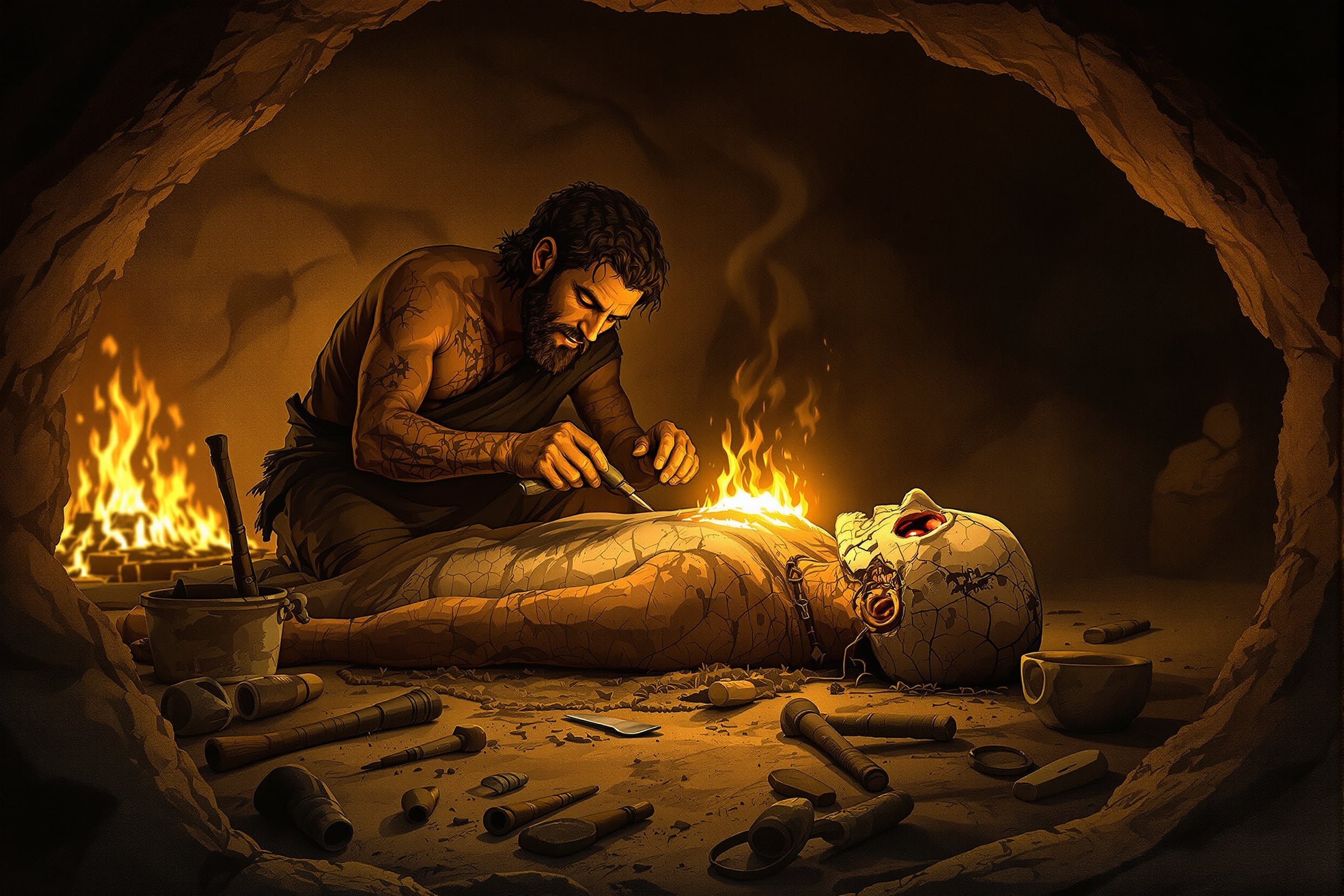
Somewhere around 10,000 years ago, a person sat very still while another person scraped a hole into their living skull with a piece of flint. No anesthesia. No antibiotics. No sterile field, no overhead lighting, no informed consent form, no medical malpractice insurance. Just bone dust, blood, and whatever passed for bedside manner in the Mesolithic. And here's the part that should genuinely unsettle you: it worked. Not always, not universally, but enough times, in enough places, across enough millennia, that trepanation became arguably the most geographically widespread surgical procedure in all of human history. [5] We have skulls from Peru, from France, from Kenya, from the Caucasus, from Polynesia, all with deliberate holes, all with evidence that the person inside was still using that skull when the hole was made, and many with evidence that they kept using it for years afterward. [2] [8]
This is trepanation. Humanity's oldest surgical procedure. And it is, depending on your perspective, either a testament to the ingenuity of our ancestors or the most horrifying thing that has ever happened to a human head. Probably both. Definitely both.
The Bone Remembers: How We Know They Survived
Let's start with the thing that makes trepanation archaeology so viscerally compelling, which is that bone heals. This is annoying when you're a forensic anthropologist trying to date an injury, and it is absolutely riveting when you're trying to figure out whether prehistoric skull surgery was medicine or murder. When the edges of a trepanation hole show smooth, rounded remodeling — new bone laid down in a process called osteointegration — that person lived. Not just survived the table, but survived long enough for their body to mount a biological response to the wound. Days at minimum. Weeks more likely. Months, sometimes years. [1]
Some skulls show complete healing. The hole is still there, but its margins are as smooth as river stone, the diploe — that spongy middle layer of skull — fully remodeled, the outer table beginning to fill in. That person lived for a long time after someone put a hole in their head. Some skulls show partial healing, which means they survived the operation but died from something else — infection, another injury, the general unforgiving brutality of prehistoric life — before the bone finished its work. And some skulls show no healing at all, which means the patient died on the table or shortly after, which, given the circumstances, is honestly the least surprising outcome.
What IS surprising is the ratio. In certain populations, particularly in ancient Andean South America, the survival evidence is genuinely remarkable. Analyses of trepanned skulls from Peru show that a substantial proportion exhibit significant bone healing, and the numbers appear to improve over time — suggesting that practitioners were actually learning, refining technique, getting better at not killing people. [2] [8] This is not random butchery. This is the early, brutal, deeply uncomfortable beginning of a learning curve.
Archaeological evidence of trepanation spans at least 10,000–12,000 years and has been found on every inhabited continent. [6] In some Andean sites, survival rates inferred from healed bone may have reached 50–80% in later periods — compared to roughly 10% survival for similar procedures in 19th-century Europe, when surgeons had metal instruments and still managed to kill almost everyone with post-operative infection. [5] Let that one sit.
Then there are the skulls that really make you put down your coffee. Multiple trepanation holes. Different stages of healing. The same skull, opened more than once, the patient surviving each time. [1] [2] We have examples with two, three, even more separate openings, each showing its own healing trajectory. Whatever was happening here — injury treatment, seizure management, ritual intervention, some combination of all three — somebody thought it was worth doing again. And the patient, having survived the first time, apparently agreed. Or at least didn't run fast enough.
Why the Hell Were They Doing This? (Historians Are Still Fighting About It)
The honest answer is: we don't entirely know. The less honest but more satisfying answer involves several competing hypotheses, a great deal of academic squabbling, and the uncomfortable realization that all of them might be partially correct. [4] [5]
The most mechanistically defensible reason is trauma. Head injuries were not rare in prehistoric populations. Interpersonal violence, falling rocks, agricultural accidents, being on the wrong end of a livestock situation — the Neolithic world was not kind to skulls. A depressed skull fracture, where bone fragments are driven inward toward the brain, causes a very specific and very bad problem: increased intracranial pressure. The brain, being a soft organ encased in a rigid box, has nowhere to go when something pushes inward. The result is herniation, neurological deterioration, and death, usually in that order. [3]
If a prehistoric practitioner looked at a patient with a depressed fracture — one eye blown wide, the other tracking nothing, body doing things bodies shouldn't do — and decided to open the skull, relieve the pressure, and remove the offending bone fragments, they would have been doing, in principle, exactly what a modern neurosurgeon does for the same injury. They wouldn't have had the words "intracranial pressure" or "cerebral herniation." They wouldn't have needed them. They would have had the observation that people with this kind of injury sometimes got better when you did this thing to their skull, and sometimes didn't, and that doing the thing was better than not doing the thing. Empiricism without the vocabulary. [4]
But trauma doesn't explain everything. Many trepanned skulls show no evidence of underlying injury — no healed fractures, no bone remodeling consistent with prior blunt force, nothing that screams "this was a medical emergency." [1] Which means some of these procedures were elected. Chosen. Performed on people who were sick in some other way — seizures, chronic headaches, behavioral changes, mental illness, whatever a given culture interpreted as spiritual intrusion or supernatural imbalance. The indications, in other words, were as varied as human suffering itself, filtered through whatever explanatory framework the culture had available. [5]
Paul Broca — yes, that Broca, the one Broca's area is named after — was instrumental in bringing trepanation to the attention of the modern scientific world after examining prehistoric skulls from France in the 1860s. [7] He initially couldn't believe the holes were surgical rather than post-mortem. When he finally accepted the evidence, he reportedly said it was "one of the most important discoveries in the history of prehistoric man." He was right. He was also a man who had spent considerable time cutting into brains, so he had context.
The spiritual explanation gets dismissed too quickly by people who want trepanation to be purely rational medicine, and that's a mistake. Across cultures, the skull has held profound cosmological significance — the seat of the soul, the residence of dangerous spirits, the point of contact between human consciousness and divine or malevolent forces. If you believe that a person's erratic behavior, their seizures, their violent headaches, their personality changes are caused by something that has gotten inside the head and needs to get out, then opening the skull is not irrational. It is the logical conclusion of your explanatory framework. [4] The framework is wrong by our standards, but the internal logic is sound. People have done far more damage with far less coherent reasoning. The nineteenth century alone could fill several volumes.
The Toolkit: A Guided Tour of Things You Didn't Want to Know
Here is where we have to talk about technique, because "they drilled a hole" obscures a level of methodological sophistication that is genuinely impressive and genuinely horrifying in equal measure. Trepanation was not one procedure. It was a family of procedures, practiced differently across cultures and time periods, with distinct tool requirements, distinct risk profiles, and distinct ways of going catastrophically wrong. [5]
The oldest and arguably most controlled method is scraping. The practitioner uses a sharp stone tool — flint, obsidian, whatever the local geology provided — to abrade the outer table of the skull in a circular or oval area, gradually thinning the bone layer by layer until the inner table is dangerously thin, then carefully, agonizingly carefully, removing the last fragment without plunging through into the dura mater beneath. The dura mater is the tough outer membrane covering the brain. You do not want to violate the dura mater with a piece of flint. You especially do not want to do it accidentally. Scraping is slow. It takes a long time. It bleeds — the scalp, which you've had to cut and reflect first, bleeds with a commitment that is frankly insulting given the circumstances — but it offers a measure of control that more aggressive methods don't. [1]
Then there is grooving, which involves cutting a circular trench through the skull's full thickness, creating a disc of bone that can be lifted free. Think of it as using the skull like a very uncooperative cookie cutter. Grooving is faster than scraping but requires more precise depth control. Go too shallow and you haven't made it through. Go too deep and you've lacerated the dura, and now you have a different problem. [5]
Drilling and connecting involves making a series of small holes in a circle — using a pointed tool rotated between the palms or against a bowstring — and then connecting them by cutting between the perforations. This method appears across multiple cultures and has a certain grim elegance to it. It's essentially the same principle as a perforated postage stamp, except the stamp is someone's skull and the perforation is happening in real time with the person awake. [6]
And then there is cutting, where a sharp blade is used to carve a geometric opening — square, rectangular, polygonal — directly through the bone. This method shows up particularly in some Andean specimens and requires the most confident hand, because there is no gradual approach. You are cutting through skull. You are doing it deliberately. You are doing it to a person.
What did they use for pain? Honest answer: it varied, and we often don't know. Some cultures had access to alcohol, some to plant-based sedatives — coca leaves in Andean populations, various herbs elsewhere. Physical restraint was likely. Ritual context may have provided psychological scaffolding that altered pain perception. What nobody had was general anesthesia, which wasn't invented until 1846, and what nobody had was a reliable way to tell a patient "this will hurt less than dying from your skull fracture." The scalp alone — highly vascular, densely innervated — would have been its own particular misery before the bone work even started. The fact that patients held still long enough for practitioners to complete these procedures, some of which took considerable time, suggests either extraordinary pain tolerance, effective chemical intervention, or a degree of social coercion that history has chosen not to record in detail.
The tools themselves evolved. Early Neolithic trepanations used whatever stone was sharpest and most available. Later populations in the Americas developed specialized metal instruments. Medieval European surgeons had purpose-built trepans — cylindrical saws with a central spike to stabilize the instrument against the skull — that were conceptually similar to modern neurosurgical trephines, which should either comfort you or disturb you, and I'm not going to tell you which. [3] [7]
Ancient Peru: The Place That Was Genuinely Getting Good at This
If you want to understand trepanation at its most archaeologically rich, you go to Peru. The archaeological record of trepanation in prehistoric South America is extraordinary — in terms of sheer numbers, geographic spread, and what it reveals about the development of surgical practice over time. [2] We're talking about hundreds of trepanned skulls spanning roughly 2,000 years of practice, from different regions, different cultures, different time periods, showing different techniques and dramatically different outcomes depending on when and where you look. [8]
The early specimens are rougher. The technique is less controlled, the openings more irregular, the evidence of survival less frequent. Then something happens. Over centuries, the evidence shifts. Openings become more standardized. Bone healing becomes more common. The ratio of survived-to-didn't shifts in a direction that suggests accumulated knowledge, transmitted practice, specialists who had done this before and learned from the times it went badly. [2]
Danielle Kurin's work on trepanation in south-central Peru during the Early Late Intermediate Period — roughly AD 1000 to 1250 — documents a population dealing with significant levels of cranial trauma, likely from inter-group violence, in which trepanation was being used as a genuine therapeutic response. [8] The survival evidence in her sample is striking. These were not ritual performances with incidentally medical outcomes. These were surgical interventions by people who had developed, through trial and error and dead patients and surviving patients, something that actually worked often enough to keep doing.
John Verano's broader survey of trepanation across prehistoric South America traces the geographic and temporal distribution of the practice and finds patterns that suggest regional traditions, transmitted techniques, and the kind of variation you'd expect from a procedure being practiced by different specialists in different places over a long time. [2] Some areas favored scraping. Others preferred grooving or cutting. The choice of method wasn't random — it reflected local tradition, available tools, and probably the preferences of whoever was doing the cutting.
Some Peruvian skulls show something that stops you cold when you read about it: the removed bone disc, kept. Found near the skull, or in burial contexts suggesting it was preserved. A piece of someone's head, saved. Whether as a ritual object, a trophy, an amulet, or something we have no framework to interpret, we cannot say. But somebody thought it was worth keeping. Make of that what you will at 2 AM.
Medieval Europe Discovers Trepanation and Makes It Much, Much Worse
If ancient trepanation, for all its flint-and-no-anesthesia horror, represents medicine groping toward something real, medieval European trepanation represents medicine confidently striding in several wrong directions simultaneously. [5] [7] Medieval physicians inherited the procedure through a combination of classical texts — Hippocrates wrote about skull injuries, Galen had opinions about everything — and local tradition, and they applied it with the kind of expansive therapeutic enthusiasm that only happens when you have a hammer and have decided that everything is a nail.
The indications list got creative. Epilepsy, yes. Severe headaches, sure. But also: insanity, melancholia, demonic possession, general stupidity, and — this is real — the theoretical extraction of the "stone of folly," a mythological object supposedly lodged in the skulls of the mentally ill that could be physically removed by a sufficiently bold surgeon. Hieronymus Bosch painted this. It is not metaphorical. People believed a literal stone caused mental illness and that a literal surgeon could find it. Surgeons, to their eternal discredit, were willing to try. [3]
The procedure itself, in medieval hands, was done with metal instruments — the trepan, a cylindrical drill with a crossbar handle — that were more efficient than stone tools and therefore capable of causing damage faster. Medieval surgery happened without anesthesia in any reliable sense. Alcohol, opium preparations, soporific sponges soaked in narcotic herbs — these existed and were used, with wildly variable effect. What patients received most consistently was speed (surgeons were incentivized to work fast when the patient was screaming) and prayer (always free, frequently administered, outcomes unclear). [3]
Medieval post-operative care was essentially nonexistent by modern standards. The wound might be dressed with wine — actually not insane, alcohol has some antiseptic properties — or with various herbal preparations whose efficacy ranged from "mildly helpful" to "actively counterproductive." Suturing the scalp back over the opening was done, but the concept of sterile technique was 600 years away. Infection killed people who had survived the surgery itself. Meningitis — inflammation of the membranes covering the brain — was a death sentence. A patient who made it through trepanation in medieval Europe had cleared only the first of several obstacles, and the subsequent ones involved bacteria that didn't care how good the surgeon's intentions were. [5]
The irony is exquisite and horrible: medieval European trepanation, performed with better tools than Neolithic practitioners had, in a cultural context with more written medical knowledge, killed more patients proportionally than the ancient procedures did. [5] The stone tools and open air of prehistory, paradoxically, may have been less dangerous than the metal instruments and accumulated medical overconfidence of the medieval period. Part of this is the indications — you can't help someone whose "stone of folly" doesn't exist — and part of this is the infection problem that wouldn't be solved until Lister and Semmelweis and a great deal of resistance from the medical establishment that really did not want to hear that they were killing people by not washing their hands.
There are medieval surgical texts — Guy de Chauliac, Henri de Mondeville — that describe trepanation with a clinical confidence that is almost admirable if you don't think about the outcomes. De Chauliac's Chirurgia Magna, written in 1363, covers skull surgery with the matter-of-fact authority of a man who has done this and seen this and is not particularly troubled by either. [3] The procedure is described, the instruments are named, the indications are listed. What is not described is what the operating theater looked like, smelled like, sounded like. That part history leaves to the imagination, which is probably merciful.
The Bone Disc, The Amulet, and the Part Where It Gets Philosophically Weird
Here is something that doesn't fit neatly into either "rational medicine" or "superstitious ritual" and therefore tends to get underemphasized: trepanation produced objects. The removed bone disc — the rondelle, in the French archaeological literature — was sometimes kept, sometimes shaped, sometimes perforated for suspension, sometimes found in burial contexts suggesting deliberate preservation. [1] [6] In some European Neolithic sites, these discs have been found as pendants, worn as jewelry or amulets. Bone from a living person's skull, removed during surgery, kept and worn.
The interpretations are various and contested. These discs may have had apotropaic properties — protection against evil, the logic being that bone that had been inside a living head carried some of that person's vital force. They may have been trophies. They may have been kept by the patient themselves, a piece of their own skull serving as a reminder of survival or a connection to the procedure's spiritual significance. We genuinely do not know. [5] What we know is that the surgical act and its material products were integrated into a broader cultural context that we can barely reconstruct from the outside.
This matters because it complicates the clean narrative where trepanation starts as magic and evolves into medicine. The reality is messier and more interesting: trepanation was always both. The practical knowledge — do this thing to a skull, person sometimes gets better — was always embedded in a framework of meaning that we'd call spiritual or ritual. The two weren't in conflict. The hole in the skull let out the pressure and let out the demon, because the demon was the pressure, phenomenologically speaking. [4] The explanation is wrong by our standards. The observation underneath it isn't.
Paul Broca, Some French Skulls, and the Moment Science Caught Up
In 1865, a French surgeon named Paul Broca — already famous for identifying the speech area of the brain, already a person with extremely strong opinions about skulls — was shown a collection of prehistoric crania from France by a colleague. Some of them had holes. [7] Broca's initial reaction was skepticism: post-mortem damage, maybe. Natural taphonomic processes. Anything but the conclusion that prehistoric people had intentionally cut holes in living skulls and that those people had survived.
Then he looked at the bone margins. The healing. The smooth, rounded edges of remodeling bone that could only mean one thing. [7] Broca, to his credit, followed the evidence. He concluded that these were surgical procedures, performed on living patients, who had survived. He published. He was right. He is one of the reasons we know about this at all, because his publication catalyzed a wave of archaeological attention to trepanned skulls that had previously been catalogued without anyone quite understanding what they were looking at. [7]
The timing is worth noting. 1865. Lister's antiseptic technique is being developed in exactly this period. Anesthesia has existed for less than twenty years. European surgeons are only just beginning to understand why their patients keep dying of post-operative infection. And here is the archaeological evidence that Neolithic people, with stone tools and no germ theory, were performing skull surgery with survival rates that would not embarrass a nineteenth-century hospital. The implications were uncomfortable. They remain uncomfortable. [3]
In 1865, the same year Broca was documenting prehistoric trepanation survival, the mortality rate for amputation in European hospitals was somewhere between 25% and 40%, primarily from post-operative infection. [3] Hospitals were, in a very literal sense, more dangerous than staying home. The ancient Andean practitioners working with stone tools, in open air, on skulls — they may have been doing better. Not because they were better surgeons, but because they weren't concentrating infectious patients in enclosed spaces and then touching all of them with the same unwashed hands. Germ theory: the most important thing medicine ever learned, and the most embarrassing thing it took so long to figure out.
The Modern Weirdos (You Knew This Was Coming)
No history of trepanation is complete without acknowledging that a small, committed, and deeply concerning group of modern people have decided that trepanation is not just historical curiosity but genuine self-improvement. [3] The contemporary trepanation movement — and yes, there is one — holds that drilling a hole in the skull increases cerebral blood flow, restores the brain's pulsatile motion constrained by the fused adult skull, and produces a permanent elevation of consciousness. This theory was developed primarily by a Dutch man named Bart Huges in the 1960s, who trepanned himself with a dentist's drill and reported that it worked wonderfully, which is exactly what someone who has just voluntarily drilled into their own skull would say.
His follower, Amanda Feilding, trepanned herself in 1970, filmed the procedure, and later ran for British Parliament twice on a platform that included trepanation access. She did not win. She has, by her account, experienced no negative consequences from the hole in her head, which she considers evidence that it worked. [3] The medical establishment disagrees with essentially every part of this. The specific mechanism proposed — that adult skull fusion restricts brain pulsation in a way that trepanation relieves — has no credible physiological basis. The self-reports of enhanced consciousness are not controlled, not blinded, and come from people who have just done something extreme enough to produce significant psychological effects entirely independent of any hole in the skull.
None of which is to say these people are uninteresting. They are extremely interesting. They are the latest iteration of something that has been happening for 12,000 years: someone decides that the skull is the problem, that what's inside it needs different conditions, and that the solution involves making an opening. The tools have changed. The explanatory framework has changed. The fundamental human impulse — to intervene, to do something, to open the box and see if the thing inside improves — has not changed at all. [5]
What Trepanation Actually Tells Us About Medicine
Here is the uncomfortable conclusion that the history of trepanation forces on anyone paying attention: medicine has always been a mixture of genuine insight, cultural framework, empirical observation, and catastrophic overconfidence, in proportions that vary by era and practitioner but never reduce to zero in any category. [4] [5] The Neolithic practitioner scraping a hole in a skull to relieve a depressed fracture was doing something real, embedded in a framework of spiritual explanation that was not real. The medieval surgeon drilling for the stone of folly was doing something technically real — a hole was made, the skull was opened — in service of an indication that was entirely imaginary. The modern neurosurgeon performing a craniotomy for a subdural hematoma is doing something real, in a framework that is as close to correct as we've ever gotten, knowing that future generations will probably identify some part of our explanatory model that is as wrong as the stone of folly.
Trepanation survived for 12,000 years because it worked for some things, because it fit explanatory frameworks across wildly different cultures, and because the human skull is an irresistible object for anyone who has ever wondered what's happening inside it. [6] The wonder is not wrong. The impulse to intervene is not wrong. What changes is the precision of our understanding of when intervention helps and when it doesn't, and the honesty with which we're willing to track the outcomes of the ones that don't.
Our ancestors left us skulls with holes in them and bone that grew back over the edges. They left us evidence of survival that should have been impossible given the conditions. They left us no explanation that satisfies, no text that says "here is what we were thinking, here is what we observed, here is what we learned." They left us the holes and the healed margins and the question.
Twelve thousand years of drilling into heads, and we're still not entirely sure why it worked when it worked, still arguing about the indications, still finding new skulls in new places with new holes that don't fit the existing categories. [5] [8] The procedure has been refined beyond recognition — modern neurosurgery operates at a level of precision that would be incomprehensible to a Neolithic practitioner — but the fundamental act, the decision to open the skull because something inside needs to change, is the same act it always was. The same terrifying, sometimes correct, occasionally lifesaving act.
Someone sat very still. Someone else made a hole. The bone healed over the edges, and the person lived, and we found the skull ten thousand years later and could not quite believe it either.
We still can't.